
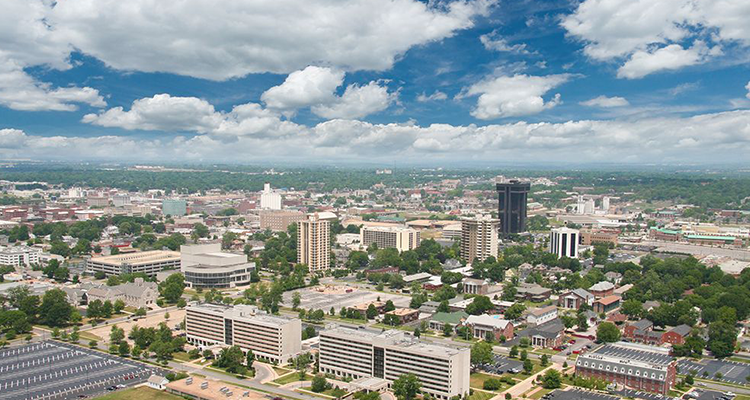
Max Miller talks about his undergraduate service-learning research from fall 2024 in mental health access throughout the Ozarks and how it stacks up to other cities.
I’m grateful to Max for giving me the opportunity to have a conversation with him about his research. Keep reading to see the full conversation:
First steps
Charlie: Okay, so the first thing I want to do is kind of get a better background on your service-learning experience. Tell me everything.

Max Miller: I started out as a biology major… Essentially, I wanted to be a doctor or something like that. And then, actually last semester, when I started service-learning, I changed my major to psychology and sociology. So, now I’m double majoring in those two. I initially wanted to go into a field that would directly help my community in some way, and I didn’t really see that happening [for me] as a biology major, so I changed it to psychology. I worked directly with Dr. Nordyke, because I had a class with her – Gerontology 180 – which she taught. And so, I got to know her through that class, and I just asked her, “How do I get more involved with campus life?”
Charlie: And that’s when she told you about service-learning as a way to be involved?
Max Miller: We kind of jumped around different ideas of what I could do with that and how I could tie back into psychology and sociology. One thing that I want to do is go into counseling. So [I asked] how I can tie that into what I’m doing now, with service-learning. [Dr. Nordyke] mentioned that I could do independent research. And I thought that was a wonderful idea, because, you know, Masters is very research heavy, so that was something I was very interested in and that’s kind of how it started.
Charlie: How do you feel about service-learning now that you’ve been in it for a little bit?
Max Miller: So, this is my second semester of service-learning. I have a pretty good idea of it. I mean, I know there are so many things you can do with service-learning, and there’s no way I could name all of it. But I know it’s tailored specifically to what you want to do.
Charlie: You wanted to potentially consider the medical field – maybe be a doctor before switching things up. Did you want to make an impact across communities quicker? Or did it feel like it was just trying to find the right focus?
Max Miller: It was more the focus. …The problem with going into the medical field for me was that it wasn’t exactly what I was looking for in terms of patient healthcare. …I wanted to connect more with people on an individual basis. Rather than just going into a patient’s room and, you know, checking on them, asking various questions, I wanted to get to know people more. And so that’s why I changed it to psychology, because it was more catered to like a counseling route for me.
Researching the state of mental health resources
Charlie: Let me ask about your research so far, what’s that looking like and how it’s connected to service-learning?
Max Miller: Last semester, I wrote an annotated bibliography about the mental health of Springfield, and it was correlated to the mental health of other cities, other communities. And one of the communities that I chose [to look at] was Chicago—to compare mental health statistics to. …I primarily focused on marginalized communities—so, people of color, low-income communities, LGBTQ individuals, and just the kind of things that they may experience with mental health.
Charlie: What was the philosophy behind using a city that’s much bigger than Springfield?
Max Miller: Chicago has a lot of mental health resources, from what I’ve seen. So, that was what originally triggered like, I’ll look into Chicago primarily. I also compared to what resources Springfield has in ways that were similar. So, that way I could say, “Hey, Chicago’s doing this. Springfield could also do this, because there’s similarities there.”
Charlie: What’s your impression of the mental health state in the Springfield area, in the Ozarks?
Max Miller: Well, looking at statistics that I’ve seen, Springfield has a higher rate of low-quality mental health compared to other counties or other cities, and other larger cities in Missouri. …And my impression is that there are things that could definitely be improved on.
Charlie: Have you had any interesting interactions with the community?
Max Miller: I’m glad you asked that, because this semester, I’m focusing still on that research, but I’m narrowing it down and interviewing places in the Springfield community. One of the places that I have looked at is the GLO Center. [I have] started an interview process of looked at and talking to locals in the community and what they think of the resources and certain ways to improve Springfield mental health as well.
Thoughts on service-learning
Charlie: If you had a chance to tell another student about your service-learning project, how would you frame it?
Max Miller: I’d probably say service-learning has helped me make genuine connections with people. It’s allowed me to express myself in a way that will benefit me in the future, and I think it’s a great resource for anyone because it’s so broad. You can do literally anything with it.
Charlie: You’re still in the middle of it, but have you been able to see how service-learning is helping you connect with your career goals?
Max Miller: I’ve been making connections just through the fact that I’ve done research. I know in the future it’s going to help me connect with local communities—especially when I’m going through the interview process with them and getting to know people. I’ll probably be able to make those connections career-wise as well… It put me on a path to meet professors, like the sociology professor, Dr. Laura Hart. I met her, and she’s been helping me with getting that certification and guiding my research forward.
Charlie: Tell me more about the impact that you hope to have on the community. What will you take with you, no matter where you go?
Max Miller: I will definitely always take the fact that I have gathered so much information just from doing the research I want. …I want to be able to make resources more available for low-income communities, people of color, LGBTQ people—high risk populations in general, because that’s something that I see as a priority. I’ve seen the effects that poor mental health has on individuals. And I want, just as most people do—I want to better my community in some way, and I see that through a research scope.
Discover more from Citizenship and Service-Learning Blog
Subscribe to get the latest posts sent to your email.