

All students are working on skill building and different approaches are needed. Some skills may require supplemental reinforcement as a motivational boost, while others are learned through engagement with activities where reinforcement is naturally built into the task.
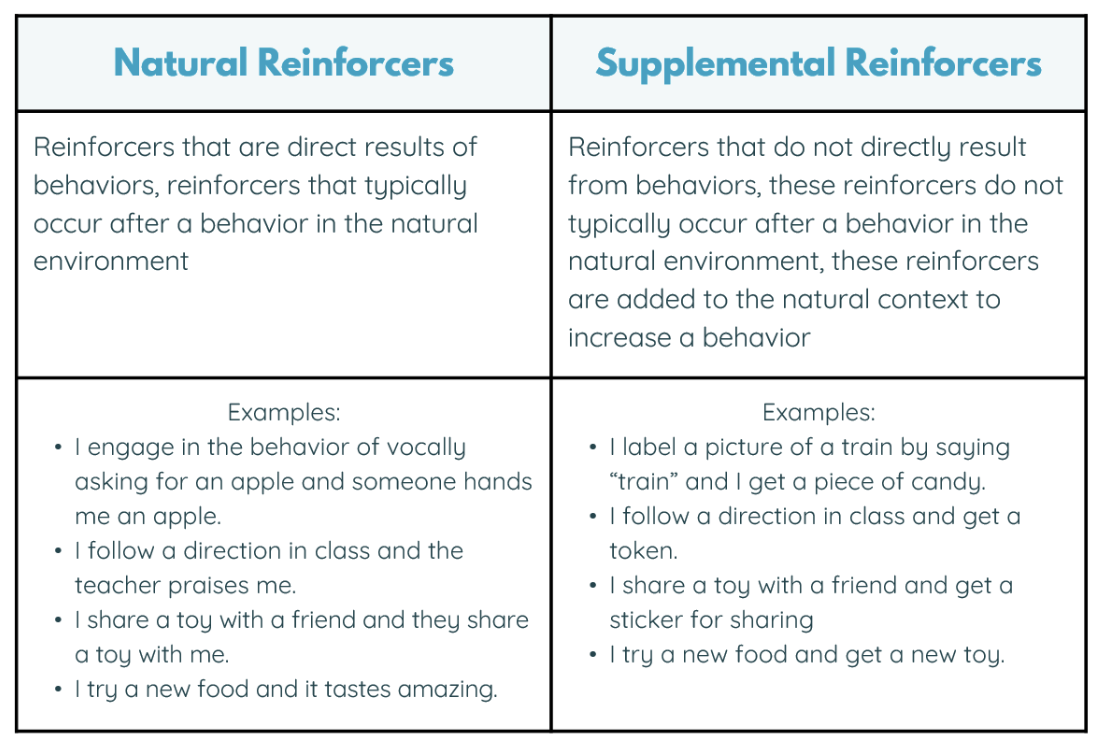
| Natural Reinforcers | Supplemental Reinforcers |
| Reinforcers that are direct results of behaviors, reinforcers that typically occur after a behavior in the natural environment | Reinforcers that do not directly result from behaviors, these reinforcers do not typically occur after a behavior in the natural environment, these reinforcers are added to the natural context to increase a behavior |
|
Examples:
|
Examples:
|
Naturalistic teaching involves teaching skills within an individual’s everyday environment using naturally occurring reinforcers (Cowen & Allen, 2007). The “natural environment” refers to settings where the individual would typically use the targeted skills, for example asking a waitress for a “Sprite” at a restaurant. This approach helps promote both the generalization and long-term maintenance of learned skills. There are many naturalistic teaching approaches (Pivotal Response Training, Reciprocal Imitation Training, etc.). These approaches have similarities in the concepts and strategies used.
Common strategies include:
- using natural reinforcement
- following the student’s lead
- using positive affect
- providing choices
- linguistic mapping
- communicative temptations
- and so much more!
- (Dufek & Schreibman, 2014; Frost & Ingersoll, 2019; Koegel & Koegel, 2019).
For learners working on language skills, linguistic mapping provides language models throughout the day (Ingersoll & Gergans, 2007). As you engage with your students, you can use linguistic mapping by being a “sports commentator” and commenting about what they are doing (e.g. You’re drawing a dog! It is so cute and fluffy!). It may feel silly at first, but the more you use the linguistic mapping, the more your students are hearing language modeled.
Communicative temptations are another great strategy for promoting language (Frost & Ingersoll, 2019). This involves arranging situations to create motivation for your students. For example, putting a favorite toy in sight but high on shelf or having shared control of activities like holding the marbles for the marble run. Once motivation is established, allow for a pause to give the student an opportunity to communicate. Remember to reward attempts!
This is just a taste of the many naturalistic strategies that you can use in your classroom to promote skill building. From language to life skills, naturalistic approaches incorporate the learner’s preferences and promote meaningful learning.
To learn more about naturalistic strategies, see our module on Naturalistic Intervention!
Discover more from Project ACCESS Blog
Subscribe to get the latest posts sent to your email.