
African cultures have been forging metals such as copper, bronze, brass, and iron for over 2,500 years. Once they developed the technology for extremely hot furnaces that enabled the smelting and refinement of different metals, blacksmithing and other forms of metalworking became highly respected professions in many different cultures. African blacksmiths and metalworkers developed sophisticated techniques in casting and forging, forming the hot metals into a multitude of not only skillfully crafted tools and weapons, but also sculptures and ceremonial implements.
Although many of the metal objects in this exhibition may appear to be weapons, today they serve primarily to show power and status. Some of them take the same traditional forms as when they were functional tools and weapons, but others have developed into non-functional, purely decorative objects to be carried or displayed during important events by people of high social status.
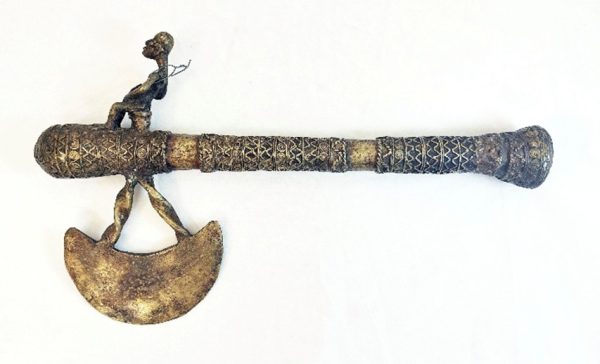
Afikpo culture
20th century
Brass, L. 40 cm x W. 4.5 cm x H. 24 cm
MSU Collection #2018.1.80
This axe is made of cast bronze, embellished with finely detailed geometric designs that suggest that it originates from the Afikpo, a branch of the Igbo culture. The registers of zigzags, spirals, and twisted two-ply thread on the handle are quite similar to the intricate bronze artworks of the 15th century Igbo-Ukwu culture, a medieval African ancestral culture of this region.
The elaborate bronze designs also indicate that this axe was not a practical tool for use in cutting wood or wielding as a weapon, but instead would have been used to signify high status and possibly served as a ritual object. Igbo cultures such as the Afikpo celebrate two types of status holders: Chiefs and traditional rulers. Chieftaincy became popular in the 20th century when the Igbo began to designate chiefs as traders who served actively to strengthen business relationships and prospects for the community. Traditional rulers, meanwhile, served in a more honorary role that was often hereditary, and they were tasked with upholding local customs and traditions and with overseeing the ceremonial aspects of life within the community. Because this axe is highly embellished — and because the embellishment includes a figural portrayal of a figure seated on a stool, a traditional seat of high status in Africa – this most likely served as a symbolic, ceremonial implement for an Afikpo traditional ruler. Researched by Madison Baker
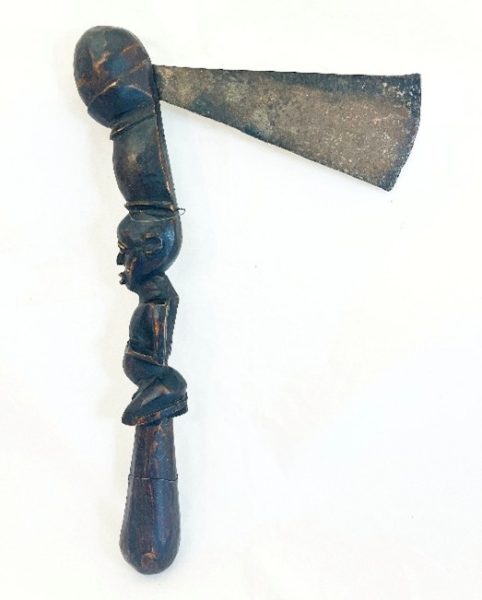
Yoruba culture
20th century
Wood, pigment, and iron, L. 19.5 cm x W. 3.5 cm X H. 33 cm
MSU Collection #2018.1.120
In the Yoruba religious pantheon, Ogun is the deity of iron and the patron god of blacksmiths and metalworkers; he serves as a connection between humans and the actual iron products that they forge. The iron blade of this axe, therefore, is believed to embody the presence of Ogun himself.
Carved into the wooden handle of the axe is a kneeling female figure who cradles her pregnant stomach, which illustrates Ogun’s alternate role as a benevolent fertility god. As Yoruba ritual objects typically incorporate images of a deity’s devotee, and as there is little wear on the iron blade, this is more likely a ceremonial implement than an axe that was used for practical purposes. Such ceremonial axes are used in the Epa festival and the Are ceremony, both of which serve to honor Ogun in hopes of bringing fertility to the community. Researched by Madison

Yoruba culture
20th century
Bone, brass wire, and iron, L. 7 cm x W. 15 cm. x H. 42 cm
MSU collection #2018.1.84
When viewed in a standing display position, this carved bone axe handle depicts two figures, one standing above the other, each wearing a tall cap formed by wound, twisted wire. The figures have differently shaped bodies and body decoration, but they have similar triangular faces, and each has two linear facial scarification marks on each cheek. Scarification has a long tradition in Yoruba culture and may symbolize many things, including familial lineage, beauty, and creativity. The number two is also a sacred number for the Yoruba and is used to represent duality, or opposing complementary opposites, such as day and night, right and left, female and male, or the spiritual and corporeal. Both the pair of figures and the two lines of scarification on their cheeks likely symbolize this type of duality and complementary opposition. Like the other figural axes in this exhibit, the elaborate carving and embellishment of this axe suggests that it is most likely a ceremonial object, and this correlates with how similar Yoruba axes in other collections have been identified as “chief’s ceremonial axes.” Researched by Madison Baker

Kota culture
20th century
Wood and iron, L. 39 cm x W. 4 cm x H. 33 cm
MSU collection #2018.1.85
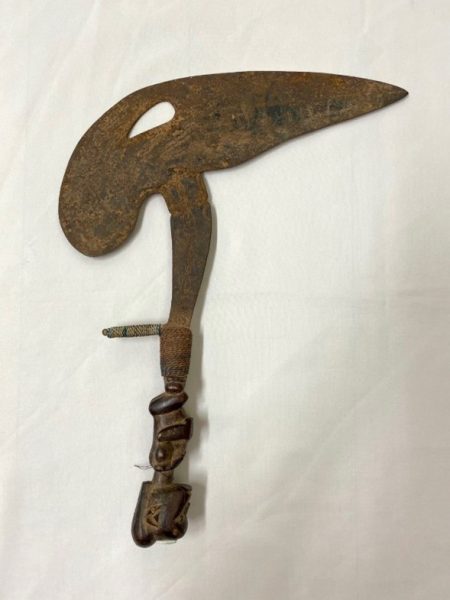
Fang culture
20th century
Iron, wood, and pigment, L. 34.4 cm x W. 4 cm x H. 43 cm
MSU collection #2018.1.96
The traditional Onzil knife is an innovative combat weapon developed by the Kota culture and later adopted by several other cultures of central Africa. This large knife is aerodynamically balanced both so that it may be used as a throwing knife and so that it may swung with lethal accuracy at enemies on horseback. The large blade also served as a psychological weapon, reflecting sunlight into the eyes of opponents and making a distinctive whining noise when it was thrown.
Onzil knives subsequently developed into ritual objects that were used in public ceremonies to represent power, social status, and spiritual protection, and they were exchanged between families during marriage arrangements to symbolize unity and agreement. Historically carried by slaves or eunuchs at public events, displayed during royal hunts, and used in rituals as magical items and tools to communicate with the spiritual realm, more recently these blades were carried by female elders at boys’ circumcision and initiation ceremonies, and they were carried by young men during public dances to show prestige and authority, in order to impress eligible young women.
The graceful shape of the knife blade is also said to represent the silhouette of the African hornbill, a highly respected bird that carries symbolic meanings ranging from being a signifier of death to being a protective omen, and from signifying a way of seeing an alternate reality to serving as a timekeeper of the days and seasons. These meanings correlate well with the functions of the Onzil knife; as a weapon on combat, the knife would likewise symbolize the death of the enemy while also being a protective omen for the person who carries it, and the knife would serve as a protective omen and a timekeeping reference for initiations, marriages, and other public ceremonies.
The carefully carved figural handles of these two Onzil knives strongly suggest that these Onzil knives were used primarily as ritual objects. The Onzil Throwing Knife with Female Figural Handle incorporates a figure that is securely identifiable as being made by the Fang culture of central Africa, as the bulging musculature and facial features closely reflect the style of more famous Fang sculptures such as the bieri reliquary guardian figures. Researched by Madison Baker and Diana Kosinska
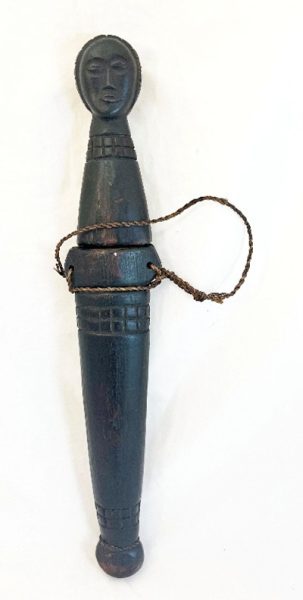
Luba culture
20th century
Wood, pigment, twine, and iron, L. 7.5 cm x W. 3 cm x H. 40.5 cm
MSU collection #2018.1.85

Luba culture
20th century
Steel, wood, and pigment, L. 3.5 cm x W. 2 cm x H. 33 cm
MSU collection #2018.1.89
Luba daggers and sheaths are functional knives with short iron blades and carved wooden handles, but they are primarily used in ceremonial contexts. While daggers are symbols of prestige, authority, and power that are owned and used by men, the carved heads on these dagger handles depict women and refer to women’s power in Luba society. The Luba are a matrilineal society, so the family name and lineage are traced through the woman’s side of the family. Luba women are esteemed for their roles as mothers, and the royal women who give birth to kings are especially highly honored.
Women also hold considerable power in Luba society in their roles as Mwadis, or spirit mediums. A Mwadi is tasked with keeping the memory and spirit of a deceased king alive after his life force is transferred to his throne and palace, which is then preserved as a “spirit capital.” The female heads on these knife hilts likely represent Mwadis, who are identifiable by high hairlines and tight coiffures that signify power and memory. Two-faced Janus figures like that on the Dagger with Janus Figural Handle further represent important dualities, such as the past and the future, life and death, or the spiritual and physical realms. Researched by Madison Baker and Diana Kosinska
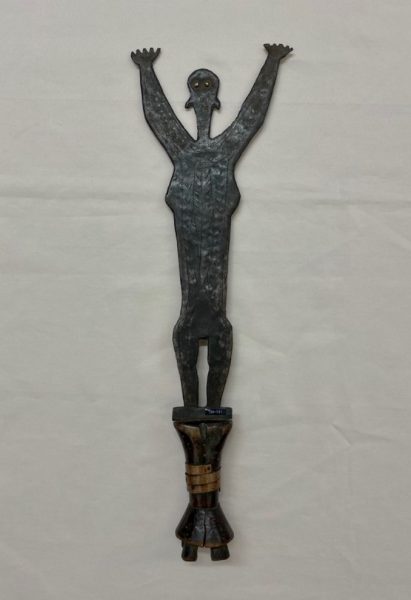
Lobala culture
20th century
Steel and wood, L. 16.5 cm x W. 4 cm x H. 48 cm
MSU collection #2018.1.79
Lobala prestige knives are ritual blades that are crafted into stylized anthropomorphic forms. Generally reserved for high-ranking men, these knives symbolized wealth, masculinity, and authority, and they served as a visible marker of elevated social status. In addition, prestige knives were believed to offer protection from harm or evil spirits; the form and decorations were thought to serve as a protective amulet that safeguarded the individual from unseen forces. The knives were displayed ceremonially and used in rituals such as leadership transitions, community assemblies, and initiation rites, which emphasized power and reinforced community hierarchies.
This Lobala prestige knife features figural elements including breasts, scarification, and flat groin that identify it as a female figure; this female form further signifies fertility and the continuity of lineage, linking this status symbol also to the ancestral and generative powers essential to maintaining the community. Thus, while the prestige knife is an emblem of elite male power, these figural components also acknowledge the foundational role and contributions of women in Lobala culture. Researched by Diana Kosinska
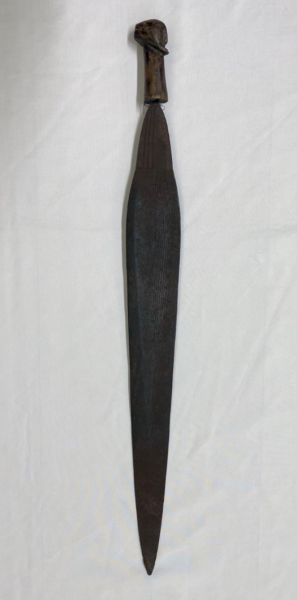
Luba culture
20th century
Iron, wood, and pigment, L. 7cm x W. 2.5 cm x H. 73.5 cm
MSU collection # 2018.1.10
Luba swords originated as functional weapons, but they developed into ritual objects and symbols of power, prestige, and lineage that were owned and carried by people of high status, such as warriors, high-ranking officials, and royalty. Some swords may also have been used as currency, and they were sometimes exchanged as gifts between leaders to reinforce alliances.
Neighboring cultures such as the Hemba and the Songye often adopted and adapted Luba implements and artforms, but the Luba were influenced by these cultures as well; such influence may be illustrated in the carved head on this sword handle, which has a jutting chin more typical of Songye figures. The carved faces on Luba ceremonial weapons often represent ancestral spirits, spiritual guardians, or historical figures who embody wisdom and strength, and they serve as powerful symbols of ancestral presence and spiritual protection. Researched by Diana Kosinska
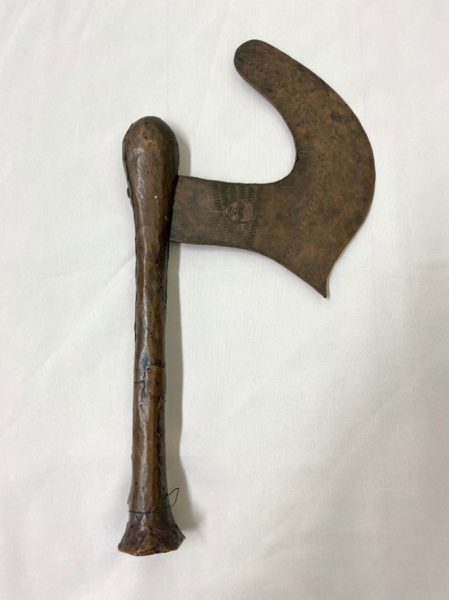
Songye culture
20th century
Copper, L. 19 cm x W. 3.5 cm x H. 37 cm
MSU collection #2018.1.101
This Kilonda hatchet is made entirely of copper, which is neither a sturdy metal nor a metal that holds a sharp edge. Accordingly, these hatchets are not functional weapons, but instead are made to serve as status symbols of authority and prestige for the Songye. Neighboring cultures such as the Nsapo and the Luba also later adopted the Kilonda as a symbolic implement.
Like the face engraved on this crescent blade, human figured or stylized face are often featured on Kilonda hatchets; these images represent ancestors or protective spirits that were believed to channel spiritual energy to the owner or to the event in which they were used. The hatchets are typically carried by chiefs as a display of power and wealth, and they were also incorporated into dances, where their presence emphasized the sacredness of the event and the leader’s role as a mediator between the physical and spiritual worlds. Researched by Diana Kosinska
For more information, you may contact the researcher(s) noted in the title of this exhibit entry, or Dr. Billie Follensbee, the professor of the course, at BillieFollensbee@MissouriState.edu