

Undergraduate Earlene Elliot-Lee completed her MST495 Museum Studies Internship in painting restoration in spring 2023, restoring three Howard Garrison paintings for the Christian County Museum. As part of her internship, she gave well-received restoration demonstrations, showcasing her scholarship to a broader audience, and created a detailed research report and PowerPoint presentation on Garrison’s life and art. Earlene has also proposed presenting her research at the Missouri Archaeological Society conference in March 2024. Through this project, she strengthened ties between the university and local museums, contributing to the preservation and understanding of regional cultural heritage.
The first live restoration showcase
The Garrison’s painting was clearly damaged. The lush, green trees, flowing water, and sunlight typical of an Ozark summer were first put to canvas around a century ago. From a few paces away, the painting looked pleasant enough, but getting up close revealed noticeable scars, ripples, and patches. The painting’s vibrance and deterioration were both equally visible under the lights of the Meyer Library Archives space. Despite visiting my fair share of art galleries, I had never quite seen anything like it.
This is where I met Earlene Elliot-Lee, who stood in front of the painting, holding a color-studded palette in one hand, dabbing at the painting with a brush in the other. She was blending colors around little sections of the canvas where scars had visibly been stitched and taped.
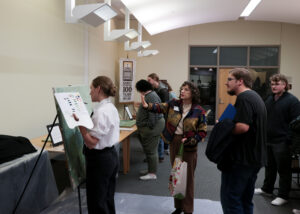
Elliot-Lee, a student in Dr. Billie Follensbee’s Museum Studies course, was repairing and restoring one of the local Ozarks figure, Howard Garrison’s “Landscape” paintings.
This was the first live, in-progress restoration to occur at the regular showcase event. The goal was to present exactly how deeply involving and hands-on Dr. Follensbee’s opportunities and experiences are for her service-learning students.
I’ve regularly attended the event to photograph the great work that is typical of Dr. Follensbee’s service-learning students. But until watching Elliot-Lee at work, I’d never seen an artwork that was mid-restoration before—there, or anywhere else for that matter. Most art hanging in a museum has already been carefully examined, studied, restored and preserved for public display by art conservationists, usually behind closed doors. It’s generally not an activity those who work in the arts are comfortable doing in an open environment.
As I snapped photos, Elliot-Lee occasionally took a step back to squint and choose the next target for her brush. Visitors milled about, many stopping to inquire and chat about what she was doing. Despite all the commotion and interruptions (including my own questions and picture taking), Elliot-Lee kept focused on the delicate process. Shortly after the showcase, I got a chance to speak with her in more detail about the damaged Garrison painting as well as the story behind how she got to work on it.
A journey through fine arts and museum studies

Elliot-Lee got started in 2004 but paused her education to prioritize raising children. She told me bluntly that, after being away for years, one of the expectations she had coming back was merely “to find self-identity.”
She began with a focus on fine art. But she found it challenging to find the self-identity she was seeking. The costs that come with time, supplies, and balancing family was blocking the “joy” part of her journey.
Elliot-Lee gave Museum Studies a try and found herself more at home: “You get to interact with artwork, and you’re with more people. There’s a strong community within Museum Studies,” she explained.
Elliot-Lee’s path then took her to the conservation side of art, “I find it to be like a romantic relationship.” She said with a smirk, but there was noticeable sincerity in her response. What she does requires starting deeply into a painting for hours. And it’s so much more than just plopping paint onto the rough spots of a damaged canvas. It involves researching the artist, studying their techniques, and aligning with their philosophy.
What she was working on during the showcase was just a small example of the effort she had already put in. Outside of that event was still a ton of meticulously blending in new paint and bandaging together chunks of canvas for several different pieces of art in a collection by Howard Garrison that the experts involved have dubbed, “Landscapes.”
The innkeeper who loved to paint
Howard Garrison was a painter and innkeeper in Christian County, Missouri. He owned the “Riverside Inn” during the prohibition era and ran it as a speakeasy (so, a local hero, depending on who you ask). At some point, the law caught up with him and his inn was raided by prohibition officers. Later, it was raided again. And then again. Multiple times. But as Elliot-Lee describes, he was “chill” about it. He would spend a little time in jail, get out, and proceed to really move his life in the right direction by immediately getting right back to his painting and speakeasying.
Strangely, he didn’t even really seem to care if he sold any of his art. He was a self-taught painter whose only ambitions seemed to be capturing his beloved Ozarks vistas on canvas. That said, his notoriety as a libatious innkeeper of the people, plus his love for the Ozarks, has solidified his name in local lore. So much so, that lord-supreme of the Bass Pro empire, Johnny Morris, was behind the rebuilding of an excellent speakeasy-themed restaurant named “The Garrison,” located near the original inn’s location. Additionally, museums in the area have conducted efforts to keep Garrison’s legacy alive.
“He has a very interesting story, and I feel like maybe I’m his apprentice at this point,” Elliot-Lee said. “I’ve studied him—I understand his personality, what he did, and why he made art. I feel like I’m conserving that and shaping it into the art it was meant to be, so people can learn from it.”
The problem with the paintings
For a while, Garrison’s “Landscape” paintings weren’t doing so good. Pieces were collecting dust, getting knocked around in storage, and even damaged in floods. While they may not have been anywhere near display-worthy, the Christian County Museum hung on to the paintings anyway. They knew the pieces needed restoration and preservation but didn’t have a solid path.

Dr. Billie Follensbee was able to convince them that her students could make a difference.
Dr. Follensbee is an awarded and recognized service-learning instructor keen on connecting her students to the best hands-on experiences available. She collaborated with the Christian County Museum, creating a partnership and acquiring seven panels painted by Garrison to assign to her students.
So, the panels—Elliot-Lee’s description on what Garrison created said it best:
“They’re panels that fit together to form one long landscape. It’s kind of like a river flowing past some very green trees, with houses and a gazebo. The research I’ve done suggests it could be the Finley River, or maybe the Riverside Inn—maybe even his dream of what he wanted it to look like.”
She went on to reflect, “What’s unique about this painting is that he didn’t frame it or sign it, and it’s very different from the style of his other work.”
A big step forward was matching paint pigments to what was already on the canvas: crucial in ensuring that repairs go unnoticed and the art would appear as originally intended. This type of restoration is way more than just simple touch-ups. Not to make other art conservation projects sound easy—I struggle to draw stick figures, so it’s all very impressive to me. But Elliot-Lee had to think beyond making pigments match. She had to judge what base the paints were made from. And it turns out that Garrison wasn’t exactly picky when it came to the quality of his paint on work that was such a departure from his other stuff.
“Some were house paints, some water-based, and others oil-based,” Elliot-Lee counted them off the way a detective lists a suspect’s alleged crimes. “The sky is even a different type of paint than the rest of the landscape. So, when I’m using acetone to clean the trees, I have to dilute it to 10%, or sometimes even 50% acetone to water, just enough to remove the varnish without taking off the paint.”
That kind of challenge frankly doesn’t get translated as effectively in a classroom setting, looking at images, discussing theory. The variability that comes with matching pigments and paint quality highlights how beneficial it is for students to get these hands-on experiences.
Art and community = chocolate and peanut butter
Another upside? The experiential nature of restoring art can forge new relationships in the community. Elliot-Lee recalled the moment that part clicked for her:
“I think it’s very important that we connect education with the community—there’s really no point in education if we don’t use it in the world around us. I didn’t realize it at first. I was told I was doing service-learning, but I didn’t understand what that meant until I started doing research and talking to people who worked in museums. They helped me see how everything I was learning could be applied beyond the classroom. …I think the real connection I made with the community came through the art—by conserving it so others can learn from it. That’s how I feel I’m giving back: by restoring this work and making it available for further education.”
A strong community partnership can help make these experiences really sing. Elliot-Lee was highly complementary of Springfield’s History Museum on the Square on how they facilitated her learning.
“They always invite our classes in, and it’s a beautiful space,” she said. They have a lot of collections that need to be processed, and they allow us to do that, and it is completely part of our community. …It makes the learning relevant—to be able to be allowed to go out into the public and work with people, rather than just be sitting at a desk and learning these things with peers.”
Howard Garrison’s art is hardly world renown. I mean, he painted Missouri trees and grass with house paint. His stuff isn’t exactly knocking down the doors of The Guggenheim, demanding champagne. Yet, his oeuvre has still managed to offer something of extraordinary value to students like Elliot-Lee. It’s a reminder that, even with arguably simple compositions that went un-signed and un-framed by the creator, artmaking is extraordinarily effervescent and enduring.
Despite its effectiveness, this type of hands-on learning experience is apparently rather rare. Elliot-Lee explained that art museums generally only try to hire trained conservators to restore items from their collections. Your average art student isn’t likely to get many chances to engage in necessary aspects of learning: imperfect practice, potentially making mistakes, and taking their time with a precious piece of art. But that, somewhat ironically, is another reason why Garrison’s work is so special: “He’s not a well-known artist,” admits Elliot-Lee. “And these [paintings] were pretty messed up because of how they were underwater for a long period of time. Maybe Christian County didn’t think that they were repairable, and so they allowed students to work on them. There wasn’t a lot of risk taking.”
For those who come after
At this point, I think it’s safe to say that Garrison’s legacy in the Ozarks has stood the test of time. Multiple conversations are occurring about him and, if having a modern speakeasy named after you isn’t evidence of a life truly lived, I’m not sure what is. So, it really shouldn’t be a surprise that the art community wants to help his paintings stand the test of time as well, regardless of how famous or not famous they are. They are part of southwest Missouri’s story. They help us connect and understand.
Experiential learning connected to the community is a transformative experience. It combines the good, the problematic, and sometimes, the strange together to take the act of learning and break it free from the perception of tedium and rigor. Once again, Elliot-Lee said it best when she thought back on her work with the project:
“Painting was [Garrison’s] lifelong passion, and his main ambition was to be an artist. The Riverside Inn was just a way to finance his art, but that led to gambling and slot machines. When he was raided in 1937 for illegal liquor during Prohibition, it became part of his story—a very interesting part. In fact, it might even make his art more compelling because of that history.”
Discover more from Citizenship and Service-Learning Blog
Subscribe to get the latest posts sent to your email.