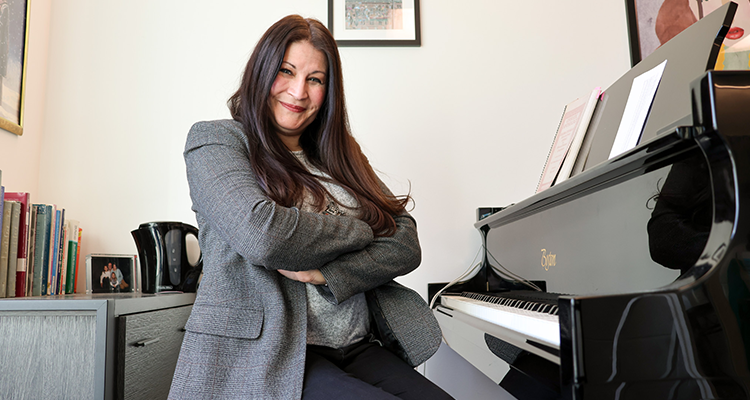
Dr. Ann Marie Daehn has taught her opera workshop as a service-learning course for over a decade. She wants opera to be a force for good.
I recently got a chance to visit Dr. Daehn in her cheery, sun-soaked office in Ellis Hall for a conversation. And, next to her beautiful Boston piano, we chatted about how she creates meaningful service-learning experiences for her students, while keeping fun in the spotlight. Take a look:
Charlie: Could you give us an overview of your service-learning opera class?
Dr. Ann Marie Daehn: So, our opera workshop is designed to teach performance for our students, but many of our singers are music education majors. Invariably, whether they’re hired at a university, or hired at a professional company, they will be doing a lot of outreach. Opera, and in the arts in general, tend to struggle with bringing in new audiences, and there are a lot of preconceived notions about what we do. When performing for kids – they just have no preconceived notions. They know they’re getting entertained and they’re having a wild and fun time. And our Missouri State students are getting an audience offering back a powerful, automatic, unfiltered reaction that it’s a real massive bucket filler for them.
Charlie: What’s being performed for elementary and middle school kids? Are they operas that have existed for some time, or new and original works?

Dr. Daehn: We pick one show to tour with each year. This year it is “Sid the Serpent Who Wanted to Sing” by Malcolm Fox. It’s specifically written to be a children’s opera. I try to keep our performances to about 35 minutes. It seems to work nicely in a standard SPS [Springfield Public Schools] day as well as ours at Missouri State. I want to get our students back to campus, so they don’t miss any of their courses.
CASL: So, are you able to dynamically adjust when you see your student’s needs, or when you see the needs in the community?
Dr. Daehn: Yeah, I think it’s necessary, and I think it’s more fun! I am drawn to different things because of the students that filter through. And I just think, “Oh, this will be so perfect for this person,” and “Won’t this be a great a great combination of actors.” We have two casts so that we can get to as many schools as possible during the school year without overwhelming any of them.
Charlie: Do you have a favorite teaching moment that originated from your service-learning class? Anything that stands out for you?
Dr. Daehn: When we first started, we were at Robberson Elementary. We did after-school care—came in and taught an opera class, a couple days a week. Our students would take the full opera class and sit among the kids, maybe around 25 of them, so we could go almost one-to-one. It was really fun to sit crisscross applesauce, talking about opera and seeing the students engage. I would say, “Okay, I’m going to play some music, and you guys draw a costume.” I had a model silhouette for them to work from, and I’d tell them to create whatever they heard. Seeing my students lying on the floor being creative while the children were also creating was so much fun. We get a lot of high-achieving students, and there’s this illusion that perfection is the goal—that they have to do everything exactly right. Of course, we want them to strive to be their best and to learn as much as they can. But perfection is an illusion, and we can’t let these four years pass without staying creative. That creativity is what will make them great educators and performers. Many of our students go on to other paths—some become grant writers or administrators for arts organizations. Others may go into business, taking the process and creativity they developed here and becoming some CEO’s dream employee.


Charlie: Can you tell us about a memorable student or a class discussion from your course?
Dr. Daehn: There’s a special glow that appears when students know they’ve done beautiful work that touched people. I can picture specific moments—at least six or eight of the students I’m currently working with—where you could just see it click: Oh, this could be something I do forever. One of our students, Veronica…went to a big conference where she met all kinds of people and attended sessions. She’s also a double major in biology or chemistry, and she said, ‘People, this is a thing. This is awesome. People do this all the time.’ And I said, ‘Yes—and you don’t ever have to give up your science skills.’ I told her we need scientists to research the voice, to study vocal health, to rehabilitate voices, to explore connections between diseases and how the singing voice functions. There are so many ways she could combine her interests. Watching her mind light up with all the possibilities—that’s exactly why my colleagues and I work so hard to give our students this kind of exposure. That’s why we encourage open minds—seeing problems, yes, but also seeking solutions that are enjoyable, fulfilling, and community-centered. It’s not just about individual growth, but about growing with and within a community.
Charlie: What drew you to service learning?
Dr. Daehn: I arrived here fall of 2012 and in our orientation, one of the visitors was Kathy Nordyke. And I said, ‘I’m doing opera, we should talk.’ And then, of course, she very quickly jogged herself over to my office, and we just sat there and very excitedly talked about the possibilities. Kathy’s so great at synthesizing the public affairs mission into something that’s accessible and actionable. And I think that’s why she’s perfect for service learning, because that’s exactly what service-learning is, and she only sees the possibilities.
Charlie: Why, in your words, is it important for students to engage in service learning?
Dr. Ann Marie Daehn: I think [because] it’s real. So much of book learning is theoretical, right? We take notes, we get tested on it. We learn things. We try to get it right. [Service-learning] is engaging with somebody other than a professor or a peer – someone who is outside of our insular world of the arts. It connects us more with people outside of our campus. …And I hope the goal is that then it gives them some really interesting things to talk about when they get back in the classroom.
Charlie: Some often-cited benefits of service-learning include hands on, experiences, critical thinking, improving communication skills, leadership. What are some of the benefits that you’ve noticed your students gain in service learning?
Dr. Daehn: Yeah, I think getting off campus and into the community is important—not only because students are engaging with their future audiences, but also because they’re teaching while they’re performing. They become part of the education of those kids. When we have time, we sometimes do a Q&A after performances. We did a student performance of The Tender Land with Ozark Lyric Opera, and they brought in a lot of homeschool families. AFPA came, and the School for Exploration also attended. We had actors talk to the students afterward, and the kids asked great questions—things like, “How did you prepare for this?” or “Did you always know you were good at this?” And of course, some silly ones too, like, “Did you really kiss him right there?” It gives our students a chance to think on their feet and consider their audience. They learn to tailor their answers to be age-appropriate, knowing the children’s parents are sitting beside them. It builds awareness of who your audience is and how to communicate effectively. When I first heard the term ‘service-learning’ before arriving on campus, I thought it meant volunteering at soup kitchens or packing food for a food bank. But what I’ve learned—and what the students are learning too—is that your unique skills, even in music, can be a force for good. You don’t have to build a house to serve the community. You can take your expertise and share it with others.
Discover more from Citizenship and Service-Learning Blog
Subscribe to get the latest posts sent to your email.