
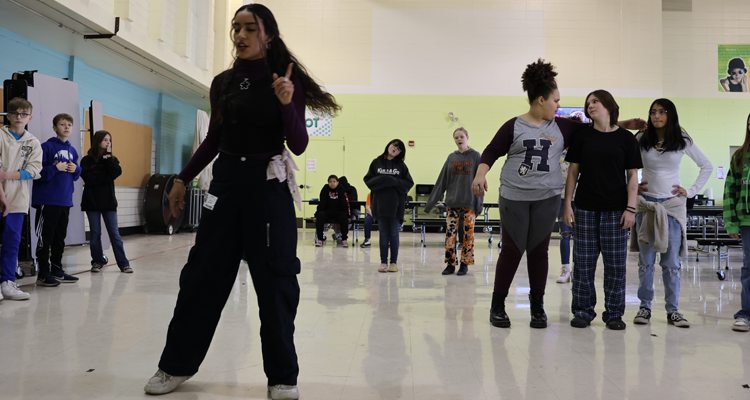
Azaria Baggett has always wanted her dancing to mean something.
“If you’re making a dance piece, you’re usually doing it because you have something to say and want people to see it,” said Baggett.
Since she was five years old, Baggett has been dancing formally. Her background includes an MFA and graduate assistantship from Texas Woman’s University (TWU). She also has teaching experience beyond higher education: including work in middle school, and community dance.
An Assistant Professor in the Theatre and Dance department, Bagget teaches Dance Pedagogy as a service-learning course. During her time at Missouri State, she has managed to find success as a teacher and as a dancer with a message. Her students seem to absolutely love it. They recently nominated her for an Excellence in Advising Award, which she received in March.
But the path to engaging her students in the community wasn’t always a smooth one.
From the top: teaching within a service-learning framework

Bagget considered her first year of teaching Dance Pedagogy courses a “first draft.” She tried hard to get her students into large operations, like Springfield Public Schools (SPS), but met logistical barriers. Later, she was able to find an opportunity with Infinity Academy, a private school that works with children who have autism. She made it work and gave her students meaningful hands-on experiences in the community. But the way she described it, she was feeling a little on her own.
Bagget learned that she needed to adjust her class time specifically to make it easier to get into local schools, which she saw this as a necessity for effectively teaching Dance Pedagogy: “When you’re teaching a class of peers who already know how to dance, you don’t get the real experience of what actually happens when teaching beginners.”
Soon, Baggett worked out a collaboration to bring Dance Pedagogy to SPS’ Reed Academy. At the time, Reed was transitioning aspects of their programming to fine arts, so it was a perfect fit. It’s also down the street from Missouri State’s main campus, making it an ideal location for university students.
At this point, Baggett wanted to see if there was a way to formalize all the effort she was putting into taking her coursework into the community. She connected with Citizenship & Service-Learning and it quickly became clear that the work she and her students were doing was essentially service-learning at its core. As a result, now she has the support and resources behind her to help maintain strong community connections.
Baggett believes service-learning aligns with her course’s objectives. She described it as a “natural fit,” and made it sound easy: “There are just elements we can tweak to meet specific requirements while aligning with our existing goals and trajectory,” she said.
Baggett doesn’t want performances to start and end on our stages at Missouri State. Students must find other ways to showcase what they’ve been working on. She even works it into her grading system – making sure that every student has an opportunity to display their work and go from theory to practice: “We have an adjudication process, so not all student works are selected for our formal concert, whether in the spring or fall. However, for those enrolled in the class whose pieces weren’t chosen, I required them to find an alternative performance opportunity as part of their grade.”
Stage presence: fostering the artistry of a community
One of Baggett’s most profound professional goals explains her commitment to making sure her courses are engaged in the community: “As an artist, I focus on ensuring artists’ work is seen. But from a pedagogical standpoint, it’s less about personal artistry and more about fostering the artistry of others.”
Missouri State is located in a community with an uneven level of awareness and support for the arts. Baggett talks about the challenges in trying to bridge gaps and mitigate the silo effect that can easily happen within higher education: “Springfield doesn’t fully realize the power of dance. It’s a cycle: we need exposure to build interest, but we need interest to bring in artists. Breaking that cycle is a constant challenge.”
But that challenge isn’t just a local problem.
“Dance, like literature or visual art, serves different functions. You wouldn’t expect a newspaper to read like poetry. And dance isn’t always meant to be interpreted in one way. In the U.S., we’re behind some other countries in understanding and appreciating dance as an art form,” Baggett remarked.
Baggett knows how to teach her students how to balance a strong message with artistry from her experiences choreographing her own projects. In “To What End,” she explored thoughtless consumerism through choreography that uses a motif of dancers running in place, symbolizing futility and an endless loop.
She’s adept at conveying elements that start on a personal level and then expanding them outward for audiences: “I draw from Black Feminist Thought—the idea that ‘the personal is political.’ My work often deals with issues like environmentalism, women’s rights, and racial equity, but in an abstract narrative form. It’s open enough for audiences to take what they need from it while still maintaining its core essence.”
Full out: the binder that ties
Baggett uses an important tool to help prepare her students for the job search: a comprehensive “pedagogy binder.” She placed it carefully on her desk and opened it up in the center. It was full of documents, but well-organized. “I got the idea for the pedagogy binder from my undergraduate teacher, and I still have mine today,” she smiled as she flipped through pages. “That’s why I make students complete a physical version—they’re less likely to lose it in the digital shuffle. When they start teaching, they’ll already have a polished teaching philosophy, a collection of lesson plans, and useful references to support them.”
Baggett said former students have told her the binder helped them get jobs and feel more prepared. It’s no surprise. It looked like a binder NASA would create, complete with extensive details, forms, and procedures. Sometimes, students in the job market are even required to have one from certain employers. Hiring dancers or dance teachers is a serious, competitive world. As Baggett closed the binder, she nodded to herself, “The ability to collaborate, to be community-oriented—these are traits that employers seek, even if they don’t always articulate it directly. When that experience appears in an application, it stands out as a meaningful asset.”
But arguably, for Baggett and most of her students, it’s easy to get the impression that employment is adjacent to another major priority. The conversations – almost magnetically – always drift back to the intersection between art and community engagement. “I think when art is done well, the two are inherently connected,” Baggett said. “I don’t see a strong divide between them. While some artists create solely for themselves, most art is meant for an audience, meant to spark discussion.”
Routine and flow
Baggett is excited about the future. She wants to continue leveraging the partnership with Citizenship & Service-Learning to enhance her coursework. She described the benefits of having an expanded set of community contacts, which gives her students more variety to explore where they take their work. “As an instructor, it’s incredibly helpful,” she explained. “But beyond that, it also teaches students independence. In dance, you have to forge your own path—opportunities aren’t simply handed to you after graduation. Service-learning encourages them to take initiative, make connections, and create opportunities for themselves.”
Discover more from Citizenship and Service-Learning Blog
Subscribe to get the latest posts sent to your email.