Professor Ana Estrella talks about what gives her the energy—every year—to lead a group of students overseas and go off the grid in support of leatherback sea turtle conversation.
In Spring 2023 and 2024, students embarked on “The Expedition: Leatherback Sea Turtle and Tropical Ecology in Costa Rica,” a 3-credit Education Abroad course with a service-learning component. Led by West Plains campus Assistant Professor Ana Estrella, this short-term program immersed students in the study of leatherback sea turtles, coral reef ecology, and tropical ecosystems. Beyond the classroom, students took part in vital conservation work. They assisted biologists at Pacuare Natural Reserve, gathering data on sea turtle nesting activities, and contributed to a coral reef census at Cahuita National Park, helping assess fish populations. Their efforts directly supported research and conservation initiatives led by governmental and non-profit organizations. Offered in partnership with MSU-Springfield, this hands-on course gave students a deeper understanding of environmental challenges and the chance to make a real impact in marine conservation.
Recently, Ana Estrella was kind enough to stop by CASL’s new digs in the Library and chat with us about her work. Take a look at the full conversation below:
About Ana Estrella
Charlie: If you could boil down all that you do as a faculty member heavily involved in public affairs and community engagement in just a few sentences, how would it go?

Ana Estrella: For me, it’s fascinating to see an institution that has that community engagement. I came from a different place, right? In Puerto Rico, you don’t see that very often—where a university says, “We are engaged with the community, and we’re doing things to make the community better and help our students grow that civil—how do you call it—responsibility,” right? So, as I have been growing as an educator, I see a lot of benefits in it. It’s not about thinking of academics as me, one person, or a student individually—but more about how their academic experiences can benefit the area: the West Plains area, the Springfield area, or, if we’re talking about Leatherback Sea Turtles, the environmental consciousness. So, all of this, for me, I think, is—if I can help to make these things happen—I am down for it. I like to be engaged, not just in the classroom teaching things that are lecture-based. Students can learn that from a book. But being engaged in the community is something not everybody has the opportunity to do, and it’s what we need nowadays, right?
Charlie: Based on my research, I started to get this big picture of your work, involving ecology, the environment, wildlife and protecting those things. How did service-learning and community engagement come into play for you?
Ana Estrella: Before becoming a faculty member for Missouri State West Plains, I was a biologist for the Department of Natural Resources in Puerto Rico working with a critically endangered species- the Puerto Rican parrot. So, I had a lot of interest in protecting the environment. For me, it’s more about education and exposing people to what is happening. Everybody sees it on the news, social media, hear people talking—whatever—but being exposed to it directly gives a different view. It helps people draw their own conclusions and also understand that, even when they think they are just one person and not going to make a difference, by being educated and passing that knowledge to others, we do make a difference. We do it little by little, but we keep moving forward—educating and trying to protect those natural resources and endangered species.
Charlie: Can a student get a complete education about wildlife preservation without being there – without getting that hands on experience?
Ana Estrella: The knowledge is in the books, right? …But the appreciation—the… how will I say it: I have been there. I know what it is and how it looks from the other side. Not just what is described in a picture, in a book, or in an article, but I have seen the work in the field. I have seen the struggles in the field. I have seen what the options are to improve. So, a balanced education will have both, right? I will not say one over the other. But I think they complement [each other] very well.
Charlie: Could you describe how your course got connected to service-learning? And did you feel like you were already doing the work before making it “official?”
Ana Estrella: It goes back to when I was an undergrad. So, I did have experience working with Hawksbill Sea Turtles. It’s another endangered species in the Caribbean. I was selected from a group of students to help in this research. It was at Mona Island a very isolated place between Puerto Rico and Dominican Republic—it’s a natural reserve—so only biologists and people doing research go there. So, that experience, when I had the opportunity to apply for the Ecology Project International Fellowship Program in 2015, is when I had the connection, like—I did this when I was a kid, as an undergraduate. Now I have the opportunity to bring this to young generations. To give them the opportunity to learn new research methods, the opportunity to learn how the fieldwork is, how people live in those biological stations. To work with species, handle new species, and grow that interest to protect the habitat we’re talking about—marine habitat.


Experiences in the field
Charlie: Your extensive experience includes work and wildlife conservation, but also advocacy for cultural consciousness. When you were first getting started, how did you approach balancing professional interests with developing community engagement opportunities for your students?
Ana Estrella: Yeah, it’s like it’s all one thing. And it happens because we are traveling to different countries, so the impact is greater compared to if we do it around here. Even if we go to the South, yes—it’s going to be a different culture also. But just having differences in language, in food, in how we have the lodging accommodations—we have places with no electricity… So, [students] come to the program, they enroll, and they spend a whole year trying to get prepared for it. And when they come back [from it], they are a completely different person. So, yes—an impactful experience, yeah. And you can read that in their reflections. And that’s what keeps me going every year. Even when I return super tired—just trying to make sure everybody’s safe, that we did okay—I have questioned if I want to do this again next year because of how overwhelming it is. But reading the reflections is like… I can’t stop.
I have questioned if I want to do this again next year because of how overwhelming it is. But reading the reflections is like… I can’t stop.
Charlie: It must be an enormous responsibility, as a teacher to be in an environment that most of your students probably aren’t accustomed to, and keep them safe and happy and healthy, while also trying to teach important and potentially complex concepts—that must take a lot of energy.
Ana Estrella: It does. One of the things that I think has helped is to prepare them, give them some readings before we go to Costa Rica. I tell students: Okay, these are topics that we’re going to run over there. We’re going to have experts in the field. They’re going to come visit with us. They’re going to give us lectures there. We’re going to be helping them collect data. I prepared them with scientific articles, with information about the country, things that they will see ahead of time. Then, it’s not that much of a question mark on how these things work when we are abroad. So, the basic information they are getting ahead of time.
Charlie: Proponents of service-learning promise a series of benefits for students. Some of those benefits are hands-on experiences, critical thinking, improving communication, and growing leadership skills. What benefits have you noticed that you would attribute specifically to service-learning and community engagement?
Ana Estrella: I see the cohesion, the group cohesion, and how they learn. These students, they are complete strangers to each other. And when we come to Costa Rica, we become like our own family for nine days. But it’s very interesting to see how they build that a cohesion, how they look for each other, a how they help each other, and like I mentioned, how they share what they know on these conversations. And they engage—rather than in a lecturer or guest speaker, by just talking. We all sit around a table and have a conversation. That’s one of the things. The other one is [due to us being] off the grid.
Charlie: Oh, yeah. You’ve mentioned that sometimes you visit places without any electricity.
Ana Estrella: When we arrive at San Jose, we drop our phones in a bag. The only people with phones are going to be our guides. Not having the technology, the cell phones, being completely off the grid helps a lot to have that mindfulness so [students] enjoy what they are doing at the moment. They are engaging with local people, not just taking pictures with them.
Students, community, and faculty
Charlie: Do you have any memories of standout service-learning moments from any of your education abroad trips?
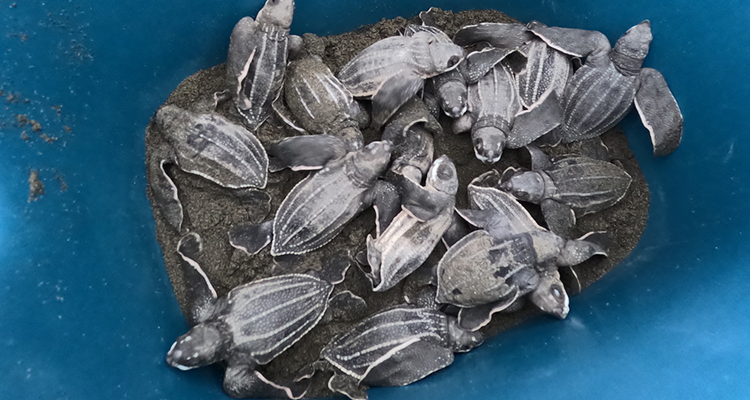
Ana Estrella: Yes, one of the first programs I did was on a rainy night. We divided the group into small teams to patrol the beach, looking for females coming to shore at nighttime—measuring females, counting eggs, doing all the protocols for this particular project. Now, that night, one of the nests unexpectedly started hatching. Well, they didn’t have any of the main biologists around—just one research assistant who needed help. Two of my students were at the research station, resting, and this research assistant reached out to them and said, Listen, I have hatchlings coming out of the nest. We need to release them. Can you help me? [For the students], it was one of those Oh my God, I’m on! moments. So, they were already running to the beach. And this was the first time my students had the opportunity to hold a baby sea turtle in their hands and help release them to the ocean.
Charlie: Wow.
Ana Estrella: Another time, a similar thing happened. One student was resting—because we take shifts—and very close to the research station, a big leatherback came ashore to lay eggs. One of the girls was resting, and the research assistant asked her: Can you help us? We need to measure. We need to get all this data, because everybody else was out on patrol. She was all into it. And that moment was a highlight for her. …That moment changed her, because she thought she would not be able to see a sea turtle during the program. I can see how vivid those moments were in their reflections—and how important they were for them.
Charlie: We’ve talked a lot about the effect on students. Can you tell us more about the overall effect that community engagement and service learning and these trips have on the community?
Ana Estrella: In Costa Rica, having the students collect data… They work with a lot of research assistants [who] start in April [and go through] to October, every night. Every night they have to go out to walk, look for sea turtles, measure. Being able to help them to collect the data, gives these assistants time to rest, so they don’t get burned out as easily.
Charlie: It’s cool to hear that that data gets shared to other projects, and you’re basically talking to other teams, in a way.
Ana Estrella: That’s what is so beautiful about it. Yes, you have research, but it’s a community project that is all about conservation.
Charlie: If you were approached by a faculty member and asked about service, learning or community-based experiences in a classroom, what would you tell them?
Ana Estrella: Make your students excited about it. I will tell my peers—my faculty peers—that there are challenges. There are students who don’t want to do it… There’s a lot of pushback in the form of Why waste my time doing this? Why do I have to put in extra effort on these other things? But at the end of the day, if we have the students mentally prepared—if we give them some guiding questions to keep in mind every time they volunteer or engage in the community—it will help them see the value. It’s not just about sending [students] into the world. These help me to see the value of adopting service for my courses. So, yes, I see that having a structured assignment, or having a structured course requirement, helps ease this—especially for the faculty. It reduces the stress of wondering Are these students really doing it? Or are they just putting somebody’s name here? Is this real? Another piece of advice I would give: have your own partners or partnerships for the course or project you want to do. Have specific partners. Don’t give a list of 300—just limit it to the ones that fit your class and the activity you want to do. Then have communication with those partners, so you can ensure they know what your expectations are for your students, and they can tell you what their expectations are for those volunteers. And that’s my advice for them. Challenges—always. But it’s important to go in with a positive mindset. And when things don’t go the way you wanted, just breathe, think about it, and try again. Don’t get discouraged, because something will always happen—and every time, it’s something different.
Note: Shortly after our conversation, Professor Estrella learned that two of the students who participated in the 2024 program will serve as unpaid research assistants during the 2025 sea turtle nesting season. It’s a testament to how the program inspires students to pursue their passions for environmental conservation.
Discover more from Citizenship and Service-Learning Blog
Subscribe to get the latest posts sent to your email.