

In the College of Natural and Applied Sciences (CNAS), many undergraduate and graduate students are actively conducting research.
Across disciplines, they are asking bold questions, testing new ideas and gaining hands-on experience in the fields they plan to lead in the future. Among them are three students from the department of physics, astronomy and materials science:
- Bishwash Devkota, senior, physics/astronomy and astrophysics
- Brogan Homburg, senior, physics/astronomy and astrophysics
- Moupia Tajrin Oyshi, graduate student, materials science
Devkota
A native of Kathmandu, Nepal, Devkota moved to Springfield, Missouri, in 2022 to pursue a physics degree at Missouri State.
“I’ve always been interested in knowing about our place in the universe, which is what led me to pursue a major with an emphasis in astronomy and astrophysics,” he said.
His research focuses on planetary dynamics by using computer simulation and studying “the orbital dynamics of a planet in the habitable zone near M stars (coolest stars) and G stars (sun-type stars).”
This work involves determining the stability of potentially habitable planets. It could help narrow down which planets in the habitable zone deserve the most resources and time, specifically those that show long-term stability.
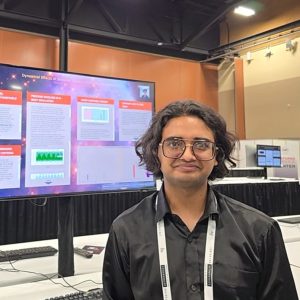
“This experience has taught me the basics of planetary dynamics and given me the confidence to be an independent researcher. I’ve been exposed to data analysis and theoretical modeling, which are essential for research,” Devkota said.
His favorite part about his research has been sharing it with the public. He has presented at three American Astronomical Society meetings; at the NASA Missouri Space Grant Consortium at Missouri S&T in 2023, 2024 and 2025; and the Mid-American Regional Astrophysics Conference in Columbia, Missouri, in 2025.
“The habitability of exoplanets is always an exciting topic for the public. In every interaction, I get a lot of questions from people of different ages and backgrounds, and it’s always exciting to answer them,” he said.
Dr. Sarah Morrison, assistant professor of astronomy, has served as Devkota’s mentor through his research process. She has taught him how to approach problems methodically and how to ask the right questions to solve them.
After graduation in May 2026, he plans to attend graduate school. He wants to further explore the dynamics of exoplanets and get more involved in observational dynamical research, which focuses on the “what” and “why” rather than the “how.”
Homburg
Homburg grew up reading science fiction books and watching movies that sparked his interest in science and space. Now, at Missouri State, he is studying the subjects in more depth, conducting research on subdwarf B stars.
These stars fall between main sequence and dwarf stars in size. With guidance from his research and academic advisor Dr. Mike Reed, distinguished professor of astronomy, Homburg is

investigating why subdwarf B stars are almost fully core and lack the outer layer seen in other stars. The research points to the likely explanation being in “binary interactions, since most known subdwarf stars exist in binary systems.”
“I’ve learned analytical writing and have grown extremely confident in my programming and computer science abilities. I also now understand how to research subjects and how science careers really work,” he said.
Homburg presented his research at the NASA Missouri Space Grant Consortium at Missouri S&T in 2024 and 2025. He also shared his work at the American Astronomy Society meeting in Washington, D.C., in 2025 and the SdOB12 (Hot Subdwarf Stars and Related Objects), an international scientific meeting in Little Switzerland, North Carolina, in 2025.
For Homburg, the most exciting part of his research journey has been the opportunity to travel to Valparaíso, Chile, last fall with Reed’s collaborator on subdwarf stars. During this trip, he got to work on telescope research with the University of Chile.
“The biggest highlight was visiting the Atacama Desert and seeing the clearest night skies in the world,” he said.
Homburg began his accelerated master’s program in natural and applied science this spring. After graduating in May 2026, he plans to continue his research with Missouri State faculty and collaborators in Valparaíso, noting he “would not have been able to do this work without Missouri State’s strong global connections.”
Oyshi
In May 2023, Oyshi earned her bachelor’s degree in materials and metallurgical engineering in her home country of Bangladesh. She learned about Missouri State’s materials science master’s program from a peer at her undergraduate institution, applied and secured a graduate assistantship from the department of physics, astronomy and materials science starting in fall 2025.
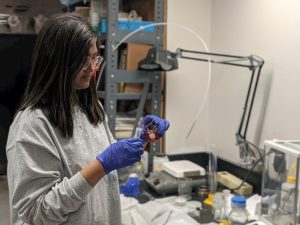
For her research, she is working with her research advisor Dr. Robert Mayanovic, department head of physics, astronomy and materials science, to develop nano-sized particles made from natural substances found in crab and shrimp shells. These particles are designed to deliver cancer medicine directly to cancer cells, rather than targeting both cancerous and healthy cells.
“After learning about Dr. Mayanovic’s research on nanomaterials for drug delivery, I knew it was something meaningful I wanted to be a part of,” Oyshi said. “He has been incredibly supportive throughout my research. Whenever I encounter challenges, he helps me think through possible explanations and encourages me to explore solutions through careful study and experimentation.”
They also collaborate with biology department head Dr. Kyoungtae Kim’s research group to test the biological performance of their materials in cancer cells.
“I was especially excited about working on a project that combines materials science and biology to solve real medical problems,” Oyshi said.
The biggest lesson about research for Oyshi is it “requires constant curiosity and critical thinking.” She realized that continuously asking questions and seeking answers are essential for innovation and improvement.
Her positive research experience has inspired her to pursue a PhD in the biomedical field after completing her master’s degree. She wants to continue researching new materials that improve health care and patient outcomes.
Explore the department of physics, astronomy and materials science
Discover more from Physics, Astronomy, and Materials Science Blog
Subscribe to get the latest posts sent to your email.