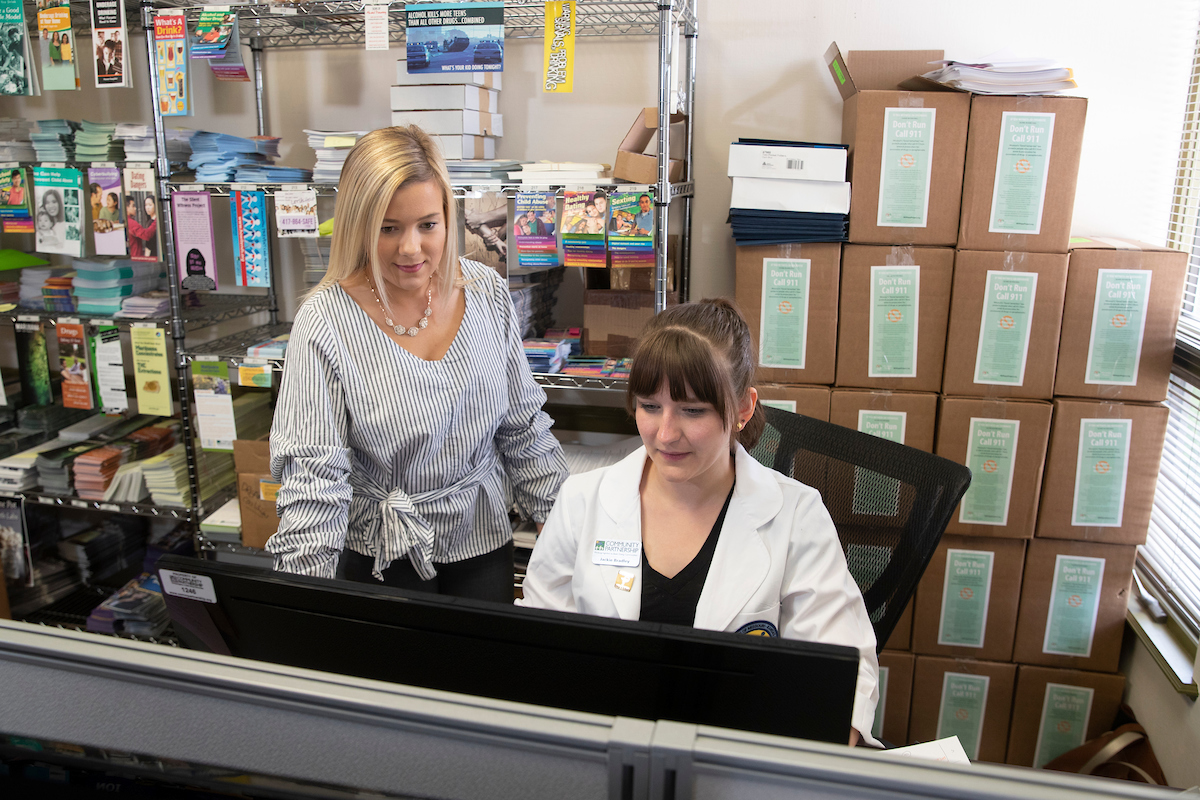
Last year, Missouri State’s Graduate College rolled out the Community Graduate Assistantship Program. It works much like on-campus graduate assistantships; participants receive a tuition waiver and stipend in exchange for a set number of working hours. But instead of working on campus, a community graduate assistant (GA) works in a local company. So far, participating employment partners include organizations like CoxHealth, Bass Pro and CNH Reman.
Provost Dr. John Jasinski calls the initiative “a triple win. It provides opportunities for students, employers and our academic programs,” he says. “The community GA program is front and center as we live our public affairs mission.”
How Community Graduate Assistantships Work
- A business identifies a need for a GA and communicates the duties and desired qualifications to Missouri State. We then advertise the position and provide a list of qualified applicants for the business to review. The business may conduct interviews or request additional information before selecting a candidate.
- Community GAs work on one-year contracts that are renewable for one year. Typically, they’re available to work 20 hours each week while the fall and spring semesters are in session. Based on an employer’s needs, some customization is available.
- The employer’s financial contribution covers a stipend, tuition and fees for the GA. Missouri State invoices this as a one-time, fixed cost.
- The employer supervises and evaluates the GA’s performance. Missouri State assists with onboarding and provides regular check-in opportunities for both the GA and the employer.
Q&A
Dr. Julie Masterson, associate provost and dean of the Graduate College, and Dr. Jerry Masterson, program director of Graduate Interdisciplinary Programs, led the effort to introduce community graduate assistantships.
We chatted with them about how this idea came together and what it means for Missouri State students and the Springfield community.
Academic Expressions: What do you want people to know about this program?
Julie: Community graduate assistantships allow students to get funding to support graduate education along with hands-on experience in a setting that is relevant to the student’s professional goals. Community GAs really get to see the things that they’re learning in the classroom come alive.
Jerry: From a student’s perspective, they get to step into something they know theoretically but may have never been in the trenches with. Now, they’re there. They get some on-the-job training, and then they’re engaged in the profession just like a traditional employee.
Julie: For employers, Jerry often describes it as “an extended interview process.” Many companies have internship programs, but an internship is a short window. One of our employment partners commented, “About the time you learn where the bathroom is, an internship is over!” With a community GA, you get a longer-term opportunity to mentor and get to know someone. Another employment partner told us: “We didn’t even know if we needed a full-time employee in this role. Having a community GA gave us a way to test the concept over a specific period of time and with a limited investment.”
Jerry: Another benefit is that for students entering the job market, one of the biggest barriers is the work experience requirement. Many positions require work experience. A community graduate assistantship gives someone that experience and helps them move past that barrier.

A Stellar Collaboration
AE: It sounds like such an intuitive program. How did it come about?
Jerry: The university had become more interested in expanding community partnerships, and we were interested in how this could include graduate assistantships.
Julie: Dr. Tona Hetzler [department head of public health and sports medicine] had been doing this kind of placement for years.
Jerry: Yes, the sports medicine graduate students are already certified athletic trainers. They have an arrangement through Mercy where the students get placed in the athletic departments for K–12 and other schools in town.
Julie: And Dr. Tamera Jahnke [dean of the College of Natural and Applied Sciences] has done something similar in our science graduate programs — placing teaching assistants for Ozarks Technical Community College. When we started having conversations with local businesses, we thought we could expand that model to include, basically, any organization in the community. Then the efactory got involved! Once Rachel Anderson [executive director of the efactory], Emily Denniston [director of the efactory’s community engagement and operations], Nicki Donnelson [director of marketing and communications for the efactory] and their team got involved, we went next level! They promoted the program and held events, which really helped get the word out. It’s an example of the stellar collaboration that happens at this university.
“It’s an example of the stellar collaboration that happens at this university.”
—Dr. Julie Masterson
Nurturing Relationships
AE: How can faculty best support this program?
Julie: If you believe your students would benefit from this kind of experience, make an appointment with Jerry. Talk to him about the knowledge and skills your students have, and he can talk about the needs we’re seeing in the community. He can also go out and develop relationships in the community, knowing that we have students with specific skills.
Jerry: The more I know about the kinds of students that are out there — all their talents and abilities — the more effective we can be. We have a limited number of these community graduate assistantships available, but there’s a lot of interest, and we’re always open to adding more employment partners.
Julie: That’s another way to help! Faculty members have contacts in our community, personal and professional. Tell your contacts about this program, and please introduce us.
Jerry: Yes, if your program has an advisory committee, loop them in on this. If they have an internship program, ask them if they’d be interested in something that allows for longer-term placements.
Julie: This program is one of Missouri State’s love letters to the community. We’re doing this so that our relationships are strengthened, and we’re able to support the advanced workforce needs in our community. It’s good for our community, and it’s good for our graduate students. Everybody wins.
Around Campus…

A team led by Dr. Kathryn Patterson, director of the School of Nursing, was awarded $377,000 from Missouri’s Nursing Education Incentive Program to expand Missouri State’s nursing program.
The grant will provide funds for two new faculty members to teach in the accelerated Master of Science in Nursing (MSN) program. This accelerated option will focus on clinical practice leadership, with additional funds to provide partial scholarships or traineeships to students who complete the program with a commitment to teach in a Missouri Higher Education School of Nursing for a minimum of three years.
“Our focus is on developing an accelerated MSN program, which reduces the time to complete the degree to increase the number of qualified nurse leaders,” Patterson says. “The program’s shorter structure will appeal to those seeking a quick turnaround.”
Discover more from Academic Expressions
Subscribe to get the latest posts sent to your email.