
In the School of Earth, Environment and Sustainability (SEES) at Missouri State University, research extends beyond the classroom to help communities better understand and respond to environmental changes.
Graduate students Kaiser Mostafiz and Katherine Brand are using data, modeling and field-based insights to tackle challenges related to flooding, river dynamics and climate variability.
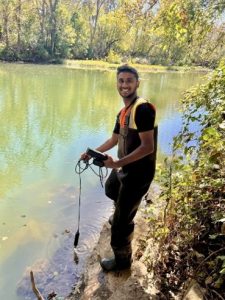
Mostafiz
Mostafiz’s path to hydrology began long before his formal education. Growing up in Dhaka, Bangladesh, he witnessed firsthand how monsoon rains, shifting rivers and seasonal flooding affected everyday life.
“Even before I understood the science, I was curious about how water moves and changes the landscape,” he said.
That curiosity led him to study hydrology, remote sensing and geospatial modeling. He earned a bachelor’s degree in city/urban, community and regional planning from Chittagong University of Engineering & Technology in 2017.
Mostafiz came to Missouri State in fall 2024, where he is pursuing a master’s degree in geography and geology. He conducts large-scale research on flood behavior across the Midwest.
His project analyzes more than 60 years of streamflow data from U.S. Geological Survey gaging stations across Missouri, Kansas, Iowa and Nebraska. The goal is to determine whether floods are becoming more frequent or intense under changing climate conditions — and whether traditional concepts like the “100-year flood” still hold true.
Using statistical modeling and programming tools, Mostafiz examines long-term flood patterns and recurrence intervals.
“Flooding directly affects people’s homes, infrastructure and safety,” he said. “If flood magnitudes are changing, that has real implications for how we design and plan our communities.”
One of his most significant findings so far is a shift toward fewer smaller floods, but more extreme flood events across many areas.
“Seeing consistent patterns across hundreds of stations was both surprising and impactful,” he said.
Mostafiz’s research contributes to a large, quality-controlled hydrologic dataset that can support floodplain management, infrastructure design and climate adaptation strategies.
Through this experience, he has developed strong skills in Geographic Information Systems, statistical modeling and programming in R and Python, along with experience in data management and scientific communication.
He credits Dr. Tasnuba Jerin, assistant professor in SEES, for her mentorship and guidance, as well as Ranbir Kang, geographer/environmental/river researcher, for helping refine his analysis.
Mostafiz has presented his work at the 2026 Missouri Natural Resources Conference in Osage, Missouri and the 2025 Southeastern Division of the American Association of Geographers Annual Meeting in Lexington, Kentucky. He has also submitted research to Geoscience Data Journal with additional projects in progress.
After graduating this spring, he plans to pursue a PhD in hydrology or geomorphology, continuing his focus on flood dynamics and climate-driven environmental change.
“This experience confirmed that research is the path I want to follow,” he said.
Brand
Brand’s journey into environmental research began in Luxemburg, Wisconsin, a small town near Green Bay. Her interest in river systems and landscape change led her to Missouri State’s graduate program in geography and geology in August 2024.
She also works as a research assistant with the Ozarks Environmental and Water Resources Institute (OEWRI), where she gained hands-on experience that influenced her research direction.
Her project focuses on the Gasconade River, examining how its channel width has changed from 1930 to 2020.
By analyzing historical data, she investigates how flood size, including two-, five-, 10-, 20-, 50- and 100-year events, and land use changes have influenced the river’s structure over time.
“This research helps explain why the Gasconade’s channel is changing,” Brand said. “It also contributes to a broader understanding of how climate and land use affect rivers in the Ozarks.”

One of her most surprising findings has been the magnitude of change in flood sizes, particularly in 1990.
“I expected to see change over time, but the increase after 1990 was much greater than I anticipated,” she said.
By working on this project, Brand has developed skills in geospatial analysis using ArcGIS Pro, hydrologic modeling with HEC-SSP and statistical analysis in R. She has also gained experience managing large datasets and conducting detailed environmental analysis.
Mentoring and supporting her along the way are her advisor Jerin, as well as OEWRI staff members: Josh Hess, research specialist and assistant director, and Marc Owen, director.
Brand presented her research at the 2026 Missouri Natural Resources Conference earlier this year and plans to present again at the 2026 Einhellig Interdisciplinary Forum on campus.
After graduating this spring, she hopes to return to the Great Lakes region to pursue a career in the environmental field. She believes her research experience, combined with hands-on work at OEWRI, has prepared her for both technical and professional challenges ahead.
“Working with real data and systems has made a huge difference,” Brand said. “It’s helped me understand how research translates into practical applications.”
Explore the geography and geology graduate program
Discover more from School of Earth, Environment and Sustainability Blog
Subscribe to get the latest posts sent to your email.