
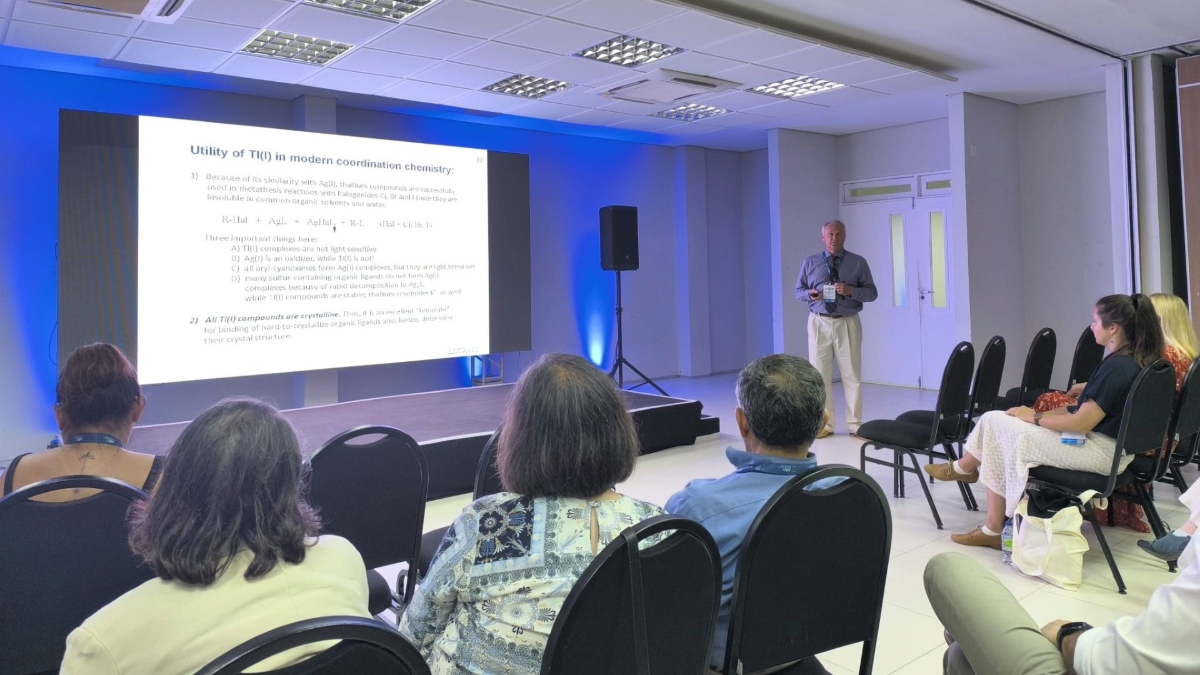
The Latin American Crystallographic Association Conference in Fortaleza, Brazil, brought together 221 researchers from 23 countries Oct. 14-17.
The conference focuses on advances in crystallography, including the study of crystal structures of small molecules, minerals, materials and large biological molecules.
Missouri State University was represented by Dr. Nikolay Gerasimchuk, professor of chemistry and biochemistry, who gave the keynote on thallium.
Building connections across continents
For him, the most important part of the conference was meeting researchers in person and communicating with them.
Many of those researchers are not well known yet and they can be difficult to find in printed sources, reviews or books. However, they conduct productive research that is not yet widely publicized and available.
One such connection was with a chemistry professor from the Federal University of Mato Grosso do Sul (UFMS) who presented on the separation of optically active molecules via crystallization. They also discussed unexpected findings and difficulties during the process.
Gerasimchuk established contact with two teams from Germany and from Brazil (San Paulo) working on anti-leishmania compounds. This is of particular interest for Gerasimchuk, who has worked in the same area for the past eight years. These conversations have already sparked new ideas for his lab.
“Networking is essential,” he said. “It helps scientists meet others whose work is completely out of scope of your literature searches but still is relevant.”
Exploring the marvels of thallium
During his keynote, “Why work with thallium? Structural chemistry of a marvel!,” Gerasimchuk focused on thallium’s great synthetic usefulness despite its toxicity.
He explained how thallium compounds demonstrate advanced properties that cannot be matched by similar silver compounds in some chemical reactions, leading to new biologically active molecules. For instance, thallium compounds are not sensitive to light and do not have oxidizing properties that cause unwanted side reactions. Moreover, all thallium compounds form crystals which are easy to study in the lab and are actual molecular structures of organic molecules bound to thallium.
His team determined eight unique structures of these molecules that otherwise are very difficult or even impossible to crystallize.
The audience was fascinated by his presentation, and it led to an intense question and answer session, new contacts and collaboration.
Advancing research
The conference also highlighted a growing trend in crystallography: studying biological molecules. Scientists are now focusing on proteins, enzymes and other complex systems to understand diseases and develop treatments.
“Structural analysis has never been more important,” Gerasimchuk said.
The event highlighted growing research resources in South America and showed great interest by students from the continent to structural sciences.
Modern facilities in Brazil now allow researchers from Peru, Uruguay, Argentina, Chile and Colombia to use high-intensity synchrotron radiation. They can obtain true independence in structural biology and chemistry research, establishing their own programs and scientific directions. This tool is crucial for studying proteins and other difficult molecules.
“This is a big step for collaboration,” Gerasimchuk said. “It gives students and faculty opportunities that were nearly impossible 10 years ago.”
His experience at the conference will help further Missouri State’s research, especially in optically active compounds. He continues to share knowledge and methods with international colleagues.
Learn more about chemistry and biochemistry
Discover more from CNAS NewsWatch
Subscribe to get the latest posts sent to your email.