
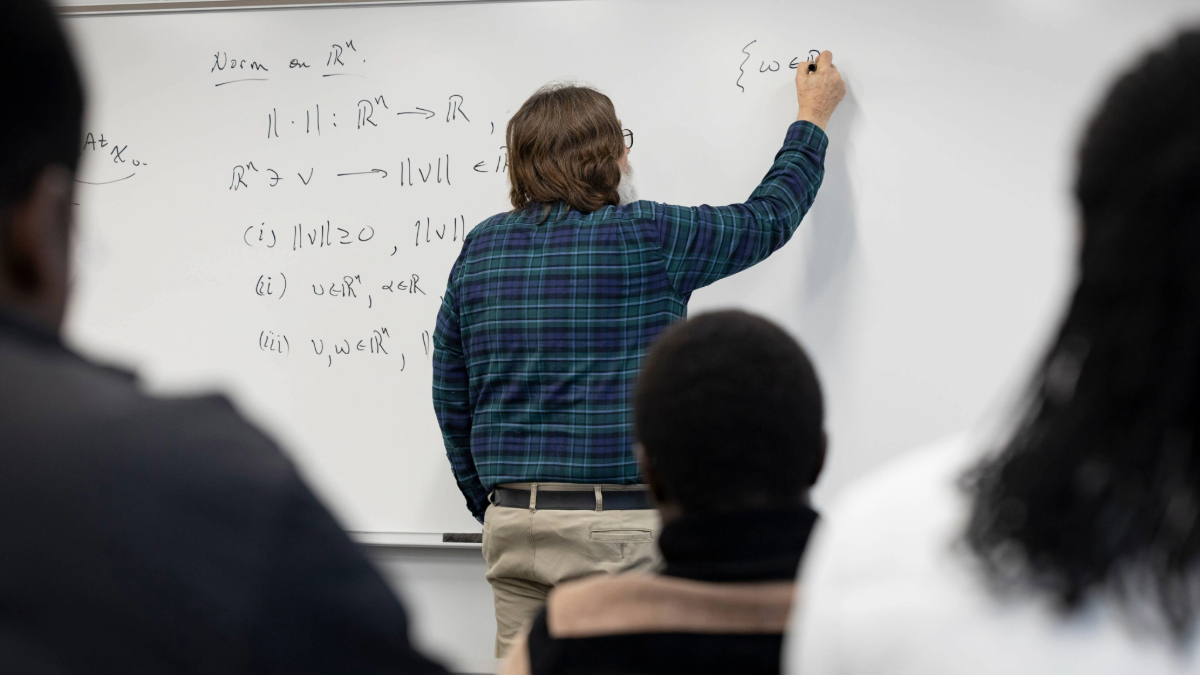
In the College of Natural and Applied Sciences (CNAS) at Missouri State University, students turn abstract math into practical solutions, applying research to real-world challenges, from traffic systems to complex networks.
Christopher Housholder, double major in mathematics and data science, and Layna Mangiapanello, double major in mathematics and secondary math education, are two seniors putting their skills to work to address issues with tangible impact.
Housholder
Housholder’s path to research was anything but linear. Originally from Marshfield, Missouri, he started at Missouri State as a computer science major in fall 2024, but soon discovered a stronger interest in math.
“After a semester without a math class, I realized I loved math far too much to give it up,” he said.
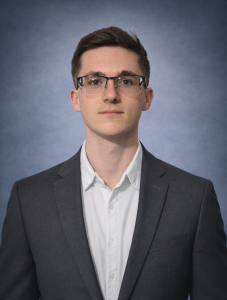
His current research focuses on traffic prediction using nonlocal mathematics methods. The project aims to develop models capable of accurately forecasting traffic behavior even when limited information is available.
“My goal is to see how pure mathematical ideas can be applied to practical problems,” Housholder said. “It’s exciting to take methods that were originally developed for one purpose and adapt them to something entirely different.”
He credits Dr. Animesh Biswas, assistant professor of mathematics, for his mentorship throughout the project.
“He keeps me moving forward without giving me the answers, which has strengthened my problem-solving and modeling skills,” Housholder said.
He has also honed technical skills through tools like MATLAB, a high-level programming language and environment designed primarily for numerical computing, data analysis and visualization. This has helped him gain experience in translating abstract mathematics into applied research.
While he has not presented this project yet, his previous work, “VC-dimension of subsets of Hamming graphs” was showcased at the Missouri-Arkansas-Kansas-Oklahoma Undergraduate Mathematics Research Conference in 2025. VC (Vapnik-Chervonenkis) is a way to measure how powerful a model or system is at separating data into different groups. In simple terms, it tells you how complex something is based on how many different patterns it can correctly handle.
His most recent project will be featured at the 23rd International Conference on Information Technology: New Generations in Las Vegas, Nevada, this month.
After he graduates either this fall or spring 2027, Housholder plans to pursue a PhD in pure mathematics with a focus on analysis. He hopes to become a math professor, using his research experience to both teach and solve real-world problems.
Mangiapanello
Mangiapanello’s research journey began as a way to explore the possibilities of mathematical inquiry beyond the classroom. Originally from O’Fallon, Missouri, she is balancing her student teaching at Glendale High School with ongoing research.
Working with Dr. Steven Senger, professor of mathematics, Mangiapanello studies VC-dimension of subsets in Hamming graphs, investigating the smallest subset size needed to guarantee shattering in an n x n graph. This work has potential implications for fields like artificial intelligence and data analysis.
“This research gave me a deeper understanding of how abstract mathematical concepts can be applied to practical problems,” she said. “VC-dimensions might seem purely theoretical, but they provide insights into how systems behave and how to model complexity in real-world scenarios.”
Collaboration has been a key part of her experience. Much of the project involved working closely with other students to brainstorm ideas, create visual models and refine proofs.
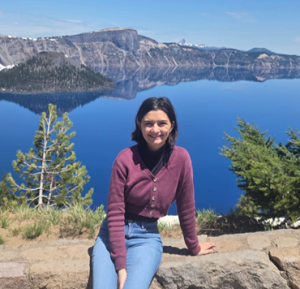
“The back-and-forth with my peers was one of the most exciting aspects,” Mangiapanello said. “When one person comes up with an idea, another builds on it or challenges it, and that dynamic really drives the research forward.”
She has also developed strong communication and project management skills, especially because Senger was often out of the country during critical phases of the project.
“Learning to coordinate and communicate effectively without traditional meetings pushed me to be more independent and proactive,” she said.
Mangiapanello and her team have presented their research at the CNAS Undergraduate Research Symposium and the 2025 Combinatorial and Additive Number Theory Conference in New York.
“Presenting our work was an incredible experience. It’s rewarding to see how the research resonates with other mathematicians, and to get feedback that strengthens the project.”
After graduating this spring, Mangiapanello plans to pursue a master’s or PhD. She is eager to return to research after completing her student teaching.
“This experience has reinforced my interest in exploring both teaching and research,” she said. “It has shown me that mathematics can be both intellectually challenging and deeply connected to solving real-world problems.”
Discover more from CNAS NewsWatch
Subscribe to get the latest posts sent to your email.