

In the College of Natural and Applied Sciences (CNAS) at Missouri State University, biology students are transforming curiosity into discovery.
They are applying research to questions that span from molecular interactions inside cells to ecological dynamics across prairie landscapes.
Graduate students Abhishu Chand and Tabitha Moul are two researchers using their passion for biology to tackle challenges with real-world implications in medicine, technology and environmental conservation.
Chand
Chand’s path to biology began long before he stepped into a research lab.
Originally from Kathmandu, Nepal, he came to the United States in 2021 to pursue his bachelor’s degree in biology at Missouri State. Inspired by family members in medicine, Chand developed a deep interest in understanding life at the molecular level.
“Biology has always fascinated me, but being able to contribute to scientific discovery myself made it even more meaningful,” he said.
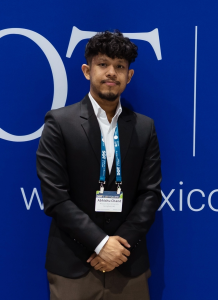
Now a graduate student in department head Dr. Kyoungtae Kim’s cell and molecular biology lab, Chand focuses his research on quantum dots, tiny fluorescent nanoparticles and their interactions with biological systems. His work examines how these particles interact with proteins like actin, which play a critical role in maintaining cell structure.
“The key question is whether quantum dots are truly biocompatible,” Chand said. “They have incredible potential in medicine, but we need to understand if they might also have unintended effects inside cells.”
Quantum dots are widely studied for applications in bioimaging, drug delivery and diagnostics. Chand’s research contributes to understanding their safety, helping guide how these materials can be designed and used more effectively in biomedical settings.
“The goal is to ensure that as we develop new technologies, we’re also considering their biological impact,” he said.
Through his research, Chand has developed strong interdisciplinary skills in cell biology, microbiology and biochemistry, along with hands-on experience designing and troubleshooting experiments. He also emphasizes the importance of adaptability and persistence in scientific work.
“Research pushes you to think differently. You’re constantly learning new techniques and approaching problems from new angles,” he said.
He credits his principal investigator, Kim, and his lab peers for influencing his approach to science.
“Dr. Kim has taught me that good research is not just about working harder, but about thinking critically and communicating effectively,” Chand said.
He has presented his work at several conferences, including the Society of Toxicology (attended annually from 2024-26), 2025 Oklahoma Cell Biology Symposium and the 2025 and 2026 Missouri Academy of Science Annual Meeting.
After graduating this spring, he plans to transition into an industry role where he hopes to apply his laboratory and analytical skills in a professional setting.
“My research experience helped me grow from following protocols to thinking as a scientist,” he said.
Moul
Moul found her way to biology through exploration and a willingness to change direction.
A Pittsburg, Pennsylvania, native, she first came to Missouri State in fall 2020 to study interior design. She later discovered her passion for science through sustainability-focused coursework.
“The moment I stepped into a biology class, I knew that was what I wanted to do,” said Moul, who earned her bachelor’s degree in 2024.
Now a graduate student studying general biology with a focus on conservation, Moul conducts research in associate professor Dr. Avery Russell’s lab, where she studies prairie bumblebee foraging behavior. Her project examines how competition and resource availability influence how bees divide resources across remnant prairie ecosystems.
“We’re looking at how bumblebee communities share resources in environments where those resources are limited,” Moul said.
Her research has important implications for conservation, particularly as native prairie habitats continue to decline. Once widespread across Missouri, less than 0.5% of tallgrass prairie ecosystems remain.
“This work can help inform prairie restoration efforts and support pollinator populations,” she said. “There’s still so much we don’t know about pollinator behavior in these systems.”

Moul’s work aligns with ongoing efforts by organizations, such as the Missouri Department of Conservation and the Missouri Prairie Foundation, which aim to preserve and restore prairie ecosystems.
Besides the research, one of the most rewarding aspects of her experience has been science communication.
“I love being able to share science with people from all backgrounds,” she said. “That’s something the biology department really encourages.”
Her research has taken her beyond the classroom and lab, involving both fieldwork in challenging outdoor conditions and presentations at conferences across the country, including events in Missouri, Oklahoma, Pennsylvania and Oregon. She has also participated in community outreach, sharing her work with non-academic audiences.
Through these experiences, Moul developed skills in teamwork, data collection, time management and communication, both in the lab and field.
She attributes her academic and professional growth to her advisor, Russell.
“He’s incredibly supportive and always pushes his students to be better scientists,” she said.
Moul also credits her family as a huge source of support and notes she would not have made it through the program without their unwavering belief in her.
She will graduate this spring and plans to pursue a career in science communication, with hopes of working in a museum, aquarium or zoo. She is also currently doing an internship at the Roston Native Butterfly House located within the Springfield Botanical Gardens at Nathanael Greene/Close Memorial Park.
“Being involved in research has shown me how important it is to connect people with science,” she said. “That’s something I want to carry forward in my career.”
Discover more from CNAS NewsWatch
Subscribe to get the latest posts sent to your email.