
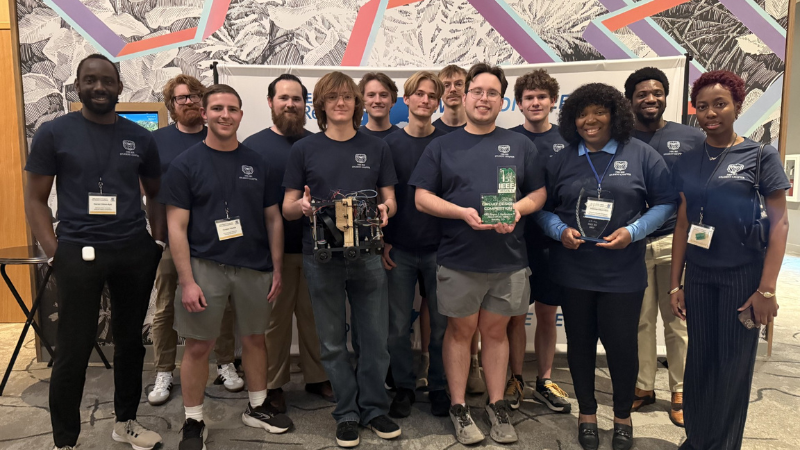
Engineering and computer science students at Missouri State University had a successful outing at the recent 2026 Institute of Electrical and Electronics Engineers (IEEE) Region 5 Congress and Student Competitions.
It took place March 27-29 in Boulder, Colorado. This annual engineering event combines the Region 5 congress, business meeting and student competitions, creating a space to collaborate, compete and help guide the region’s direction.
Joining the students was Dr. Theresa Odun-Ayo, program director of the cooperative engineering program. She serves as the student activities chair for their section and as the faculty advisor for the university’s chapter. She won the IEEE Region 5 Individual Achievement Award at the event.
The competitions
The Mo State teams competed in four areas:
Circuit Design (first place):
- Jordan Neal, electrical engineering junior
- Aiden Seiler, electrical engineering junior
This competition encourages student’s ability to design and build circuits based on given practical requirements and constraints.
Robotics (third place):
- Ryan Kidd, electrical engineering senior
- Josh Lambert, computer science junior
- Sam Lambert, computer science junior
- Cooper Martin, electrical engineering senior
- Evan Musick, computer science senior
- Gavin Robertson, computer science senior
Teams had to build a robot to complete a themed “Mining Mayhem” mission.
Cyber Challenge (tied for fifth place):
- Grace Akintoye, computer science junior
- Tyler Mills, electrical engineering senior
The Cyber Challenge followed a traditional capture-the-flag format, featuring jeopardy-style questions that test a range of computer science skills.
3-MinuteThesis (3MT):
- Daniel Odun-Ayo, computer science graduate student
- Olurotimi Olugbemi, computer science graduate student
3MT required participants to explain their research in language suitable for a non-specialist audience.
Performance under pressure
According to Seiler, success in circuit design came from preparation and clearly defined roles.
“We were not given a specific prompt beyond a vague premise. The best way we found to prepare was to know what our roles would be in advance,” he said.
That plan helped the team stay focused under pressure.
“Our team was surprised to win first place, as most competitors finished very close together,” Seiler said. “Our hard work paid off since were able to implement the design requirements and refine some of them beyond what was expected.”
For robotics, the team overcame early setbacks through persistent collaboration.
“We were a bit discouraged because the robot wasn’t performing exactly how we had hoped,” Kidd said. “However, we made significant progress during an all-night troubleshooting session.”
He also pointed to the value of interdisciplinary teamwork.
“As an interdisciplinary team, we were able to approach the same problem from multiple perspectives,” he said. “That led to more creative and well-rounded solutions.”
Building experience beyond the classroom
Across all competitions, students strengthened their technical ability alongside communication, teamwork and adaptability. Theresa emphasized the broader impact of the experience.
“It gives students hands-on experiences that bridge theory and practice,” she said. “It also offers opportunities for leadership, networking and professional growth — key elements in preparing students for successful engineering careers.”
Looking ahead, she plans to expand student engagement, strengthen industry partnerships and continue fostering a culture of innovation and excellence.
Discover more from CNAS NewsWatch
Subscribe to get the latest posts sent to your email.