
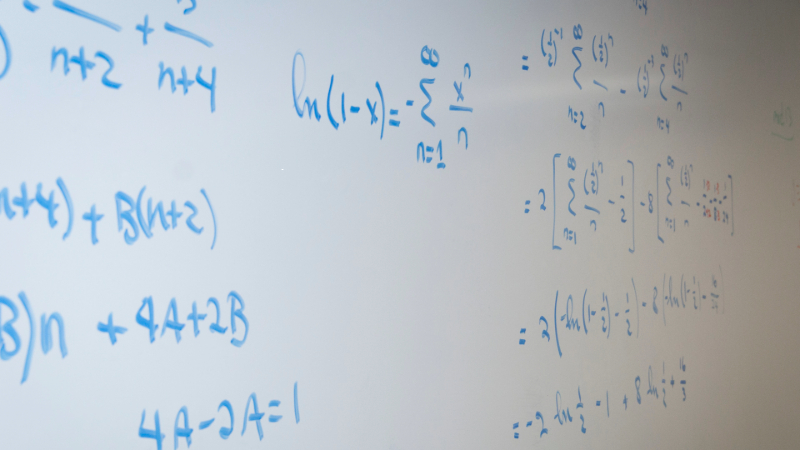
Mathematics is always evolving and new discoveries often begin when researchers come together to share ideas.
At Missouri State University, Dr. Steven Senger, professor of mathematics, and Dr. Matthew Wright, associate professor of mathematics, recently received a $20,000 National Science Foundation (NSF) funding recommendation for their proposal, “Conference: Combinatorics and Harmonic Analysis in Geometric Settings (CHARMING).”
The funding will support the CHARMING Conference, scheduled for Dec. 4-8, at Missouri State. The international conference will bring together around 75-100 mathematicians to explore connections among harmonic analysis, combinatorics, geometry and fractals.
Math across disciplines
The week-long event will highlight how different areas of mathematics work together to solve complex problems.
Senger describes harmonic analysis as a way to study individual parts of a system without losing sight of the whole picture.
“I think of it as the forest and the trees,” he said.
Geometric combinatorics focuses on counting shapes and studying how lines, circles and other objects intersect. Together, these fields offer tools for understanding complex structures, including fractals.
The conference will also celebrate the contributions of Prof. Alex Iosevich, Senger’s former doctoral advisor. A faculty member at the University of Rochester, Iosevich has influenced mathematicians through his research and mentorship.
“Alex is an absolute powerhouse,” Senger said. “The guy draws from a seemingly infinite well of energy, creativity and compassion.”
Iosevich’s contributions to the field have helped form the next generation of mathematicians, including Senger.
Investing in future mathematicians
A key goal of the NSF funding is to help early-career researchers attend the conference. This includes students, postdoctoral researchers and untenured faculty members.
Senger sought additional funding to support these participants and make the conference more accessible.
“This makes the conference a lot livelier and ensures it’ll have a much larger impact, so I’m grateful to the NSF,” he said.
At the conference, early-career mathematicians will get a chance to connect with established researchers, ask questions and build professional relationships.
“I think a lot of early-career folks are well served by meeting their heroes,” Senger said. “It can demystify and humanize people, which is typically a good thing.”
Attendees can also expect presentations from leading researchers and opportunities to discuss the future of math, including the growing role of artificial intelligence in math research.
Strengthening Mo State’s research community
Hosting an international conference gives Mo State an opportunity to connect with researchers from around the world and showcase its growing research presence.
According to Senger, the university has made significant progress in building its reputation as a place for serious research.
“I believe we’re really hitting our stride with research, so meetings like this will just further catalyze our prominence on the global stage,” he said.
The CHARMING Conference will continue that momentum, fostering collaboration, new research and meaningful connections across the math community.
Discover more from CNAS NewsWatch
Subscribe to get the latest posts sent to your email.