Missouri State University

Skip to content Skip to navigation
a b c d e f g h i j k l m n o p q r s t u v w x y z

Center for Writing in College, Career and Community Blog

  • Center for Writing in College, Career and Community
  • CODERS Program

Middle School Camp – Final Week and Author’s Chair

June 29, 2015 by Rachel Schober

photo 5 photo 4 (1)

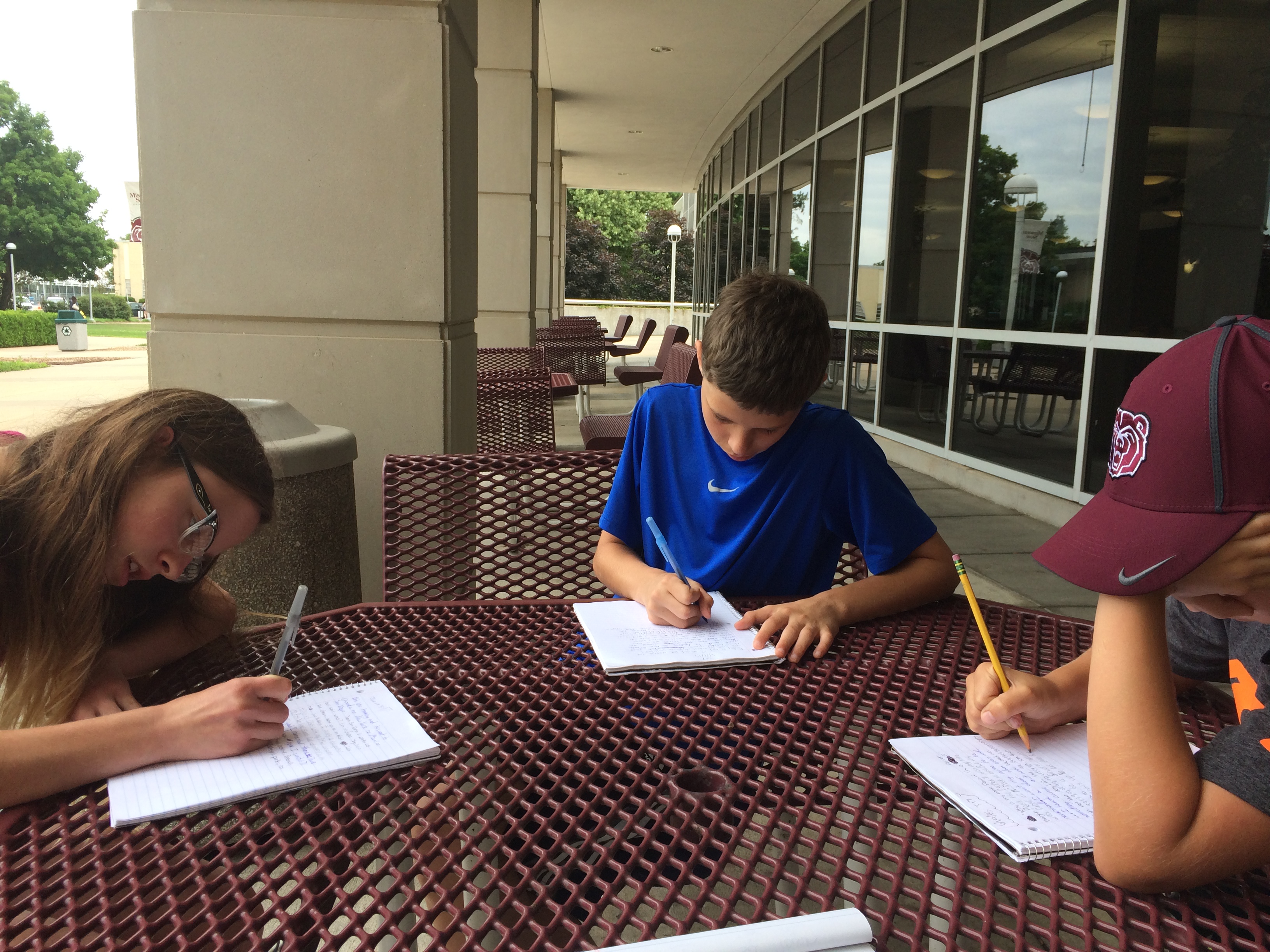
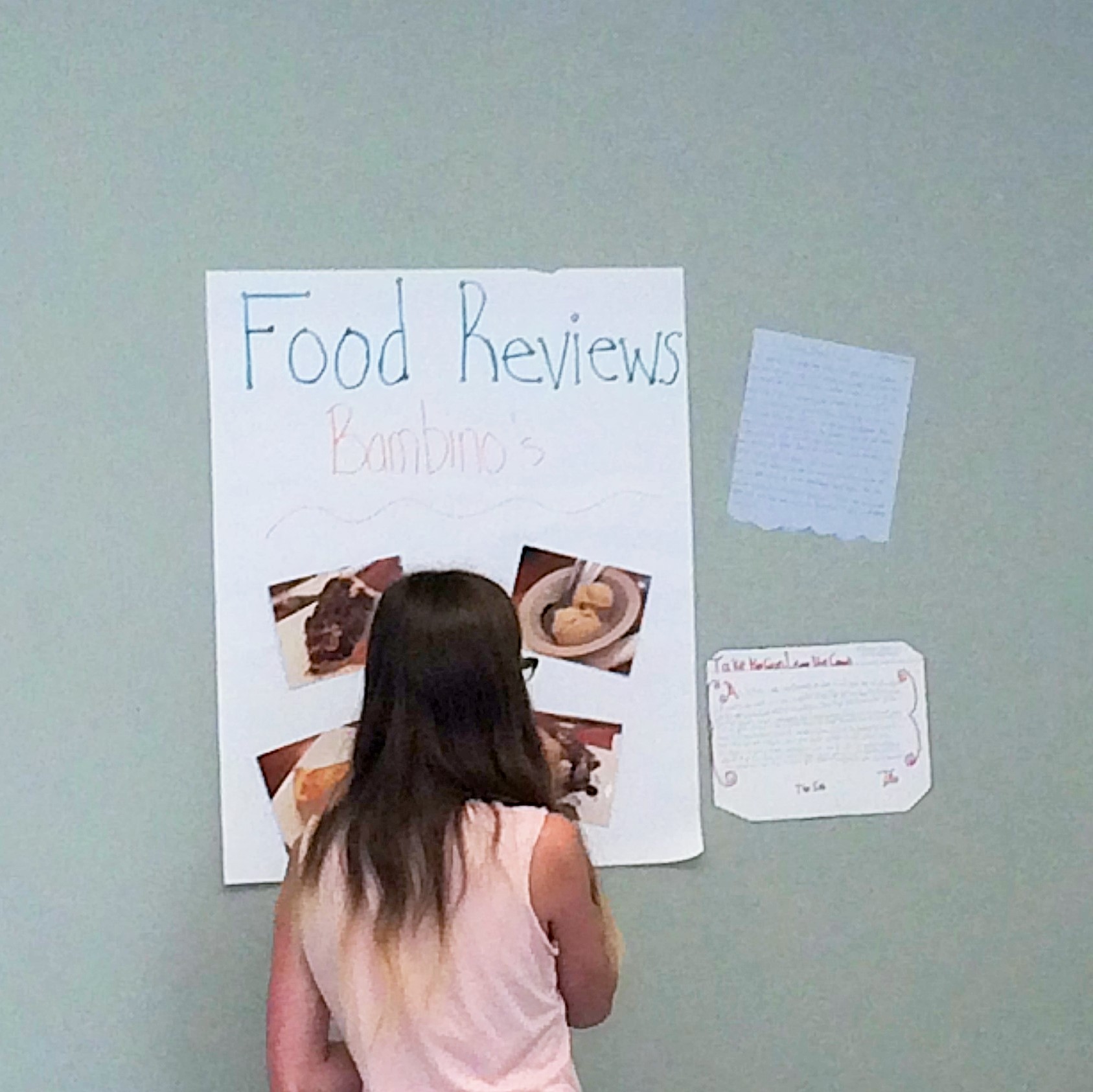
It’s hard to believe the middle school camp is already over! The second week flew by with a flurry of field trips and Writing Workshops. From writing inspired by works at the Springfield Art Museum to food reviews of desserts at Bambino’s Cafe to a Writing Marathon around downtown Springfield, the campers were out writing all over central Springfield this past week.

For our closing camp activity, campers shared some of the pieces they had worked on for the past two weeks to a crowd of family, friends and the community. Some of the pieces, including their Altered Books, were on display around the room for the audience to investigate and read on their own.  Each camper also chose 4-5 original pieces to read aloud to the audience, including found poems, short stories, parodies, and group writing projects. Below are a few of the pieces they shared:

photo 2 (2) photo 1photo 3 (2)

Filed Under: Ozarks Writing Project Tagged With: Camp, Middle School, youth writing

Middle School Writing Camp – Week 1

June 22, 2015 by Rachel Schober

IMG_3789

Our Middle School Youth Writing Camp is entering into it’s second week! Last week, we tried our hand at poetry, short stories, altered books and more. We even braved the rain to do a nature photography scavenger hunt and place-writing!

     IMG_00302015-06-17 14.49.05

     IMG_00282015-06-17 13.52.21


Friday, we did a brief Author’s Chair at the Park Central Library, where we shared a couple of original pieces including some of the micro flash fiction that we wrote. Two of the final products are below:

Sci-fi:  Just a normal day. Flying to work on my Jet Pack. Past hover cars and sky scrapers. I enter a building and make new inventions.

Horror: I saw something following me it was gray and tall. Then I saw it coming closer and closer. I screamed help m…

We’re looking forward to another week full of more creating, thinking, writing and fun, but maybe a little less rain!

Filed Under: Ozarks Writing Project

Jimmy by Jana Parrigon, 2015 SI Teacher Consultant

June 16, 2015 by Catherine English

Every day, like an annoying alarm, Jimmy walked by my room, stood in the doorway, and asked, “Do I have speech today?”. He had no sense of time, no idea of yesterday and tomorrow.

Jimmy came to my classroom twice a week for thirty minutes at a time, and we worked on speech sounds and language concepts. Sometimes, when I felt he’d had enough of those, we worked on his letters. One particular day, his clothes reeked of stale urine, and leftovers from lunch splayed across his face. His shirt showed stains and signs of wear, holes in worn areas. I kept coming back to the smell, the odors fighting to fill up my nose. I did my best to breathe through my mouth, which is hard when talking. Jimmy always took the weight of the world on his shoulders when it came to answering questions, pressed himself too hard. His mind worked slower, like a big tow-truck with three flat tires, full of power, but not fixed to work properly. They have identified him as intellectually disabled; however, his sweetness always penetrated any mental defaults he possessed.

I had had Jimmy in speech for a couple of months before I knew he couldn’t read. One day, the special education teacher told me of this lacking concept in his intellect. She told me he couldn’t identify letters or numbers. Jimmy was in the first grade. Not able to read, I thought to myself. No way. But I soon found out this teacher was right.

Before Jimmy’s next speech session, I made flashcards of letters, capital and lowercase, and flashcards of numbers, thinking that I would bring this boy around to the light. I would show him how to read.

When he next came to speech, we began by working on a few articulation sounds. /V/ sounds in all positions of words, “vacuum, lever, cave”; /l/ sounds in all positions of words, “light, umbrella, bowl.” As we practiced these various words, I realized that a majority of Jimmy’s speech articulation errors probably stemmed from his inability to identify letters and their sounds, to associate letters with sounds. I could tell Jimmy to make the /v/ sound, but unless I showed him how to make the sound, giving him the name of the letter that made it was pointless.

After we worked on sounds for a few minutes, we moved on to letters. Okay, I thought to myself. This is it. I’m going to teach this boy how to read.

On the kidney-shaped table between Jimmy and me, I laid out three flashcards, Aa, Bb, Cc. Surely, he knows these, I thought.

“We’re going to practice the names of the letters. Okay?” I asked him.

Jimmy nodded his head, looking skeptical. “I think I know some of these,” he said.

“Just do your best. What is this letter?” I asked, pointing to the Aa card.

“That one’s ‘H’,” he said. My guess was that he had mixed up the two letters due to their similarity in shape.

“No, not ‘H’,” I replied. “Can you think of what else it might be?” I prodded, pointing at the Aa flashcard again.

“I know this one. I do. I really do,” he said, confident.

Then, his hopeful smile fell, reality sinking in that he had forgotten the name of the letter.

“I guess I don’t remember,” he said gloomily, sad dark blue eyes raising up to look at me, almost waiting for condemnation or punishment.

“That’s okay, Jimmy. That letter is ‘A’,” I told him.

“That’s right!” he exclaimed, a smile revealing two missing front teeth. “‘A’! I knew it. I really did.”

“I believe you,” I assured him.

We repeated the same process with Bb, him almost positive he knew the name of the letter, but again, coming up with nothing.

“This letter is ‘B’, Jimmy,” I explained. “Remember, ‘B’ for bumps. See the two bumps on the ‘B’?” I asked.

“Yes, I see them. Bumps for ‘B’. Okay,” he said, shaking his blonde head up and down.

I pulled the flashcard of Cc over to join Aa and Bb.

“Oh, I know this one. I really do. It’s ‘C’,” he said, standing up with excitement. He smiled so wide, as if someone had a hold of his grin from each side of his mouth, pulling it wider.

I must have looked surprised, because he said, “See, I told ya.”

“Yes, you did, Jimmy,” I applauded. “I’m so proud of you.”

I wish all of our letter-learning lessons had proceeded as smoothly. The only other letters Jimmy “really” knew were ‘J’ and ‘X’. Within five minutes of working on letters with Jimmy that day, I realized that despite my superwoman efforts, this child’s learning to read would take more; it would require the dedication of everyone who came in contact with him.

This reality of a first grader not knowing how to read puzzled me greatly when I first had to deal with Jimmy’s disability. My teacher training revolves around working with high school students, writing, reading fiction and nonfiction, and studying elements of language. All of my preparation for teaching was contingent on my students being able to read. Personally, my dad taught me how to read when I was four. So working with a student who couldn’t tell me the name of the letter ‘A’ boggled my mind.

Later in the year, Jimmy and his younger brother Alex came to school in clothes they had wet the bed in the previous night. The special education teacher came to my room and told me the situation, that she, the school nurse, and the principal were going to hotline DFS due to the severity of the incident.

The school nurse had removed the boys from their classes, and they sat at a table in her office, coloring. The smell in her office matched that of a dingy nursing home, the pungent stench of ammonia and urine flooded over me. I barely lasted thirty seconds in her office.

The special education teacher asked the boys why they didn’t change clothes before they came to school.

“If we tell our mom we wet the bed, she spanks us,” Jimmy said, matter-of-factly, as if this topic of conversation was part of his everyday routine. “So we changed our shirts, but we didn’t have any other pants to put on.”

The principal ended up taking the boys home, making the mother bathe and put clean clothes on her children, and then the principal brought them back to school. Their mother couldn’t, or wouldn’t, come get her children.

I returned to my classroom, turned off the lights, sat down at my desk, and cried. I cried for these boys, for the care, love, and proper nourishment they do not receive. I cried for their mother, for the state of her mind, that she tells herself it’s okay not to take responsibility for her boys. I cried for my ability to do nothing, for yearning to take them home with me, to feed them and read to them, to love them.

I still question this past year of teaching, why I was stuck in the position of speech implementer. But stories like Jimmy’s remind me why. That for students like him, whose parents found better things to do than love their children, I could love those children. God granted me a sliver of insight, a sneak peek into what it takes to raise a child, what it means to care for a child, physically, intellectually, emotionally. While I didn’t learn a lot about teaching English this year, I did learn a lot about life. I learned a lot about living beyond me. When Jimmy would come to my room for speech, I understood, by a fraction, what it meant to view the world through his eyes.


Filed Under: Ozarks Writing Project

Living Well: The Value of Teaching Place

February 26, 2015 by Catherine English

The Ozarks Writing Project 2015 Summer Institute is just around the corner, i.e. June 8-July 1, 2015.  With that in mind, I wanted to write to first remind local educators (in all content areas and grade levels) that we are accepting applications to the institute due on March 23.  The instructions for the institute are posted on this website. I experienced my first summer institute in the summer of 1997 at a rural institute in the community of Henderson, Nebraska, population 986 (and several assorted cats and dogs).  Henderson was unique because it is a Mennonite community with an agricultural foundation.  The rural institute was unique becasue it was held at Henderson Public Schools.  I commuted 15 minutes to the site but others, i.e. teachers from every corner of the state, either lived in people’s homes or a local hotel for the four weeks of the summer institute.  To say that we bonded as educators is an understatement. To help you understand a bit more about my experience in that summer institute, I offer you an excerpt from my dissertation, “Living Well: The Value of Teaching Place,” where I write about how that rural institue became the impetus for the research I continue to do in place conscious pedagogy.

A Life-Changing Teacher “Moment”
What happened in my career that moved me to consider a place conscious pedagogy? In 1997 I was invited to participate in the Nebraska Writing Project’s first Rural Institute in Henderson, Nebraska. The teaching demonstrations of that rural institute, with its emphasis on place, first piqued my interest in place consciousness. In a National Writing Project summer institute, teacher leaders are invited to participate in a course where each teacher brings from his or her classroom a best practice of writing which they demonstrate to their peers. Twenty-two teachers came from every part of our vast state, from the northeast, southwest, northwest and the central, spanning a range of 300 miles to become immersed into the locale of Henderson, population 986.

I know that we were all changed by that rural institute. I learned that the most successful practice in my classroom was building relationships with my students through a constant dialogue. I had to practice and model my own writing along with my students to affect any kind of change or growth in our lives or within our communities. I wanted a classroom community where students could write about what they cared deeply about and know that others cared just as much as they did. Sidney Dobrin, in “Writing Takes Place” states, “We write our places and in turn those places write us. That is, the relationship between discourse and the construction of environment, nature, and place is a deeplyenmeshed, coconstitutive relationship” (Weisser and Dobrin 18).

One of the epiphanies I experienced in the rural institute was that “local knowledge both centers, and spirals out into, more general knowledge, whether in history, science, business, or literature. If we understand our local place well enough to grasp how it came to be this way, the forces that shape it, and how it compares to other places, we will have developed a robust and extensive knowledge base” (Brooke 63). In this summer institute three teachers from the Henderson community and school studied places nearby the community: Suzanne Ratzlaff and the history of Farmer’s Valley cemetery, Ron Pauls and the Big Blue River biome, and Sharon Bishop and the Marie Ratzlaff Memorial Prairie. These teachers focused on environmental learning where place-conscious education has its roots. In Place-Based Education: Connecting Classrooms and Communities, David Sobel writes, “Environmental education grew out of the Nature Studies movement of the early twentieth century and traditionally focused on learning about the natural sciences…Place-based education takes us back to basics, but in a broader and more inclusive fashion” (8-9).

These three demonstrations “addressed an underdeveloped aspect of critical pedagogy through intentional experiences, or learning opportunities that are intentionally or deliberately structured while remaining exploratory and inquiry-based in nature, focused on local place” (Ball 204). These demonstrations made me contemplate what I could do within my school and community to engage my own students concerning the history, culture, science, business, or literature of our place. I marveled at the thought of students going outside the classroom to explore the community around them, and not just a community of people, but the land, the flora and fauna. These teachers understood what Wendell Berry meant when he wrote: “so all who are living here, human and plant and animal, are part of one another,…therefore, our culture must be our response to our place, our culture and our place are images of each other and inseparable from each other, and so neither can be better than the other” (Unsettling, 22). Berry also notes that “a healthy culture is a communal order of memory, insight, value, work, conviviality, reverence, aspiration. It reveals the human necessities and the human limits. It clarifies our inescapable bonds to the earth and to each other” (43).

Ratzlaff’s demonstration focused on a sense of connection, or living well spiritually, a cultural and spiritual sustenance, discerning connections to one’s place on earth and understanding and articulating the meaning of living one’s life in a given place. Ratzlaff, an elementary teacher, engaged us with stories of people buried in Farmer’s Valley Cemetery. She had taken her students to the Plainsman Museum in Aurora to investigate the lives of some the people buried in the cemetery. Ratzlaff gave us a printed record of each person buried in the cemetery, but the stories she told made these people come to life. Her demonstration helped me to personally contemplate the importance of action—I had to act in order to preserve history within my community. She had devoted a great deal of time and effort to learn more about Farmer’s Valley Cemetery on behalf of her students, and I would soon find out that it takes a lot of time to glean the stories from local residents and then write about them.

Ron Pauls was the elementary principal/guidance counselor at Heartland Community Schools, but he was also a former science teacher. Pauls’ demonstration focused on the biome of the West Fork of the Big Blue River. His teaching demonstrationcentered on a sense of place, or living well ecologically, developing a sustainable relationship with the natural world in his community or as Owens notes “a healthy natural environment is nourishing for the self-actualization of persons and communities.” In his demonstration, he noted this about the Big Blue River: “[It] is part of our surroundings. Our life here will be made richer and our chances of survival will be enhanced if we can come to some understanding of this phenomenon of nature, why it is the way it is, its impact on us, our impact on it, and what our understanding will mean for both our futures” (English, Writing Portfolio). Pauls asked us to observe this biome on our ‘field trip’ to the West Fork, which at that time of year was barely a trickle, but definitely a river bed. The photographs I took that day contain native flowers and grasses and a nest. I became enthralled with knowing the names of things while we were scanning the area surrounding the river. Pauls’ expert instruction on the elements of biome and the river ecosystem elicited many memories for me from my own childhood associated with another river, the Platte.

Ron Pauls’ intentional instruction had asked us write “about a past or present experience with a stream. It could be memories of living near a stream and how you went wading and catching tadpoles, or fishing, or bridges along the stream, floods in the stream and your feelings at the time, sights and smells along a stream then and here today” (English, Writing Portfolio). Pauls also made me think again. He made me think more critically about the ecosystem of not only the Big Blue River, but the Platte River and all of the characteristics of plants and animals living alongside me. He had asked us all to zoom in to the life around us and consider the effect of human behavior upon the ecosystems right here in our back yard. I became acutely aware of my own use of water and began to question the extensive use of water in the Platte River Basin.

One of the concepts that Ron Pauls deeply understood is that it is vital for students to know about their environment in these present times because knowledge of their place will affect the decisions they make as future citizens. He notes,

‘These people are residents of the prairie. It’s a place where they were born. They live here now. I think it’s good to have some understanding of the big picture, of the ecosystem where you live…I really believe that we’re on a crash course with the future because what we’re doing now in agriculture, I don’t think, is sustainable. I just don’t think that very many people can continue to make a living from agriculture on the farm the way we’re doing it now. I think it’s going to have to change. We’re going to have to change policy, and we’re going to have to change the way we do things to better fit the environment.’ (qtd. in Ball 214)

While Pauls asked us to consider the present ecosystem of the Big Blue River and the sustainability of this ecosystem, his colleague, Sharon Bishop, asked us to observe the Marie Ratzlaff Memorial Prairie. Like Pauls, Bishop’s teaching demonstration zeroed in on Haas and Nacthtigal’s first of the five senses, or living well ecologically. The preserve contained elements of flora and fauna from Nebraska’s original prairie grasses, much of which has since been plowed under to cultivate corn. As Bishop stated in her demonstration, “This ecosystem is a kind of museum because it gives us a small picture of what Nebraska looked like before settlement. It is also kind of a laboratory, able to be studied from many scientific perspectives: webs and food chains, root systems, plant communities, etc.” Bishop asked us to use our “senses and record [our] observations, feelings, responses to this land. Imagine what Nebraska looked like before settlement.”

Sharon Bishop also shared with us the integrated curriculum unit she created with biology teacher, Mark Regier. She writes, “This curriculum integrated science and language arts to present opportunities for sophomores to learn about a native prairie, a wetland, the Sandhill cranes, and some aspects of their rural culture from scientific and literacy perspectives” (English, Writing Portfolio). The objective for their students was to “know the interdependence of all systems of the prairie and the influence of man on the prairie and the influences of the prairie on man.” It greatly intrigued me that Bishop and her colleague were able to integrate language arts and biology, using lab procedures, poetry, essays, photographs and small group work so students could learn about the ecosystem of their surrounding area. Bishop’s insight and commitment to place- conscious education was extraordinary. She portrayed deep convictions concerning how “projects that connect young people productively with other youth and adults are now seen to be the foundations upon which healthy communities can be built…The success of any community-based approach to learning rests on whether a new and empowering partnership between the community and school has been developed” (Miller 163, 167).

Initially, I had a very vague understanding of what it meant to turn place conscious theory into practice in my classroom. After the rural institute in Henderson I just knew those teachers “were onto something.” I thought their activities were engaging and I desperately wanted my students to feel engaged in their learning. I wanted them to care about learning as much as I did. I also wanted them to care deeply about writing. Since that time, through multiple experiences and “experiments” in the classroom, I’ve come to understand more clearly what Haas and Nachtigal conceive as community: “Community is how we collectively create a story about our place. It is the narrative of who we are, how we get along together, how we make a living, and how we are connected to it…Community is how we live well together” (21).

Through teaching a place-conscious curriculum I have learned about the heart and soul of this community, and am surrounded by residents whom I respect and consider friends because they were willing to share their stories and histories with my students. We have expressed our experiences with community members through various compositions, and we have learned, together, about the history, culture, economy, and the land. And we have learned about why it’s so important to care about sustaining this community well into the future. I know I serve my community in the best way I know how: preparing its future citizens for the task of citizenship. Like Marian Matthews says in the afterword of Rural Voices: Place Conscious Education and the Teaching of Writing, “I want to learn something about myself, my capabilities, and what I can contribute as a citizen to the place where I now live. I think this is what we all want and what we want for our students” (187).

Works Cited

Ball, Kevin Eric. “Excavating Perceptual Landscapes: Re-imagining Community Inquiry in the Composition   Classroom.” Diss. U of Nebraska, Lincoln, 2000. Dissertations and Theses. Web. 17 June 2009.

Berry, Wendell. The Unsettling of America: Culture and Agriculture. San Francisco: Sierra Book Club Books, 1977. Print.

Brooke, Robert E. ed. Rural Voices: Place Conscious Education and the Teaching of Writing. New York: Teachers College P, 2003.Print.

English, Cathie. Writing Portfolio. Nebraska Writing Project Summer Institute. 1997. Print.

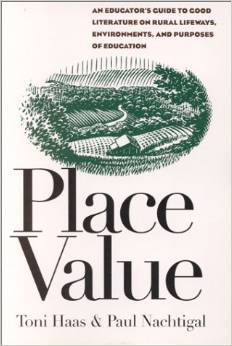
Haas, Toni and Paul Nachtigal. Place Value: An Educator’s Guide to Good Literature on Rural Lifeways, Environments, and Purposes of Education. Charleston, WV: ERIC Clearinghouse on Rural Education and Small Schools, 1998. Print.

Miller, Bruce A. “The Role of Rural Schools in Community Development: Policy Issues and Implications.” Journal of Research in Rural Education. 11. 3 (1995): 163-172. Print.

Sobel, David. Place-Based Education: Connecting Classrooms & Communities. Barrington, MA: Orion Society, 2004. Print.

Weisser, Christian and Sidney Dobrin. Ecocomposition: Theoretical and Pedagogical Approaches. Albany: State University of New York Press, 2001. Print.

Place Value

Filed Under: Ozarks Writing Project

Planting Seeds: How Do We Grow as Teacher Leaders?

February 24, 2015 by Catherine English

Twelve teacher leaders are participating in a Teacher Leadership Workshop course throughout this spring semester.  We are focused upon understanding more deeply what it means to be a teacher leader in our own classrooms, within our school district (or university) and within our local community.  We are investigating what it means to become an advocate for our profession by the inquiries we have established within our classrooms and schools.  Through this investigative lens, we are learning how to be agents for change in our schools and in our communities.  This workshop also specifically focuses upon how we are developing a new project or significantly redesigning an existing project that can be implemented in our classrooms or in conjunction with community agencies or individuals.  We have experienced intense research into the development of curriculum through small group or cadre work and exchange of both personal and professional writing.  We are learning how this kind of research-based inquiry can be modeled to other teachers at our Ozarks Writing Project site so others may understand the importance of research/evidence-based curriculum design and implementation.

We have learned a great deal about teacher leadership through this workshop, but first and foremost we’ve learned that we often don’t completely understand what it means to be a teacher leader, because, as educators, we are continuously barraged with negative publicity.  We have a tendency to forget that we are leaders in our schools and communities.  We have gained a greater understanding of what it means to advocate for education within our school districts.  We are learning that we cannot be an agent of change if we are not willing to advocate on behalf of our students to administrators, school boards, or the community.  We know this kind of leadership is crucial if we are going to develop curriculum that involves connections with community members. We are also absorbing information about the latest digital tools and how to integrate these tools into our classrooms thereby increasing our students’ digital literacy.  As leaders, we must be on the cutting edge of the rapid changes in education so digital literacy is essential.

We are eagerly and earnestly jumping into our inquiry projects focused upon both teacher leadership and literacy instruction, including some of the following: student-led writing groups, revision strategies in the creative writing classroom, after school writing clubs, argument writing, informal grammar instruction, podcasting and daily writing, just to name a few.   The list of books that teachers have requested is an impressive collection, too:

Buckner, Aimee. Notebook Know How: Strategies for the Writer’s Notebook. 

Connors, Neila. If You Don’t Feed the Teachers They Eat the Students: Guide to Success for Administrators and Teachers. 

Clark, Ron. The Essential 55: An Award-Winning Educator’s Rules For Discovering the Successful Student in Every Child.

Culham, Ruth. The Writing Thief: Using Mentor Texts to Teach the Craft of Writing.

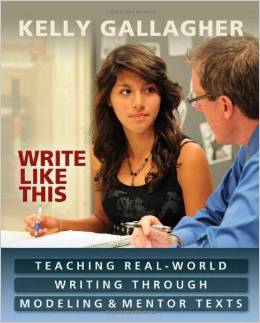
Gallagher, Kelly. Write Like This: Teaching Real-World Writing Through Modeling and Mentor Texts.

Heard, Georgia. Awakening the Heart: Exploring Poetry in Elementary and Middle School.

—. Finding the Heart of Nonfiction: Teaching 7 Essential Craft Tools with Mentor Texts.

—. Writing Toward Home: Tales and Lessons to Find Your Way.

Hicks, Troy. Crafting Digital Writing: Composing Texts Across Media and Genres Paperback.

—. The Digital Writing Workshop 

Hobbs, Renee. Discovering Media Literacy: Teaching Digital Media and Popular Culture in Elementary School.

Kittle, Penny. Write Beside Them: Risk, Voice, and Clarity in High School Writing

Lamott, Anne. Bird by Bird: Some Instructions on Writing and Life.

Noden, Harry. Image Grammar, Second Edition: Teaching Grammar as Part of the Writing Process.

Romano, Tom.  Fearless Writing: Multigenre to Motivate and Inspire.

Scott, Susan. Fierce Conversations: Achieving Success at Work and in Life One Conversation at a Time.

Schoeberlein, Deborah and David and Suki Smith. Mindful Teaching and Teaching Mindfulness: A Guide for Anyone Who Teaches Anything.

Silverman, Rita. Case Studies for Teacher Problem Solving.

Tobin, Lad. Writing Relationships: What Really Happens in the Composition Class.

Weaver, Connie. Grammar to Enrich and Enhance Writing.

Winter, Dave and Robbins, Sarah.  Writing Our Communities: Local Learning and Public Culture.

Wong, Harry.  The First Days of School: How to Be an Effective Teacher, 4th Edition.

In March we will experience two field trips that will demonstrate how teachers can utilize local resources in their curriculum.  We will visit the archives of the Meyer Library on the Missouri State University Campus where we will learn how we might utilize some of the historical documents.  We will also tour the Springfield Art Museum and the Nature Center where we’ll have an opportunity to learn about the educational programs offered at each so that we might consider the possibilities for our own students.


Notebook
GallagherKittle

Filed Under: Ozarks Writing Project

« Previous Page
Next Page »

Meta

  • Log in
  • Entries feed
  • Comments feed
  • WordPress.org
  • Accessibility
  • Disclaimer
  • Disclosures
  • Equal Opportunity Employer and Institution
  • © 2026 Board of Governors, Missouri State University
  • Contact Information