Missouri State University

Skip to content Skip to navigation
a b c d e f g h i j k l m n o p q r s t u v w x y z

Residence Life, Housing and Dining Services Blog

  • Residence Life, Housing and Dining Services
  • ResNet Residential Technical Support
  • My Missouri State

Residence Life Diversity Committee Consider This: April 23, 2021

April 23, 2021 by Matthew McGhee

Diversity Committee Consider This Logo

Corporate Social Justice

Corporate Social Justice is a reframing of Corporate Social Responsibility (CSR) that centers the focus of any initiative or program on the measurable, lived experiences of groups harmed and disadvantaged by society. CSR is a self-regulated framework that has no legal or social obligation for corporations to actually create positive impact for the groups they purport to help. Corporate Social Justice is a framework regulated by the trust between a company and its employees, customers, shareholders, and the broader community it touches, with the goal of explicitly doing good by all of them. Where CSR is often realized through a secondary or even vanity program tacked onto a company’s main business, Corporate Social Justice requires deep integration with every aspect of the way a company functions.

“Our employees and your customers expect you to engage, and not just verbally. They expect you to do something,” says Lisa Osborne Ross, who next month will become the first Black person to serve as chief executive officer for the US division of Edelman, one of the world’s largest and most influential public relations firms.

The release of the 2020 Edelman Trust barometer revealed that brand trust and brand reputation ranked second and third behind price as the most important factors for consumers deciding which new products to purchase. Edelman’s August 2020 special report on “The Fight for Racial Justice in America” found 54% of Americans surveyed had a “continued expectation” for the brands they support to speak out about racism.

“Consumers, customers and employees will buy or boycott based on how they feel about your actions,” Ross said of US business leaders. “The counsel we’ve given clients throughout the summer and that we are giving clients right now on this issue is, ‘Silence is not an option.'”

Consider what social justice causes are significant to you and evaluate how the companies you patron stack up to your expectations. Questions to consider before you do and/or continue to do business with a company – Are they…

  • Speaking out and taking a stance…do their actions back up their words?
  • Spending money in philanthropic efforts and supporting suppliers owned and managed by diverse folks…how much, what percentage, and who benefits?
  • Are they training themselves and their employees on diversity, equity, and social justice topics…is this effective, mandated, and ongoing?
  • Creating policies, procedures, and benefits packages that are inclusive…who is included in making these decisions?
  • Educating, advocating, and using their influence to create positive social change…are they involving the voices of those they are serving as they do this and compensating them appropriately?
  • Criticized for lacking diversity amongst its leadership …ist blind spot failures, where they donate profits, who they liaison with, etc.…is this repeat criticism, what is their response?
  • Intentional about their culture…living their values, focusing on impact and responsibility, holding themselves accountable, employee and customer satisfaction, etc.?

Corporate Social Justice is a new paradigm that imagines a healthier and mutually beneficial relationship between companies and the communities with whom they interact. It is driven by the growing desire of socially-aware consumers and employees for companies, especially socially-conscious and forward-thinking companies, to do better. Companies have an opportunity to rise to the occasion and leverage their influence to build a better world for all — including themselves.

Resources and further learning:

  • Article | Like it or not, ‘woke’ Corporate America is here to stay
  • Article | We’re Entering the Age of Corporate Social Justice
  • Article | Corporate Social Responsibility Took Stage At CES, But 2021 Demands More
  • Human Rights Campaign Foundation – Corporate Equality Index 2021 | Rating Workplaces on Lesbian, Gay, Bisexual, Transgender and Queer Equity


Diversity Committee Logo with embedded Twitter

How to Get Paired with the Perfect “Random” Roommate”

April 13, 2021 by Matthew McGhee

LET US HELP YOU MEET SOMEONE NEW

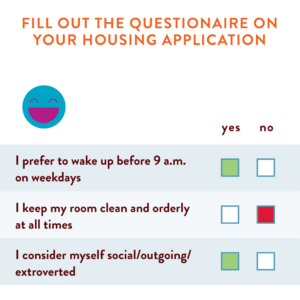
Want to live with a roommate, but don’t know anyone who would be a perfect fit? If you don’t have a preferred roommate, we can help pair you with someone new! “Random” roommates are anything but. Residence life will use a set of questions in your housing application to pair you with someone who has similar living preferences and interests. Answer the questionnaire truthfully, to get an accurate roommate pairing. Once we receive your answers, we will compare them to the answers of other students, and pair you with the perfect match!

fill out the questions on your housing application

we will compare your answers with those of other students

you will be paired with someone who has similar living habits and interests


Tagged With: Incoming Students, Residence Life

Residence Life Diversity Committee Consider This: April 9, 2021

April 9, 2021 by Matthew McGhee

Diversity Committee Consider This Logo

What is Ramadan?

Ramadan marks the month when the Holy Quran is said to have been revealed to Prophet Muhammad PBUH by Allah. This is observed by a month-long fast.

Muslims around the world abstain from food and drink for 30 days, including water, during daylight hours (from dawn to dusk), as a means of celebrating and reflecting on their faith.

Fasting at Ramadan is one of the five pillars of Islam – the fundamental rules that all Muslims follow.

Ramadan is the 9th month in the Islamic Lunar Calendar which consists of 12 months in a year of 354/55 days. In Arabic, this is called the Hijri Calendar and started with the migration of Prophet Muhammed PBUH to Madinah from Makkah 1442 years ago.

Due to the Islamic Calendar being based on the different phases of the moon, each of the months moves back around 10 days each year. So, Ramadan could be in the middle of summer in 2015 and be in December by 2030! This year, Ramadan begins on Monday 12th April and will end on Wednesday 12th May.

If you do not observe the month of Ramadan, you can help Muslim family, friends, coursemates, and colleagues by:

  • Trying not to schedule meetings around evening time (dusk) when the fast for the day ends, so they can eat on time.
  • Additionally, don’t schedule catch-ups over lunch or dinner, as you will be the only one eating.
  • Don’t make a big deal about eating.
  • Show your encouragement with kind gestures and words.
  • Ask them how you could support them through this month e.g., any adjustments that may need to be made. Everyone’s needs are different, so it’s best to ask individually.

Diversity Committee Logo with embedded Twitter

Residence Life Diversity Committee Consider This: February 19, 2021

February 19, 2021 by Matthew McGhee

Diversity Committee Consider This Logo

James Baldwin was an African American essayist, novelist and playwright, who focused on race in America. This made him an important voice in African American Literature and history. Baldwin has created many works throughout his lifetime and interviewed many historical activists in the 60’s and 70’s. Some of his work includes “ If Beale street could talk”  and I am not your Negro. The first work is a play that has turned into a movie, which you can find on Hulu or HBOmax, it uncovers  a love story set in Harlem in the early 1970s. The title is a reference to the 1916 W.C. Handy blues song “Beale Street Blues”, named after Beale Street in Downtown Memphis, Tennessee.Beale Street is the first Baldwin novel to focus exclusively on a black love story; it is also the only novel in his corpus narrated by a woman. Published at the tail end of the Black Arts Movement, it explores love within black life, centering on the emotional bonds holding two African American families together.

It was adapted as a film of the same name, written and directed by Barry Jenkins, and it garnered an Academy Award for Best Supporting Actress for Regina King. The film was released theatrically on December 14, 2018.

The second work is a book that has turned into a documentary which can be found on Netflix. This Documentary is based on James Baldwin’s unfinished work called Remember this house. The film explores the history of racism in the United States through Baldwin’s memories of the civil rights leaders.  Many of these leaders have inspired Baldwin’s work throughout his life. Baldwin also discovered his sexuality as a queer black man, this is embodied in many of his works in the earlier stages of his life.

Diversity Committee Logo with embedded Twitter

Residence Life Diversity Committee Consider This: February 12, 2021

February 12, 2021 by Matthew McGhee

Diversity Committee Consider This Logo

February is Black History Month, the one month throughout the year that Black people can celebrate their accomplishments, their hard work and their strife.  You might wonder why Black History month is celebrated in February. On February 12th President Abraham Lincoln was born, Lincoln signed the Emancipation Proclamation which helped free slaves in America. Lincoln was a catalyst for black people to begin their fight for equal rights. Frederick Douglass’s birthday falls on February 20th, Douglass was an escaped slave who became a prominent activist, author and public speaker.  He became a leader in the abolitionist movement to end the practice of slavery. These leaders in America were part of the reason February is celebrated as Black History Month. However, one activist known as the “Father of Black History” inspired a week-long celebration.

Carter G. Woodson, the first man to establish African American studies in the 20th century, joined four others in founding the Association for the Study of Negro Life and History (ASNLH). They encourage engagement amongst scholars in the study of Black history. A subject that has been neglected by academia for decades in U.S schools. A few years later Woodson and the ANSLH launched Negro History Week in February 1926. Today we have turned an entire week into a month, which shows the progress we have made as a community.  If you are interested in reading some of their work, below is a list of a few of their famous pieces.

  • The Mis-Education of the Negro – Carter G. Woodson
  • A century of negro migration – Carter G. Woodson
  • Free Negro owners of slaves in the United States in 1830, together with Absentee ownership of slaves in the United States in 1830 – Carter G. Woodson
  • Narrative of the Life of Frederick Douglass – Frederick Douglass
  • My Bondage and My Freedom – Frederick Douglass
  • “What to the Slave Is the Fourth of July?” ( Speech) – Frederick Douglass

Diversity Committee Logo with embedded Twitter

« Previous Page
Next Page »

Categories

  • Residence Life
  • Uncategorized

Archives

Tags

Break Closing Break Housing Closing Information COVID-19 find roommate Incoming Students Information Living Learning Communities Move-In Move Out Residence Life room room change room change request roommate Success Story

Meta

  • Log in
  • Entries feed
  • Comments feed
  • WordPress.org
  • Accessibility
  • Disclaimer
  • Disclosures
  • Equal Opportunity Employer and Institution
  • © 2026 Board of Governors, Missouri State University
  • Contact Information