

Knowing how to take notes and how to study can be a key to success for students everywhere. By building strong habits and diligent practice, your memory will improve and your grasp on the information will strengthen. It’s more than rote memorization, it’s finding ways to deeply understand the information given and build your knowledge base.
Note Taking
Whether you enjoy taking notes or not, it is proven to be a valuable tool in learning and understanding. Simply writing down everything your instructor says word-for-word is unlikely to be helpful. Plus, can you really write as fast as someone speaks? Taking notes forces active engagement with the material. Because you cannot write as quickly as someone speakers, you are forced to condense and paraphrase the message in your own words (this strengthens comprehension!).
Typing and writing are both great ways to take notes, but by writing the information, new neural pathways are created which improves your memory. A study done in 2011 showed that, “Statistically, most studies on the relationship between handwriting and memory (including those conducted in Japan, Norway, and the United States) have shown that people remember information better when it is handwritten compared with when it is typed.” (Handwriting vs Typing, Longchamp) Typing is still an effective learning tool, but has spurs different brain activity.
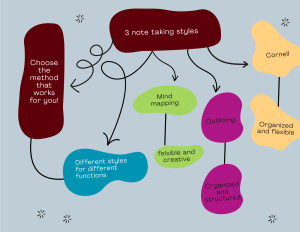
Whether typing or handwriting your notes, you are forced to make connections with what you know and new information presented. Organizing the information by headings, bullets, and diagrams also helps simplify these complex ideas into digestible content. There are multiple proven note taking methods, but the best method for you is the one that you can stick with.
Cornell Method
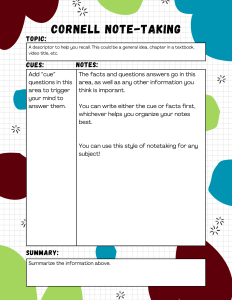
This method was devised by Walter Paulk an education professor at Cornell University. With this method, you creat a space to write down facts (Notes), write down questions (Cue), and summarize the information on the page (Summary). You can use the Cornell Method for any subject and for any type of class or presentation: in-person, virtual, video, PowerPoints, etc.
Example:
Learn more from the experts at Cornell
Outlining
Outlining is an easy and simple method for notetaking. Goodnotes breaks down the process into four easy steps:
- Write down the main point to the left of the page
- Indent to the right, and note any supporting ideas below it
- Whenever you need to elaborate on a point, indent to the right and start adding new points below
- Repeat
This method of note taking allows you to easily identify a hierarchy of ideas and how each point relates to each other. Outlining may not be best suited for diagrams, visuals, or charts, due to the overall structure of this note-taking style. This style is particularly beneficial for online/typed notes where information can quickly be added and adjusted for ease of organization.
Example

Mind Mapping
Mind mapping is another popular technique for notetaking. It can be particularly helpful within the review phase of studying, or as a summarization tool. A mind map is a visual representation of information and ideas, organized around a central topic, and branches and sub-branches help to capture relationships. Goodnotes offers 4 separate mind mapping methods: library maps, brace maps, flow charts, and brainstorming.
- Library maps are best used for organizing everything you need to know about a topic.
- Brace maps are usefully in breaking down big ideas into small parts- going from big ideas to topic specifics.
- Flow charts are helpful when you need to illustrate a process.
- Brainstorming is ideal when ideas are free-flowing. This may not be ideal for structures note taking during a lecture, but can be helpful when you’re generating ideas for creative projects or problem solving.
Summary
This is not a comprehensive list of note taking styles or methods, and more than likely, you’ll end up using a blend of these methods. Personally, I use the outlining method and add in visuals and diagrams as necessary, with labels to help me connect the point to the visual. The Center for Academic Success and Transition has additional academic resources for students on active reading strategies, additional note taking strategies, study tips, and more! Stay tuned for Part II – How to Actually Study.
Discover more from Adult Student Services Blog
Subscribe to get the latest posts sent to your email.