
Missouri State University

Skip to content Skip to navigation
a b c d e f g h i j k l m n o p q r s t u v w x y z

Adult Student Services Blog

  • Adult Student Services

Mid-Semester Check-In

March 5, 2026 by Hannah M. Smith

The semester is flying by and we are so eager to see campus bloom in the coming weeks. And if you can believe it, we are already at mid-semester and first block final exams (March 6th)!

Study Tips

  • Make time to study. As simple as it sounds, designating time specifically for study and review can make a huge impact in helping you feel prepared and easing pre-test anxieties.
  • Anotate your notes. Take notes and review them carefully. When you’re reviewing, write overarching ideas, important details, and definitions in your own words to help you retain the information. Don’t be afraid to revisit your source materials and textbooks.
  • Take advantage of your instructor’s office hours. Your instructors want to see you succeed. If you feel like you’re falling behind or need extra guidance on a topic covered in class, reach out and meet during their office hours.
  • Rest and refuel! Getting enough sleep and having proper nutrition will help you immensely.

Quick Tip

On campus and need a spot to relax or study? Check out the Commuter Corner on the second floor of the Plaster Student Union (PSU) next to Bear Necessities. The Commuter Corner is equipped with study pods, a microwave, a printer, and multi-seat tables. There’s comfortable seating throughout PSU with a variety of vendors for quick bites and drinks, making it a great spot to tuck into for a quick study session over lunch or between classes.

COMMUTER_CORNER 3

Commuter Corner, PSU. Image by Madison Reece, 2024.

Take a break

Shortly after exams, students will have spring break. March 14th-22nd, there are no classes and you are encouraged to celebrate your hard work and take a deep breath. For our students in the Ozarks region, there are so many events and activities happening this time of year. Visit Springfield has put together some great guides on spring activities: check them out! For our non-Ozarks students, check out your local activities boards and make time to enjoy your break from studies!

Note that offices remain open during spring break – we’re here if you need anything!


Do you need support?

We understand that the first weeks of the semester are full of transition; you have a new schedule and you’re learning all new information. Hopefully, as you settle into your routine you’re feeling more comfortable and confident on campus and in your online classes. Or, maybe you’re enrolled in second block classes and a brand new round of courses awaits you. Regardless of where your schedule takes you, Missouri State is here to help support you.

  • Adult Student Services: let us give you tips on time management, studying skills, and connect you with additional resources on campus
  • Bear CLAW includes subject area tutoring, peer mentors and coaches, and the Writing Center and Presentation Center
  • Counseling Center: be sure to take care of your mental health.
  • Support your physical health by visiting Magers Health and Wellness and the Foster Recreation Center
  • Career Center: whether you’re looking to begin preparing for graduate school, an internship, or enter the professional world, the Career Center can help you get started.
  • And so much more!


Stay Informed on Campus Happenings

  • Academic Calendar
  • MO State Calendar of Events


You got this, Bears!

Filed Under: resource, tips

2026-2027 Alpha Sigma Lambda Scholarship

February 17, 2026 by Hannah M. Smith

We are happy to share information about a scholarship opportunity for undergraduate adult students attending Missouri State University offered by Alpha Sigma Lambda. Alpha Sigma Lambda is a nationally recognized honor society for adult learners. The Alpha Sigma Lambda Scholarship award will be made to adult students in continuing higher education based on scholarship, leadership, the clarity and content of their personal statement, strength of recommendation and need. 

Funds will be disbursed to the student and made payable to the student and the university/college. Maximum award per individual will be determined each year. 

For the 2026-2027 Academic year, Alpha Sigma Lambda will award: 

  • Six (6) named scholarships of $3000
  • Fourteen (14) scholarships of $2500
  • Four (4) scholarships of $2000

Qualification Criteria 

Adult students who are attending an institution that currently has an active Alpha Sigma Lambda chapter and who have achieved the following criteria:

  • Student does not have to be a member of the local Alpha Sigma Lambda chapter to apply

Undergraduate Criteria

  • Enrollment: Enrolled in an associate or baccalaureate degree program.
  • Residency Requirement for baccalaureate degree students: Completed 24 semester hours (36 quarter hours) of graded coursework at the member institution.
    • Transfer hours, CLEP credit, assessment hours, and current coursework do not count.
  • Academic Performance: Minimum GPA of at least 3.5 on a 4.0 scale

Students must submit their applications to the institutional chapter counselor, as only chapter counselors are authorized to send application packets after validating application materials.  Missouri State’s chapter counselor is Tara Bresee in Adult Student Services. 

Documents and Instructions for 2026-2027 Scholarship Applications 

Please read through the instructions on the application packet carefully and fully.

  • 2026-2027 Application Packet
    • Faculty recommendation form provided in application packet
  • Tips for Faculty Recommendations

Submit completed application packet to AdultStudentServices@MissouriState.edu. Faculty recommendation forms should be submitted to AdultStudentServices@MissouriState.edu, as well. All application materials must be received no later than 5:00pm (central standard time) on Friday, April 10, 2026. Applications received after this time will not be submitted to the ASL Central Office for review. 

Adult Student Services will review applications and the top 2 submissions will be sent to the Central Office for final consideration. Scholarship review guidelines are available within the application packet.


Good luck, Bears!


If you’re interested in joining Alpha Sigma Lambda at Missouri State University, please visit our website for more information. 

Filed Under: resource

A Time for Thanks, A Time for Advising

November 21, 2025 by Hannah M. Smith

Happy Thanksgiving

Before you sign off for Thanksgiving break, give your future self something to be thankful for: get prepared for the spring 2026 semester! Find a registration checklist and extra tips and resources to help you start the spring semester on a high note below.

Thanksgiving break: November 22, 2025-November 30, 2025. No classes, offices closed November 26-28, 2025. (See academic calendar)

Your Registration Checklist

1. Meet with your academic advisor

    • Find your advisor’s name and contact information in My Missouri State > My Student Records > Advising Notes
    • With your advisor, you can discuss your degree requirements, course options, and resources for support if you need extra assistance in the upcoming term.
    • If you do not have an assigned advisor, contact the appropriate advising center or connect with your department directly.
    • Check out our tips for making the most of your advising appointments

2. Remove registration holds

      • You won’t be able to register if you have any holds on your account, so it’s important to get those cleared up as soon as possible.
      • Clicking on the hold often provides more information or a way to resolve the hold, but a breakdown of hold codes can also be found online.
      • To find holds: Log in to My Missouri State > Registration > Registration Status Eligibility

3. Check your registration time

    • Your registration time is the earliest you’re able to register and is based on earned credit hours. You can register any time after your assigned time. It’s recommended to register as soon as possible to increase the likelihood of getting a seat in your preferred section(s).
    • This information is located on your Registration Status Eligibility page.

4. Register for classes

    • Review your Degree Audit to confirm the courses fit your program and requirements.
    • Use Trial Schedule Builder or the Class Schedule Search to review possible schedules. It’s a good idea to consider back up courses or alternative sections if you’re first option is full.

5. Check on your financial aid

    • Check the renewal criteria for any currently awarded scholarships
    • Free Application for Federal Student Aid (FAFSA). Use federal school code 002503.
      • You can still make edits to your 2025-2026 FAFSA if necessary.
    • If you have questions regarding your aid package or need assistance completing the FAFSA, consider scheduling a meeting directly with the Office of Financial Aid.


Be Thankful You Thought Ahead!

If you are planning on taking classes in fall 2026 and spring 2027, set yourself up for success. The 2026-2027 FAFSA is open and applications are being accepted now. Complete by December 1, 2025 for priority consideration and to maximize your eligibility for grants and scholarships.

Furthermore, the MSU Annual Scholarship is also open! The deadline to submit is March 1, 2026; awards are dispersed in Fall 2026. This one application will apply you toward nearly 1,000 different scholarships. Please note that you must be admitted to MSU in order to access and complete this scholarship application.

  1. Log into your My Missouri State account.
  2. Locate your “Financial Aid & Scholarships” card.
  3. Complete your Financial Aid e-Agree (if you have not already done so).
  4. Select the MSU Foundation Scholarships link to complete and submit your application.


Additional Resources

  • Registration Resources: find guides on using the Trail Schedule Builder and adding/dropping classes
  • Academic Calendar: see important dates for spring 2026
    • Winter break: December 22-January 2 (no classes, offices closed)
    • Spring 2026 full semester and first block classes begin January 12, 2026
  • Student Support: there are many offices at Missouri State available to help you be successful. Take advantage of them!


Thankful to be a Bear!

Filed Under: resource, tips

A Study Guide for Studying: Part II, Review and Test Preparation

October 28, 2025 by Hannah M. Smith

Step 2 of learning how to study is actually studying (go back and read Part I: Note-Taking, if you missed it!). Studying is both simpler and more complex than one might think. Studying can be broken down into two smaller sections: preparation and time management.  

Preparation

In my opinion, the preparation takes the most time, because it requires planning (sometimes before you know what you’re planning for!). By reading your syllabus and keeping an up-to-date calendar of important due dates, you’re less likely to be surprised by any quizzes or exams. If you haven’t checked your syllabus or Brightspace lately for upcoming assignments, it’s not too late! Check down and begin preparing for future success.

If you’ve been keeping up with your notes (like we discussed in Part I), then you’ve been preparing! Taking notes help you actively engage with the material and promote retention. Next, do your assignments – doing is preparing.

Every assigned reading, discussion board, and homework assignment is designed to get you to study and retain information. By doing the work, your brain is making connections. 

Read your notes, revisit your graded assignments and make note of what you did well on and what areas could see improvement. Be brutally honest! If you find that you mix up dates in history, or swap integers in calculus, it’s important to recognize so you don’t continue to make the same mistakes.

Time Management

The second step, time management, would come after the test has been announced (or sooner if you’ve been keeping track on your syllabus!). A great way to manage your time to create a study plan. A study plan will help you stay focused and review the information you need to do. Questions to ask while you make your study plan: 

  • When is my test? 
  • What does it cover? (Specific chapters, topics/themes, etc.)
  • Was I comfortable with the assignments and readings that I completed in this module?  
  • What areas did I struggle most with?  

By asking these questions, you will be able to have a clear understanding of what you need to do.  

Making a Study Schedule  

While everyone’s study schedule will be different based on subject matter, familiarity level, timeline, etc., the following week-long sample plan serves as a solid foundation.

  • Day 1: Make an outline of what you already know. And revisit the textbook to add in additional details that you may have overlooked or forgotten. Also, leave a section for questions – write down any questions as they come (don’t answer them yet!).  
  • Day 2: Make flashcards for the unit, focusing on the areas that you struggled with, and quiz yourself regularly. 
  • Day 3: Take a brain break! Let your mind sit with information – allow the questions to arise (and write them down). This is a time where deficiencies can be defined clearly. 
  • Day 4: If you’re taking more than one class, begin mixing in flashcards from other classes to help your brain recall information when it’s not necessarily primed to do so. (This is a great tip from Cornell University!)
  • Day 5: Make a new outline of what you know. You’ve added more details and information in your mind, so it is a good idea review once more. 
  • Day 6: Test Eve! Find answers for all the questions you wrote down throughout the week and have not yet been able to answer during review.  
  • Day 7: Feel prepared on test day! 


Bonus Tips 

  • Get rest. It’s easy to fall into the thought pattern that you need to study as much as possible, even if it means giving up rest. This is a trap! Your mind and body need to rest in order to perform their best.
  • Proper nutrition*  Proper nutrition supports optimal brain function, so be sure you eat well during study sessions and on test day!
    • *If you’re facing food insecurity: visit the Bear Pantry or search Food Finder to find a local food pantry near you. 
  • Take advantage of MO State Resources!


Sources and Support
  • TedEd, 3 Tips on How to Study Effectively
  • Cornell Univerity, Effective Study Strategies
  • William Rapaport, How to Study (State University of New York at Buffalo)

Filed Under: resource, tips

A Study Guide for Studying: Part I, Note-Taking

October 7, 2025 by Hannah M. Smith

Knowing how to take notes and how to study can be a key to success for students everywhere. By building strong habits and diligent practice, your memory will improve and your grasp on the information will strengthen. It’s more than rote memorization, it’s finding ways to deeply understand the information given and build your knowledge base.

Note Taking

Whether you enjoy taking notes or not, it is proven to be a valuable tool in learning and understanding. Simply writing down everything your instructor says word-for-word is unlikely to be helpful. Plus, can you really write as fast as someone speaks? Taking notes forces active engagement with the material. Because you cannot write as quickly as someone speakers, you are forced to condense and paraphrase the message in your own words (this strengthens comprehension!).

Typing and writing are both great ways to take notes, but by writing the information, new neural pathways are created which improves your memory. A study done in 2011 showed that, “Statistically, most studies on the relationship between handwriting and memory (including those conducted in Japan, Norway, and the United States) have shown that people remember information better when it is handwritten compared with when it is typed.” (Handwriting vs Typing, Longchamp) Typing is still an effective learning tool, but has spurs different brain activity.

Whether typing or handwriting your notes, you are forced to make connections with what you know and new information presented. Organizing the information by headings, bullets, and diagrams also helps simplify these complex ideas into digestible content. There are multiple proven note taking methods, but the best method for you is the one that you can stick with.

Cornell Method

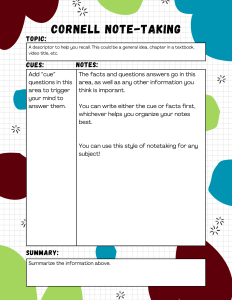
This method was devised by Walter Paulk an education professor at Cornell University. With this method, you creat a space to write down facts (Notes), write down questions (Cue), and summarize the information on the page (Summary). You can use the Cornell Method for any subject and for any type of class or presentation: in-person, virtual, video, PowerPoints, etc.

Example:

example image of Cornell note set up

Learn more from the experts at Cornell

Outlining

Outlining is an easy and simple method for notetaking. Goodnotes breaks down the process into four easy steps:

  1. Write down the main point to the left of the page
  2. Indent to the right, and note any supporting ideas below it
  3. Whenever you need to elaborate on a point, indent to the right and start adding new points below
  4. Repeat

This method of note taking allows you to easily identify a hierarchy of ideas and how each point relates to each other. Outlining may not be best suited for diagrams, visuals, or charts, due to the overall structure of this note-taking style. This style is particularly beneficial for online/typed notes where information can quickly be added and adjusted for ease of organization.

Example

Example of outline structure with advantages and disadvantages

Mind Mapping

Mind mapping is another popular technique for notetaking. It can be particularly helpful within the review phase of studying, or as a summarization tool. A mind map is a visual representation of information and ideas, organized around a central topic, and branches and sub-branches help to capture relationships. Goodnotes offers 4 separate mind mapping methods: library maps, brace maps, flow charts, and brainstorming.

  1. Library maps are best used for organizing everything you need to know about a topic.
  2. Brace maps are usefully in breaking down big ideas into small parts- going from big ideas to topic specifics.
  3. Flow charts are helpful when you need to illustrate a process.
  4. Brainstorming is ideal when ideas are free-flowing. This may not be ideal for structures note taking during a lecture, but can be helpful when you’re generating ideas for creative projects or problem solving.

See examples for Mind Mapping


Summary

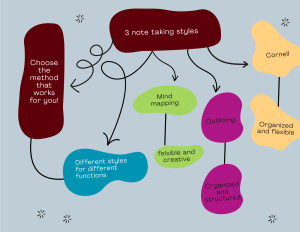
This is not a comprehensive list of note taking styles or methods, and more than likely, you’ll end up using a blend of these methods. Personally, I use the outlining method and add in visuals and diagrams as necessary, with labels to help me connect the point to the visual. The Center for Academic Success and Transition has additional academic resources for students on active reading strategies, additional note taking strategies, study tips, and more! Stay tuned for Part II – How to Actually Study.

Mind map showing the three note methods, concluding that individuals should choose what works for them.

Filed Under: resource, tips

Welcome Back, Bears!

August 11, 2025 by Hannah M. Smith

Students gathered on lawn for Welcome Weekend event.

Sharpen your pencils and charge your laptop, it’s time to kick off a new semester of learning and growth, and we are so happy that you have joined us!

We understand the unique needs of adult learners and this monthly newsletter full of resources, tips, and important dates is just one way Adult Student Services can support you in achieving your academic goals.

In this month’s newsletter you will find important dates regarding the beginning of the semester, change of schedule, and refund/drop deadlines; an introduction to campus and learning resources; and tips for overcoming challenges and setting yourself up for a successful semester.

Important Dates

  • August 18 – First day of full semester and first block classes
  • August 18-22- Change of schedule period
  • August 22- Last day to drop for 100% refund * Be sure to check your Personalized Refund and Drop Deadlines from your portal August 29- Return to Learn Scholarship application deadline
  • September 1- Labor Day (no classes)
  • September 10- My Payment Plan installment due

Back-to-School Checklist

  • Activate Missouri State account
  • Meet with your advisor
  • Register for classes
  • Purchase textbooks and supplies
  • Take care of any financial aid requirements (entrance counseling, setting up direct deposit)
  • Familiarize yourself with My Missouri State Portal, Brightspace, and resources
  • Commuting? Get a parking permit
  • Get your BearPass
  • Check in with your support system
  • Design a schedule with built in flexibility and downtime
  • Keep an open mind

Student Resources

There are many resources available for Missouri State students, whether attending classes on campus or online.

Adult Student Services is your resource for resources! We understand that being a student is just one aspect of your life, and we are here to help you find a way to manage it all.

The Veteran Student Center serves veteran and military students and their dependents.

Bear CLAW Center for Learning and Writing offers tutoring, peer mentors and coaches, the Writing Center and Presentation Center.

The Disability Resource Center provides support, accommodations, and resources to help individuals with disabilities.

MSU Libraries offer access to all types of media, research assistance, and more.

The Computer Services Help Desk offers online and in-person support for account access, computer troubleshooting, and many how-to guides for processes such as registering for classes and using Brightspace.

The Career Center offers guidance about where different degrees can lead you, career fairs, mock interviews, and much more.

Student Wellness, Student Engagement, and the Foster Recreation Center create opportunities to connect, learn, engage, and take care of yourself through programs like the Fall Walking Challenge, online counseling, and student organizations.

This is nowhere close to a complete list of all the resources available to you as a student at Missouri State University, if you can’t find what you are looking for, please ask!

Tips for a successful semester:

1) Get organized- Whether you want to call it a plan, a schedule, a routine, or something else, time management is a big part of your life. You know what all you are responsible for, knowing how you are going to put the puzzle pieces together ahead of time will help you fulfill your responsibilities.

2) Plan on studying- The time commitment outside of class varies from course to course, but in general, doing well in your classes will require some study time. Maybe you will study in the evening after the kids are asleep or get up early to study before you go to work. Maybe you need to leave the house entirely to be able to focus and study at a library or coffee shop. Find what works best for you and protect it.

3) Communicate- Strong communication skills are important for every person in every aspect of life. Talking with your support network, instructors, and advisors can make a huge difference in your life as a student. Ask questions, ask for help, share your ideas and experiences.

4) Set realistic goals- An important factor in your success is being realistic about how much you can add to your already busy schedule. As tempting as it may be to dive in head-first, you are a full-time adult and easing back into school as a part-time student may benefit you in the long run. This allows you to acclimate to the changes in your schedule, routine, and get used to schoolwork again.

5) Keep an open mind- If it has been a while since you were in a classroom, school may be different than you remember. Technology has changed, the demographics of students have changed, academic expectations have changed, and most of all, you have changed. Whether you were previously a “good” student or a “bad” student does not define the type of student you will be now. You are not just here because you are “supposed” to be. You are actively choosing to be here, and that is powerful.


Here to Help!

Whether it is your first time attending college or you are picking up where you left off, we are excited to help and support you as you work towards your goals. Check out the Adult Student Services Blog and the Adult Student Services Community on Brightspace for more detailed information about resources and tips for success. As always, your Adult Student Services team is here to assist you in any way we can, so do not hesitate to reach out. Our booking links are always available online so you can schedule an appointment whenever you need us.

Filed Under: resource, tips Tagged With: adult student services

Campus Resource Spotlight: Meyer Library

July 2, 2025 by Hannah M. Smith

Everyone knows that a library is full of information, but did you know that Missouri State’s Meyer Library is also full of unique and exciting resources?

At Meyer Library, you will find books for leisure reading and research. You may access online databases and peruse special collections and University archives. As a student, you’ll have access to research and collection tools. The Library is also the perfect study location; with quiet and social zones, you’re certain to find an area that meets your needs. (Did we mention that you can reserve a private study room?)

There are a variety of equipment available for check out, as well: Apple pencils, portable audio recorders, Blu-ray players, cameras, laptops and more! Explore equipment lending.

One of my favorite “hidden gems” of the Library is the audio studio. The audio studio is located on the north side of the lower level. The exterior is upholstered in grey fabric and features a large window and white door. It’s a sound isolation room equipped with hardware and software to help you record yourself for a speech class, video audition, or even a quiet place to conduct a video interview with a potential employer. Reservations of the studio are highly recommended – make your reservation.

If you need to take a proctored exam, you’ll also find yourself helped by the Testing Center located in the lower-level of the Library. The Library offers many exams, such as the Accuplacer, ACT and SAT, HiSET, LSAT, Parapro, and many more.

Explore the Meyer Library Services


Conveniently Located Resources

There are also additional services and units located within the Library building! This makes it easy to get the support you need in a convenient location.

  • Access and Success Programs
  • BearCLAW
  • Center for Academic Success and Transition & Associate Vice President for Student Success
  • Computer Services
  • Disability Resource Center
  • Honors College
  • Oldham Family Veteran Center
  • TRIO Programs
  • and others!

Not a current student?

Not a problem! Active Community, Reciprocal Borrowers, and members of the MSU Alumni Association can use certain library facilities and materials. Check out general collection books maps, government documents, and educator resources (juvenile books and curriculum guides). Within the Library you can use bound and unbound periodicals, educator resources (textbooks and curriculum kits), DVDs/videotapes/audiovisual materials, microforms, general reserve materials, reference books, and computers are available upon specific request for online research. Become a community borrower today!

Filed Under: resource

Categories

  • adult student services
  • Bears Can-Do Food Drive
  • resource
  • tips
  • Uncategorized

Archives

Meta

  • Log in
  • Entries feed
  • Comments feed
  • WordPress.org
  • Accessibility
  • Disclaimer
  • Disclosures
  • Equal Opportunity Employer and Institution
  • © 2026 Board of Governors, Missouri State University
  • Contact Information