
While African masks and large-scale sculptures are highly celebrated, the small figures produced by African cultures are much less well-known. These sculptures generally take human form, but they are made of diverse media, including carved wood, assemblages of resin, cloth, and found materials, and even soft sculptures of sewn, stuffed cloth. They range from relatively naturalistic to stylized or abstracted, and they also vary greatly in purpose: Some figures are meant to function as fertility charms, while others are made as offerings to deities; still others are given to girls as educational toys, and some are made primarily for the tourist trade.

Asante culture, Ghana
20th century
Wood and pigment
L. 13.5 cm x W. 5.5 cm x H. 33 cm
BFPC collection #2010.30
The akua’ba figure (plural akua’ma) is likely the most famous and recognizable of African small figures. Akua’ma serve as charms to reverse infertility, which is socially unacceptable in this matrilineal society. A woman who wants to become pregnant has an akua’ba figure made, and she then carries the figure with her and pretends to feed and care for it to prove that she would be a good parent. After a successful pregnancy, the akua’ba may be placed in gratitude on a shrine as an offering, or the akua’ba may be given to the daughter so that she may learn child care.
Akua’ma are carved from a single piece of wood and are highly standardized and identifiable, with features that represent, in very abstracted form, the ideals of beauty to the Asante: a round or oval head; a high forehead, emphasized by compressing the facial features into the lower half of the head; downcast eyes, a straight nose, and a small mouth; a ringed neck; and youthful, cone-shaped breasts. The features that are not considered important to beauty are simplified and de-emphasized–the bodies are columnar, the arms are simple cone shapes that are held out to the sides, and legs are left out entirely. The scarification across the forehead and on the torso of this figure are added embellishments that suggest this figure was made for the tourist trade, but the figure is predominantly traditional.

Asante culture, Ghana
20th century
Wood and pigment
Male: L. 5 cm x W. 2 cm x H. 12 cm
Female: L. 4 cm x W. 2 cm x H. 13 cm
BFPC collection # 2012.12a (male)
BFPC collection # 2012.12b (female)
These small figures are marketed as Asante fertility figures, but comparison with the traditional Asante fertility figure—the akua’ba—reveals that they are clearly variations that have been developed for the tourist trade. Like the Akua’ba with Facial and Body Scarification in this exhibit, these figurines are carved from blackened wood and have oval heads, high foreheads, small mouths, and cone-shaped arms, and the female figurine has pointed breasts. They vary greatly from traditional figures, however, in being much smaller and in one being male, as well as in having curved eyes, rounded noses, torsos that flare out, skirt-like garments adorned with carved squares, and legs. The figures also lack neck rings, an important ideal of beauty in Asante culture.

Asante culture, Ghana
20th century
Cotton cloth, polyester, plastic, cotton and thread
L. 25 cm x W. 8 cm x H. 35
BFPC collection #2010.25
This 21st-century figure was developed for the tourist-trade, but offers an accurate representation of traditional Asante cloth as well as traditional Asante dress. The body of the figure is constructed of factory-made polyester knit material, while the figure is adorned with a blue bandana and scarf as well as a traditional dress that is printed to represent Asante adinkra cloth.
Adinkra cloth is a traditional, woven cloth that is stamped with meaningful designs, most of which refer to Asante proverbs. Originally adinkra was produced in black, red, and brown, and this type of cloth is worn as mourning dress. Adinkra with brightly colored designs, sometimes referred to as “Sunday adinkra” or fancy cloth, subsequently developed as a form of celebration dress. As this figure’s costume incorporates not only black and red, but also blue and white, it represents this later form of adinkra, indicating that this figure is dressed for a special occasion. This figure is thus a tourist-trade souvenir, but it also serves as an accurate and educational representation of Asante textile art.

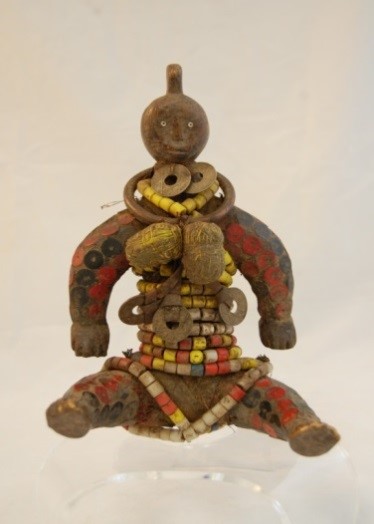
Namji or Namchi culture, Cameroon
20th century
Wood, burlap, plastic, brass, steel, leather, cotton, resin, and pigment
L. 13 cm x W. 10 cm x H. 23 cm
Mace collection #TA062
This seated figure is a very traditional example of an Ndungu, a multi-media figure made by artisans of the Namji culture, also known as the Namchi. This Ndungu is a wooden figure embellished with leather, cloth, beads, and plastic disks, and then adorned with strings of beads, amulets, and charms; libations, or liquid offerings, may also be poured on the figure. These figures are given to young Namji girls to promote good childcare and fertility, and they are also used by women who are having a difficult time conceiving. The figure serves as a surrogate baby that is named, coddled, fed, and talked to, just as a real infant, in hopes that this will prove that the girl or woman will be a good mother.
For more information, you may contact the researcher(s) noted in the title of this exhibit entry, or Dr. Billie Follensbee, the professor of the course, at BillieFollensbee@MissouriState.edu