
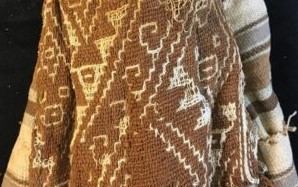
The story behind the figures in this display unfortunately starts with the looting of ancient tombs, as looters have ravaged the ancient graves of the Chancay culture (1000-1460 CE). In their haste, the looters often ripped apart the delicate textiles that they were attempting to steal. In the 20th century, Peruvian Mestizo (mixed Spanish and indigenous ancestry) artisans began to collect these scraps and to fashion them into these stylized figures, called “Chancay dolls,” to sell in the tourist trade. While the figures themselves are actually 20th-century creations, therefore, they are made from scraps of actual textiles produced by Chancay textile artists. Since the original context has been lost, and since the cloth is found only in small, tattered pieces, these textiles have been rendered virtually worthless both to archaeologists and to collectors; the surviving fragments are, however, of interest to art historians and other scholars of textile construction and design. These Chancay textiles are the focus of this display.
As in other Andean cultures, weaving was a gendered craft, and the master textile artisans of the Ancient Chancay were women. These female artisans produced their fine textiles on the traditional Andean backstrap loom, a simple but highly versatile device. They created a wide variety of textiles using techniques that ranged from a simple plain weave with painted designs, to complex tapestry weave designs, to delicate, twisted and woven laces, and even to the notoriously complex double-weave–an extremely difficult technique that requires the weaver to create and interconnect two layers of patterned cloth while only being able to see the top portion.
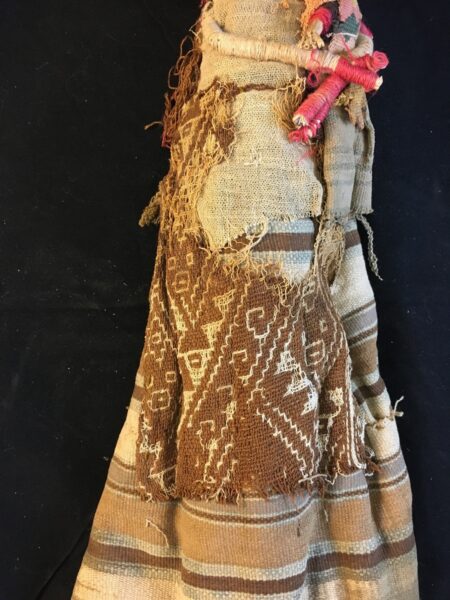
Chancay culture
Late Intermediate period (1000-1460 CE)
Cotton fiber and pigments, L. 12 cm x W. 1 mm x H. 15 cm
BFPC collection #2011.16a
The relatively simple-looking, linear pattern of stylized cat heads, spirals, and triangles on this textile is actually a fine demonstration of the supplementary weft technique, which requires the weaver to manipulate extra weft threads, interweaving designs into the basic weave of the textile without interrupting the structure of the textile as a whole. This simplified cat motif was popular among Chancay textiles, as were repeating geometric patterns. Researched by Lindsay Werner
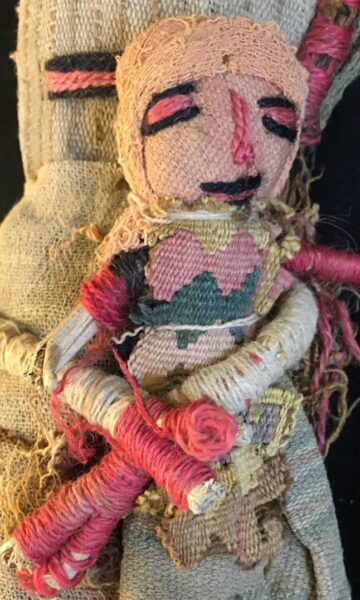
Chancay culture
Late Intermediate period (1000-1460 CE)
Cotton fiber and pigments, L. 4.1 cm x W. 1 mm x H. 8.2 cm
BFPC collection #2011.16b
The scrap of cloth used for the baby figure’s tunic is a heavy, diamond-patterned tapestry textile. While geometric patterns are common in Chancay textiles, tapestry weave was used to create luxuriously thick, finely made cloth. These block-color shapes are also somewhat unusual in their bright, bold, solid designs. Researched by Lindsay Werner
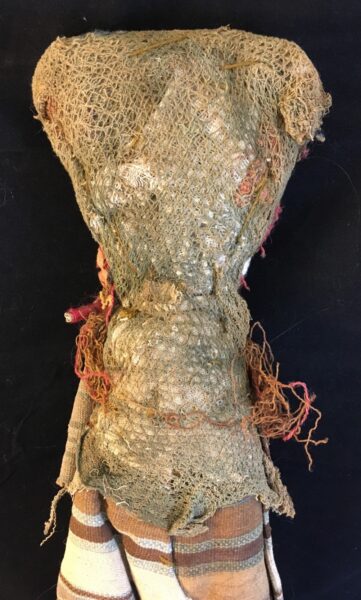
Chancay culture
Late Intermediate period (1000-1460 CE)
Cotton fiber and pigments, L. 12.3 cm x W. 1 mm x H. 23.9 cm
BFPC collection #2011.16c
The Chancay created their delicate lace or gauze textiles by warping their looms with a variety of yarns. They then twisted and crossed the warp yarns in specific patterns, and they used the weft threads to anchor the twists into place. Researched by Lindsay Werner
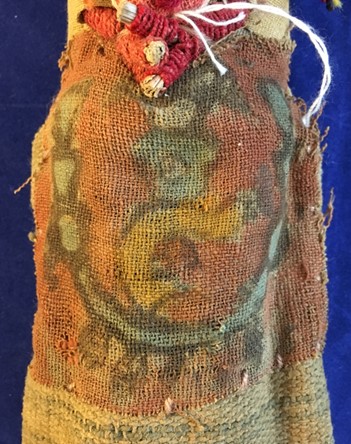
Chancay culture
Late Intermediate period (1000-1460 CE)
Cotton fiber and pigments, L. 10 cm x W. 1 mm x H. 10.3 cm
BFPC collection #2011.15
The plain-weave fragment of cloth used for this apron has been embellished with a painted design of an anthropomorphic figure in a boat. The figure is elaborately clothed in a gold-colored top and a gold-colored headdress that is shaped like a tumi knife, a crescent-shaped ceremonial blade used for ritual sacrifices. While this costume suggests high status, the face of the figure is blue, possibly suggesting that this figure represents a deceased individual. Researched by Lindsay Werner
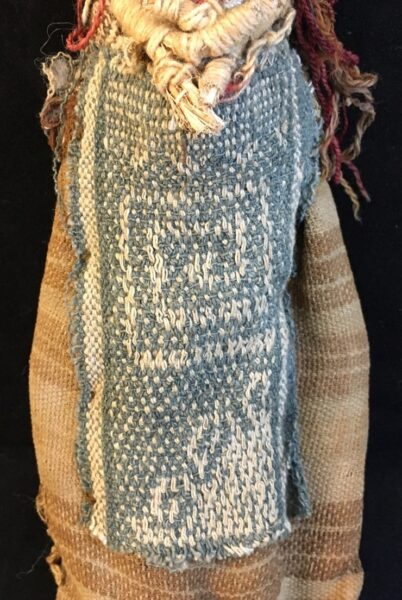
Chancay culture
Late Intermediate period (1000-1460 CE)
Cotton fiber and pigments, L. 6 cm x W. 1 mm x H. 12 cm
BFPC collection #2011.18
The piece of cloth used for this figure’s apron was created using the extremely difficult weaving technique known as a double-weave, and the clear, regular designs on this textile are a testament to the weaver’s skill. The designs depicted are well-known and meaningful in Andean cultures, including the rounded spiral shapes of crashing waves, the squared spiral design that indicates a cloud, and above these, the wide design with pointed, triangular rays pointing downward that indicate the sun. Researched by Lindsay Werner
For more information, you may contact the researcher(s) noted in the title of this exhibit entry, or Dr. Billie Follensbee, the professor of the course, at BillieFollensbee@MissouriState.edu