The hum of hundreds of bat scientists in one place is hard to describe.
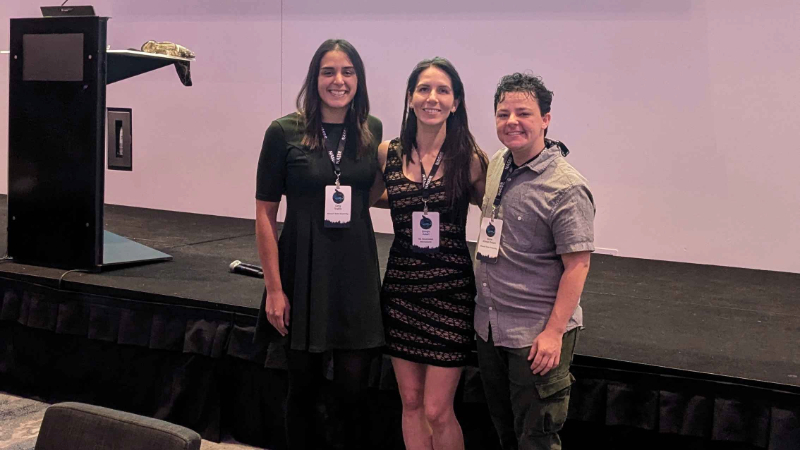
For Dr. Giorgia Auteri, a biology adjunct faculty member at Missouri State University and senior research scientist at Bat Conservation International, the 53rd North American Symposium for Bat Research (NASBR), was a reminder of why scientific community matters. The event took place Oct. 8-11, 2025, in Edmonton, Canada.
“Scientific conferences are always exciting and motivating,” Auteri said. “You’re surrounded by researchers who are passionate about the same things.”
From feeding ecology to genetics, the symposium offered a fast-moving snapshot of where bat research is headed and why it matters.
Students win awards
Two Missouri State biology graduate students earned major awards, underscoring the strength of research happening in the biology department.
- Marxe Altman-Orbach received the Bat Conservation International award for research on genetic diversity in endangered gray bats.
- Carly Trujillo earned support from the Southeastern Bat Diversity Network for work on disease-driven adaptation in little brown bats.
According to Trujillo, the biggest challenge of her project was finding little brown bats across such a wide range of species.
“With the help of many amazing biologists, we were able to collect samples from populations across North America,” she said. “This project is definitely a team effort.”
For students early in their careers, this kind of recognition can be transformative. It validates their work and strengthens their resumes.
“Getting awards at conferences can be extremely encouraging for students,” Auteri said. “It’s external recognition of their work and helps support conference travel.”
A real-world impact
Altman-Orbach’s research showed that gray bats remain genetically healthy despite past population declines. This is an important sign that early conservation actions by the U.S. Fish and Wildlife Service has made a lasting difference.
Trujillo’s research focused on how little brown bats are evolving in response to white-nose syndrome, a deadly fungal disease. By identifying which populations are adapting best, her work helps guide future conservation decisions.
“Seeing students do cutting-edge research is always the most exciting part of the conference,” Auteri said. “They’re thinking creatively about conservation.”
Beyond the classroom
Outside of the lab, conferences help students see what is possible. They can meet future collaborators, mentors and employers. In addition, they learn how to communicate ideas clearly and confidently.
“I was grateful for the opportunity to share my research and preliminary findings,” Trujillo said. “Hearing other talks also helped shape how I think about my own project and showed me new ways to involve both scientists and the public in conservation.”
Support from Missouri State and the biology department plays a critical role, making these professional experiences accessible to students doing high-impact research.
Discover more from CNAS NewsWatch
Subscribe to get the latest posts sent to your email.