
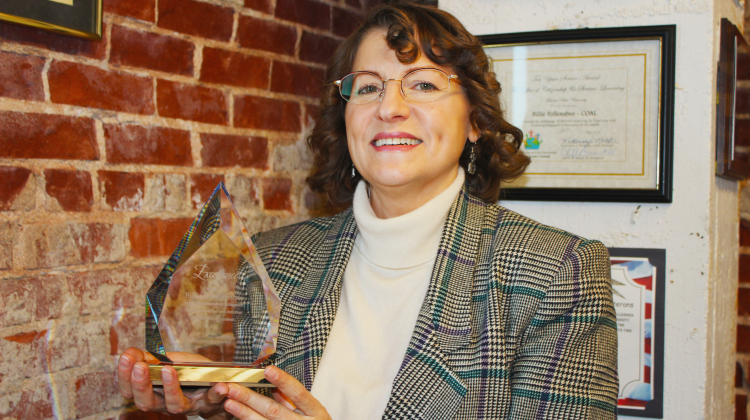
In May, at Missouri State University’s annual Faculty Awards ceremony, Citizenship and Service-Learning was pleased to announce Dr. Billie Follensbee as the recipient of the Faculty Excellence in Service-Learning Award. The award, represented by a beautiful, engraved glass trophy, was presented at the Faculty Awards event, honoring exemplary teachers at Missouri State University.
Dr. Follensbee is the Art and Design department’s Museum Studies Program Coordinator and a specialist in art history and archeology. She teaches courses on non-Western art (African, Oceanic, Mesoamerican cultures) to art history and anthropology students seeking careers in museums, educational institutions or community organizations. In addition to her successes as an arts and culture educator, Dr. Follensbee has skillfully integrated service-learning into her courses, giving students valuable work experience in a competitive field and a passion for connecting the arts with community.
“It makes my classes much more interesting,” said Dr. Follensbee of service-learning. “Instead of just studying things in books, I can show students actual works of art and artifacts that relate to the cultures that we’re studying.”
In Dr. Follensbee’s advanced classes, she has integrated service-learning with the study and exploration of art and artifacts that can be accessed locally. Her students receive real-world, hands-on experience in the classroom and outside in the community that directly connects to their careers. For instance, Dr. Follensbee and service-learning students from her ART/MST 488 Basic Conservation of Art and Artifacts course recently co-authored an article published in Ozarks Watch Magazine. The detailed article covers the research and restoration of gravestones at the Union Campground Cemetery in northwest Springfield.
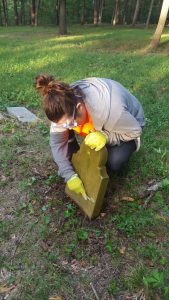
Dr. Follensbee guided the students to approach the opportunity as a career project, rather than a simple class assignment. Dr. Follensbee recalls these students as thrilled that service-learning offered them this experience – one that has had a significant impact in their graduate program and employment search. Additionally, because of her efforts and concern for the well-being of the historical site, the Union Campground Cemetery Association has since made Dr. Follensbee an honorary lifetime member.
“It’s great because bringing in real-world objects and situations can help students apply their knowledge,” said Dr. Follensbee. “Normally they’d have to take an internship or a co-op and, while that’s wonderful to do, not all students have the means to do that, or they don’t have the time in their program. Doing service-learning brings those experiences to them.”
Students are able to interact with the past and understand the purpose of the artifacts they are using. It’s often a challenge to intertwine service-learning and art at the same time, yet Dr. Follensbee has established an exemplary model for it, shining a light not only on how students are learning, but how they are making a positive change in their community. In her classes, she has made students stop and think and become aware of important their research and their involvement. “They are surprised at how they are making an impact on the community, she said. “They consistently tell me that they have developed a real appreciation for the arts.”
The office of Citizenship & Service-Learning is proud of Dr. Follensbee and the example she is setting in using service-learning as a teaching method that offers rich, career-based experiences to students of the arts here at Missouri State.
Learn more about service-learning and get involved as a student, teacher or member of the community.
 I left the small town I call home to come to Missouri State University in the Fall of 2013. While I did not realize it growing up, I quickly discovered that I had been extremely sheltered in my small, quiet town. I was never openly exposed to homelessness, hunger, or poverty. Although I know now that those issues were present where I grew up, they were always hidden from me as a child and adolescent. When I moved to Springfield, it became common to witness poverty wherever I went; I even witnessed it frequently on Missouri State’s campus.