
Missouri State University

Skip to content Skip to navigation
a b c d e f g h i j k l m n o p q r s t u v w x y z

Residence Life, Housing and Dining Services Blog

  • Residence Life, Housing and Dining Services
  • ResNet Residential Technical Support
  • My Missouri State

Residence Life Diversity Committee Consider This: August 27, 2021

August 27, 2021 by Rachel Brinley

Diversity Committee Consider This Logo

Cultural competence is a cornerstone of the Missouri State experience. It requires awareness of one’s own cultural worldview, recognition of one’s attitudes toward cultural differences, realization of different cultural practices and worldviews, and thoughtfulness in cross-cultural interaction. Missouri State University offers many ways to develop cultural competence and to engage with cultural differences and worldviews, and we value respectful interactions that help to expand our understanding of ourselves and others. We hope that you will utilize the diversity calendars coordinated by the Residence Life Diversity Committee as opportunities to learn about topics that are important to you, but also about topics that require you to step outside of your comfort zone to learn more about topics with which you are unfamiliar. Lean into new opportunities and challenge yourself to learn about others’ cultures, practices, beliefs, and customs. Respectfully engage in the community, and reflect on how your experiences expand your understanding of Public Affairs. Commit to being a person who values difference and who takes care to learn about others’ unique qualities while celebrating our similarities. Let’s make this a year of growth, compassion, and inclusion.

Learn more about Missouri State University’s commitment to cultural competence and the Public Affairs Mission at https://publicaffairs.missouristate.edu/.

Diversity Committee Logo with embedded Twitter

Tagged With: Consider This

Residence Life Diversity Committee – Celebrate Asian Pacific American Heritage Month: May 24, 2021

May 24, 2021 by Rachel Brinley

Asian Pacific American Heritage month logo

This Asian American and Pacific Islander post is to focus on AAPI excellence in the entertainment world. The AAPI community needs visibility, take the time to dive into some of these excellent artists’ work! This blog post features Books, Movies, and Music, but there is so much more to entertainment.

Love movies? Check out these 10 Movies by Asian American Directors, you can stream right now:

  • The Farewell directed by Lulu Wang
  • Meet the Patels directed by siblings Geeta V. Patel and Ravi V. Patel
  • The Joy Luck Club directed by Wayne Wang
  • Columbus directed by Kogonada
  • Lucky Grandma directed by Sasie Sealy
  • The Grace Lee Project directed by Grace Lee
  • Bitter Melon directed by H.P. Mendoza
  • Tigertail directed by Alan Yang
  • Crazy Rich Asians directed by John Chu
  • Minari directed by Lee Isaac Chung

Like to read? These books by AAPI authors will reel you in:

  • Stories of Your Life and Others by Ted Chiang
  • Naturally Tan by Tan France
  • Minor Feelings: An Asian American Reckoning by Cathy Park Hong
  • Jade City by Fonda Lee
  • Mimi Lee Gets a Clue by Jennifer J. Chow
  • Where the Rekohu Bone Sings by Tina Makereti
  • Where Dreams Descend by Janella Angeles
  • Girls of Paper and Fire by Natasha Ngan
  • Girl Gone Viral by Alisha Rai
  • The Prince and the Dressmaker by Jen Wang

If you’re a true book lover, check out these additional 30 book titles by Asian authors.

Into awesome music? Here are 9 Asian American and Pacific Islander Musicians you need to hear:

  • Low Leaf
  • Awkwafina
  • Clones of the Queen
  • Paul Kim
  • Asobi Seksu
  • Blue Scholars
  • Kishi Bashi
  • Mitski
  • King Khan

Want to hear more, check out these AAPI musicians who are dominating the alternative genre right now.

Appreciate a great Art Museum? Check out the best at the Smithsonian. Take a virtual tour of Asian American Artists and selected works.

  • Video Flag
  • Grey Sun
  • Lunar Landscape
  • Vase with Landscape and Dinosaurs
  • Okame
  • Maya Ying Lin
  • Forlorn Spot
  • Portrait of Yasuo Kuniyoshi in his studio
  • Fakirs
  • Full Moon
  • And many many more…

Have children in your life and want to find ways to celebrate AAPI culture? Check out these 24 beautiful kids’ books that reflect the Asian American experience.

  • “Laxmi’s Mooch,” by Shelly Anand and Nabi H. Ali
  • “Watercress,” by Andrea Wang and Jason Chin
  • “The Ocean Calls: A Haenyeo Mermaid Story,” by Tina Cho and Jess X. Snow
  • “Hannah’s Night,” by Komako Sakai
  • “Measuring Up,” by Lily LaMotte and Ann Xu
  • “Stargazing,” by Jen Wang
  • “The Magic Fish,” by Trung Le Nguyen
  • “The Prince and the Dressmaker,” by Jen Wang
  • “All Thirteen: The Incredible Cave Rescue of the Thai Boys’ Soccer Team,” by Christina Soontornvat
  • “It Began with a Page: How Gyo Fujikawa Drew the Way,” by Kyo Maclear and Julie Morstad
  • “Paper Son: The Inspiring Story of Tyrus Wong, Immigrant and Artist,” by Julie Leung and Chris Sasaki
  • “From a Whisper to a Rallying Cry: The Killing of Vincent Chin and the Trial that Galvanized the Asian American Movement,” by Paula Yoo
  • And many many more…

This blog post features Books, Movies, and Music, but there is so much more to entertainment.  If you want to learn more about pop culture and art, check out IU’s Asian Culture Center. Or check out how these 60 Asian American creatives are designing a better Los Angeles. Meet dozens of other podcasters, writers, photojournalists, filmmakers, and comic book creators, musicians. There are tons of ways in which to engage with AAPI entertainment to shine a spotlight on the excellence that comes from these artists.

Diversity Committee Logo with embedded Twitter

Tagged With: Consider This

Residence Life Diversity Committee – Celebrate Asian Pacific American Heritage Month: May 17, 2021

May 17, 2021 by Rachel Brinley

Asian Pacific American Heritage month logo

How We’ve Gotten Here

As we celebrate Asian Pacific Islander Heritage Month, it’s important to look at how our society has gotten to where it’s at today. 

The Chinese Exclusion Act was signed into law on May 6, 1882, and it suspended immigration of Chinese skilled and unskilled laborers for ten years and prevented Chinese immigrants from becoming United States citizens. The California Gold Rush and the building of railroads in the American west drew thousands of Chinese workers to the United States and many American citizens blamed those immigrants for low wages and lack of jobs. The Geary Act of 1892 extended the ban on Chinese immigration an additional ten years and required the immigrants to carry “certificates of residence.”  

Chinese immigrants began to argue and fight for their rights. Lee Yick, a Chinese laundry worker, won a Supreme Court Case, Yick Wo v. Hopkins, on May 10, 1886. The case said that all people, citizens and non-citizens, had equal protection under the law. After being jailed for not paying a $10 laundry permit fine, Yick and another launderer, Wo Lee, sued stating that their constitutional rights had been violated because of the unfair and biased administration of the law requiring laundry permits. The court ruled that the Equal Protection Clause of the Fourteenth Amendment was violated.  

From the 1960s and ‘70s the Asian American civil rights movement sought an end to the Vietnam War, for the development of university and college ethnic studies programs, and for monetary reparations for Japanese Americans forced to live in the World War II internment camps. The Asian American community began to recognize that they were also victims of institutional racism as were the Black American community. Proclamation 4417 was signed by President Gerald Ford in 1976. The proclamation declared internment camps a “national mistake.” The Civil Liberties Act of 1988, signed by President Ronald Reagan, apologized for the internment camps and provided $20,000 to surviving internees or their heirs. 

President Barack Obama signed legislation, H.R. 4238, replacing the words “Oriental” and “Negro” with “Asian American” and “African American” in U.S. code. Written in the late 1970s, U.S. code attempted to define minorities and this replaced those antiquated words with more culturally sensitive words. 

COVID-19 has brought unfair targets to our Asian American residents. People are taking their frustrations and lack of education about the virus out on them, and Asian Americans are feeling a new level of harassment, violence, and hate. Stop AAPI Hate by reporting hate incidents. 

Sources: 

The Chinese Exclusion Act
Office of the Historian, Department of State, United States of America
The Zinn Education Project
History of the Asian American Civil Rights Movement
“Congress sends bill eliminating ‘Oriental’ and ‘Negro’ from law to Obama”, by Cristina Marcos 

Diversity Committee Logo with embedded Twitter


Tagged With: Consider This

Residence Life Diversity Committee – Celebrate Asian Pacific American Heritage Month: May 10, 2021

May 10, 2021 by Rachel Brinley

Asian Pacific American Heritage month logo

“K.O.”: Knockout Our Ignorance

“Stop Asian Hate!” Three words that sparked protests across America including MSU’s campus. Asian Americans communities struggle from violence and hate created by the racist rhetoric of the pandemic. Advocates are urging Americans to be allies, but in order to advocate we have to Knockout Our Ignorance. This requires us to learn about the historical cycle so that we do not repeat the same cycle. Hate crimes against Asian Americans have grown since the 2020 Pandemic. There is a report of 3,795 reported incidents of hate against Asian Americans and Pacific Islanders. AAPI leaders urge the importance of understanding the history Asian Americans in the United States. The community is not a monolith, they have diverse experiences of each community in America. 

  • On May 19, 1975, Peter Yew/Police Brutality Protest – 15,000 Chinatown community members took to the streets to fight back against police attacks and brutality against their community. Public protests are manifestations of disagreement and the expression of the urgent need for policy change.  
  • On May 26, 1924, the Immigration Act of 1924 Prohibits Immigration from Asia. Designed to limit all immigration to the United States, the act was particularly restrictive for Eastern and Southern Europeans and Asians. Upon signing the act into law, President Calvin Coolidge remarked, “America must remain American.” It is important to know when it was made, especially looking at the history of our country. 

How can we help assist our AAPI community? Learn more about the resources below:  

  • Stop Asian Hate     
  • AAPI
  • Asian American Advancing Justice

Diversity Committee Logo with embedded Twitter

Tagged With: Consider This

Residence Life Diversity Committee Consider This: May 7, 2021

May 7, 2021 by Rachel Brinley

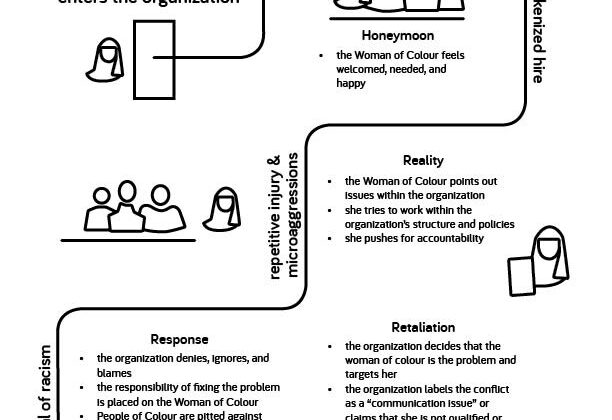
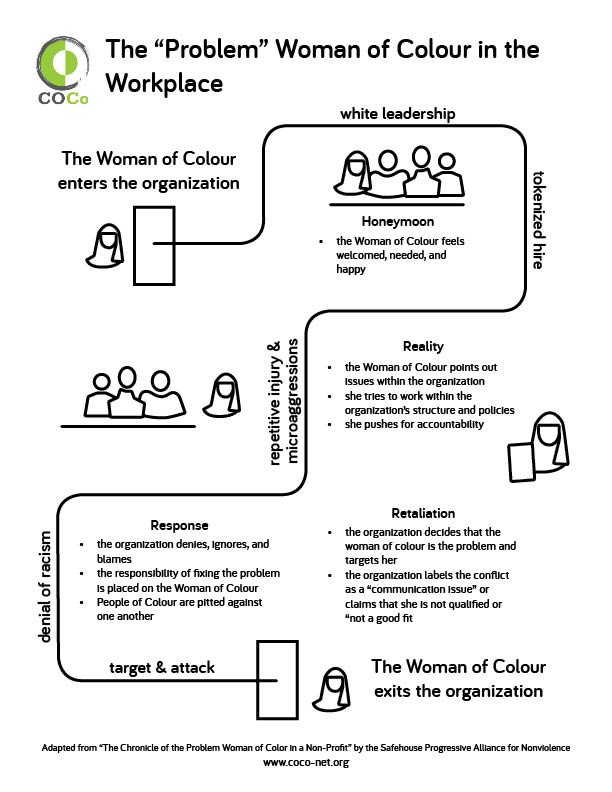
The infographic details difficulties that women of colour encounter in the workplace.

Diversity Committee Consider This Logo

Despite making up about 20% of the U.S. population, in 2020 women of color represented only about 3% of the highest-ranking senior executive-level positions (also known as c-suite or chief-level roles) in corporate America.1 Factors such as microaggressions, double standards, and unconscious bias prevent women of color from advancing at work in ways that are different from white women and even men of color.

In the mid-1970s, five African American women from St. Louis sued General Motors for discriminatory employment practices; however, their claims were dismissed because of a perceived lack of proof of discrimination. GM’s white female employees hadn’t experienced this particular discrimination, so the plaintiffs couldn’t sue for gender discrimination, and men of color hadn’t experienced it either, so they complaint couldn’t be covered under racial discrimination.2 The nuanced experience of being both women and Black created a framework of unique experiences of discrimination, later recognized as “intersectionality,” as coined by Kimberlé Crenshaw.3

This framework can be seen in both big and small ways in work settings across employment sectors. Often, the experiences of women of color are misunderstood or mischaracterized, and unwelcoming racial environments fester even when these individuals address issues. Canadian-based Center for Community Organizations developed the following infographic to shed light on the impact of factors such as tokenization, repetitive injury and microaggressions, and denial of racism that perpetuates employment issues for women of color.4

The infographic details difficulties that women of colour encounter in the workplace.

As ethical leaders, we all have a responsibility to be aware of inequities and to name and dismantle harmful practices that make our workplaces unwelcoming. While employment concerns are not limited to race and gender, consider how you demonstrate cultural competence in your workplace and how you create an environment welcoming to and supportive of women of color.

Learn more:

  1. Women in the Workplace: Corporate America is at a Critical Crossroads (report)
  2. Race, Gender, Intersectionality, & Employment (article)
  3. The Urgency of Intersectionality (video)
  4. The “Problem” Woman of Colour in the Workplace (infographic)

Diversity Committee Logo with embedded Twitter

Tagged With: Consider This

« Previous Page
Next Page »

Categories

  • Residence Life
  • Uncategorized

Archives

Tags

Break Closing Break Housing Closing Information Consider This COVID-19 Dig This find roommate Incoming Students Information Living Learning Communities Move-In Residence Life room room change room change request roommate Success Story

Meta

  • Log in
  • Entries feed
  • Comments feed
  • WordPress.org
  • Accessibility
  • Disclaimer
  • Disclosures
  • Equal Opportunity Employer and Institution
  • © 2026 Board of Governors, Missouri State University
  • Contact Information