
Papel picado banners have a long history in indigenous Mesoamerican culture. Mesoamerican cultures such as the Otomi and the Aztec traditionally made paper from the inner bark of maguey, fig, or mulberry trees. Religious practitioners cut the paper into designs for use in rituals to combat disease, misfortune, and dangerous spirits, as well as in rituals to ask for protection. Often the designs consist of figures such as Miquitzli, the Aztec deity of death. Later, after the Spanish confiscated and burned these paper images and forbade indigenous cultures from making paper, a very thin silk paper known as papel de chine was imported into Mexico, and indigenous cultures began cutting images from this paper. These eventually developed into papel picado banners with Christian motifs.
Contemporary traditional papel picados are lightweight banners made from tissue paper and cut with elaborate designs; the tissue paper is stacked in layers, and chisels of different shapes and a hammer are used to cut designs through several banners at once. The finished banners are hung in rows from strings that are stretched across altars, ceilings, entryways, and streets.
Today these banners are commonly used for many different Mexican celebrations, but they are especially well-known for being used on Mexico’s Dia de los Difuntos, also known as el Dia de los Muertos or the Day of the Dead; this celebration corresponds to the Christian All Hallows’ Eve (also known as Hallowe’en) on October 31, Hallowmas (also known as All Saint’s Day) on November 1, and All Souls’ Day on November 2. On these days, Mexicans visit relatives’ graves and set up altars called ofrendas, which are decorated and provided with the deceased’s favorite foods and drinks.

Mexican Mestizo culture
Late 20th century
Tissue paper, L. 71 cm x W. 1 mm x H. 45 cm
BFPC collection #1993.5f
Like Otomi and Aztec paper figures, papel picado banners can show images that relate to death, commonly depicting skulls, skeletons, caskets, and crosses or gravestones. Although these appear to be morbid subjects, they are considered to be humorous or even satirical representations of the dead, as they are meant to celebrate the afterlife rather than to mourn. This is a result of Mesoamericans traditionally not seeing death as an end, but as part of a cycle and something to be embraced as part of life. Researched by Nichapat Kongpaisarnnatee

Mexican Mestizo culture
Late 20th century
Tissue paper, L. 71 cm x W. 1 mm x H. 45 cm
BFPC collection #1993.5g
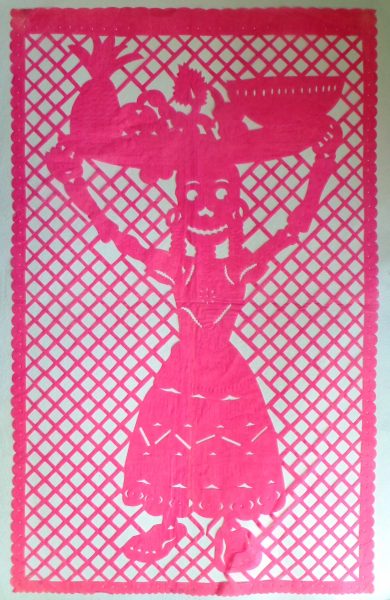
Papel picado banners today are mass-produced in tissue paper or even thin plastic, and they feature a wide variety of motifs appropriate for celebrations including Christmas, Cinco de Mayo, weddings, and baptisms. The most popular motifs, however, are still those of El Dia de los Difuntos, which feature skeletal figures participating in activities in the afterlife as they would have participated in activities in life. This figure illustrates a young woman in braids, a fancy dress, and sandals who carries a large basket of fruits and other foods on her head, as if returning from market or going to a festival. Researched by Michelle Eveker
Original design by Jose Posada
Mexican Mestizo culture
Late 20th century
Tissue paper, L. 68 cm x W. 1 mm x H. 44 cm
BFPC collection #1993.5i
This papel picado banner is a rendition of a famous design first created by Jose Posada. The image is called “La Catrina” or “La Calavera Catrina,” and it was originally depicted in a political cartoon by Posada, a lithograph artist of the early 20th century. “La Catrina” is the satirical depiction of a person of indigenous or Mestizo (mixed Spanish and indigenous) heritage who paints her face a lighter color with cosmetics and wears European aristocratic clothing. She is thus a symbol of a person who puts on airs and denies her native heritage—even in death. Researched by Celeste Hanford
For more information, you may contact the researcher(s) noted in the title of this exhibit entry, or Dr. Billie Follensbee, the professor of the course, at BillieFollensbee@MissouriState.edu