Missouri State University

Skip to content Skip to navigation
a b c d e f g h i j k l m n o p q r s t u v w x y z

A Bear's Life: Student Stories

Student stories from our peer counselors

  • Center for Academic Success and Transition

Supporting classmates today, impacting students for years to come

March 18, 2026 by Quincy Young

Daniel Paige crosses his arms to pose for a picture in Meyer Library.

Do you see someone struggling in college? 

You may be the ticket to their success. 

Take it from Daniel Paige, a senior at Missouri State University. 

Because of his leadership and guidance, his peers are learning how to make the most of their college experience. 

Upon discovering his interest in working with students, he decided to direct his career path toward higher education.

Plot twist: Shifting his path beyond the classroom

Formerly from Greenfield, Missouri, Paige left his small town and saw the chance to save costs on his education and graduate affordably at Missouri State. 

Paige, an avid book worm, is currently majoring in literature. 

“Ever since I was really young, I’ve always been a really strong reader,” Paige said. “I’ve always been really interested in books and the stories that can come out of that. As a kid, I was just really quiet, so it was just very easy for me to become more immersed in books.” 

His favorite classes were taught by Dr. Cathie English, who is now a faculty emeritus in the English department. 

“(Dr. English) has really always been a really great example of someone that will reach out to you and just help you get to wherever you need to be. She’s been probably one of the best professors that I’ve had,” Paige said. 

Originally, Paige entered Missouri State as an English education major. Through the lens of an aspiring teacher, he found opportunities to build on his desire to work with students. 

In between two rows of shelves, Daniel Paige leans against a shelf of books at Meyer Library.

Serving first-generation students in Bears Lead

While attending Student Orientation, Advisement and Registration (SOAR) as a first-year student, Paige received an email about the Bears Lead program, a student organization designed to encourage, motivate and support first-generation students. 

He applied to the program, and after one year of membership, he decided to give back to the program by becoming a Bears Lead Ambassador. 

As an Ambassador, Paige serves as a support system to students in the program.  

The Bears Lead members that he works with are first-generation students — those who are the first in their family to graduate from college — and students who have Access Program Scholarships. 

“The main things that (Ambassadors) help out with are running some of the meetings that Bears Lead has, as well as being able to help engage students and basically encourage them to just start getting out there more.”

Daniel Paige rests his arms on top of a stack of books as he sits at a table in the library.

Being “the link” as a peer leader

Through his time as a Bears Lead member, Paige found another opportunity to grow and further his mission to support students: becoming a peer leader. 

In this role, he reports to Dr. Tracy Glaessgen in the Center for Academic Success and Transition (CAST), who connected Paige to an instructor of the GEP 101: First-Year Foundations course. 

“Basically, whenever I’m in the classroom, I’m mostly like a link between the instructor and the students and serve as an example of what a successful student would look like.”

As a peer leader, Paige has enjoyed getting to know underclassmen and help them locate resources and opportunities that match their goals. 

“I’ve been working very closely with first-year students especially…and also, with second-year students, trying to help them get used to being at college and trying to understand some of the bigger things that you need to know that are less touched upon whenever you’re starting college,” he said. 

Paige notices that sometimes new students get overwhelmed by the various organizations and campus resources during the first week of classes. 

“If students are struggling in college, they’re always more than welcome to come up and talk to me,” Paige said. “In addition to that, I try to give tips on different resources on campus, like the Career Center, Magers (Health and Wellness Center), as well as the Foster Rec Center. Just trying to give the students some information about the different locations on campus as well as how to start using them.”
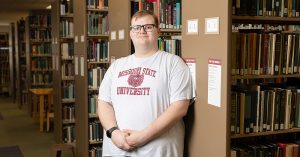
Daniel Paige poses professionally next to a bookcase in the library.

The student becomes the advisor

Because of these experiences, Paige realized that guiding college students could be his calling. 

He plans to graduate with his bachelor’s degree in spring 2026 and will begin the fall semester in Missouri State’s student affairs in higher education (SAHE) graduate program.  

In preparation for his future studies and career, Paige consulted with Christina Bowles, an academic advisor and success coach. 

“Christina Bowles over in the CAST office has been someone that I’ve been able to reach out to and get a lot of information, both about working in higher education as well as the SAHE program because she is an (alumnus) of the program. She doesn’t teach in the program or anything, but she was in it and so she knows what it was like,” Paige said. “It’s been nice to talk to her and hear her experiences as well as just working with her.” 

After Paige earns his master’s degree, he plans to follow in Bowles’ footsteps by continuing to serve students as an academic advisor or a success coach. 

“Being in the Bears Lead Ambassador role, as well as the peer leader role, I started to realize that I really do enjoy working more one-on-one with students rather than teaching 30 different students each hour or so,” he said. “That was what led me to wanting to work more with students individually, establish relationships, help them determine what they are wanting to do and try to help them reach their goals.” 

Major in literature Join Bears Lead Become a peer leader

Photos by Jesse Scheve

 

Filed Under: Peer Mentors, Student Stories Tagged With: first-generation students, peer leader

Making realty her new reality

March 5, 2026 by Quincy Young

Portrait of Kamryn Middleton, a finance and entrepreneurship major, posing next to a stairwell in Glass Hall.

A house isn’t a home without the people who live in it. 

That’s why we need aspiring realtors like Kamryn Middleton. 

After spending the past three years moving through foster homes, Middleton now seeks to give others what she was missing: a chance to put down roots. 

“I want to create a business. I want to create a name. I want to help people be able to find their ‘forever homes,’ not in a cliché way. But I know for me, I moved around a lot, and I struggled with making a home somewhere,” she said. 

As a freshman at Missouri State, she is set on double majoring in entrepreneurship and finance. 

After completing an internship with Springfield real estate companies, Middleton realized how much she enjoyed communicating with her clients. 

With business and money often intertwined, she sees a finance major as an asset that will complement her entrepreneurial ambitions. 

When Middleton was deciding on colleges, her high school teacher encouraged her to consider applying to Missouri State, which quickly became her first choice of schools due to its affordability and proximity to her hometown of Independence, Missouri. 

She was also drawn to the promising opportunities in Springfield, where she could engage with the community. 

“I felt like Missouri State was the best option for me,” Middleton said. “They gave me the most financial coverage, and I had a lot of people there to help me — whether that was my success coach, my academic advisor and other people who were there with me to help me through the process.” 

Kamryn Middleton seated a table in Glass Hall.

Set up for success

Middleton’s transition into college life was made easier with the support of her success coach, Christina Bowles. 

“I was very nervous to have a success coach, because I didn’t really want someone who was necessarily a therapist for me. And I didn’t want a tutor,” Middleton said. “I wanted someone that I could just kind of talk to (and) problem solve with who understood where I was coming from.” 

Middleton was glad to have someone who could walk her through things like:  

  • Getting started at Missouri State. 
  • Preparing for tests and classwork. 
  • Finding out if she had any learning disabilities. 
  • Staying up to date on student opportunities. 
  • Her personal concerns. 

“(Christina) stays very engaged in my life, so I hadn’t met with her for two weeks coming around finals week this past semester, and she still emailed me to ask me how my finals went and about specific classes that she knew I was struggling with,” Middleton said.  

Although Middleton is a stellar student in her own right, she gladly accepted study tips from Bowles. 

During one of their meetings, Bowles showed Middleton how to use Quizlet, a study website, to prepare for an upcoming final. 

“Those were simple ways to help and push you to make you want to do better,” Middleton said. “I definitely want to do better for myself, but it helps having someone you know believes in you and who you can just talk to who’s here, especially when your family is three hours away. It’s very, very needed.” 

In addition to classwork, Middleton works with her success coach to establish her future goals and to balance her coursework with her personal time. 

Middleton credits Bowles with boosting her confidence to ask professors questions and voice any of her concerns. 

“If I’m struggling with something, (Christina) would help me and push me towards communicating and engaging with others better in all different aspects, whether that’s socially or academically.”

Kamryn Middleton smiling and leaning against the glass stairwell in Glass Hall.

A support system for a first-generation student

During her first semester living on campus, Middleton had many opportunities to engage with other students and dive deeper into her academics. 

One of her favorite events was Greek Street, a block party where all Missouri State students were welcome to learn about Panhellenic groups. Although Middleton isn’t currently in a sorority, she enjoyed getting to know active members. 

Jumping into her degree path, Middleton has already attended many student organizational meetings in the College of Business, including risk management and insurance clubs, as well as Women in Business. 

“There’s just a realm of fun things to do here, so I’m never bored,” she said. “I’ve never really had an interest in basketball or football, but here I am attending games and meeting new people and going out with my friends. I’ve always been a very social person, but I felt like even college would be a little bit harder for me. But, Missouri State has definitely made that easier.” 

Through Bowles’s influence, Middleton was able to expand her network and get plugged into the first-generation student community.  

Bowles would notify her about first-generation club events and opportunities, like study groups, crafting activities and breakfasts. 

“I think that having a success coach definitely helped me branch out more and understand that I’m not the only one who is a first-generation student.”

Currently, Middleton expects to graduate in May 2029, but she is looking into paths to graduate sooner. 

While a career in real estate is her clear-cut destination, she also hopes to give back to the foster care system in the future. 

Aside from potentially minoring in social work, she continues to look for ways she can be a present and helpful neighbor, which she says, are by “being there for the community, whether that’s fostering my own children or going out and helping in the community or just supporting my parents because they foster children.” 

Major in entrepreneurship Major in finance Connect with a success coach

Photos by Kevin White

Christina Bowles, academic advisor and success coach, poses next to her student, Kamryn Middleton.
Christina Bowles, academic advisor and success coach, has been influential in the college journey of her student, Kamryn Middleton. Kevin White/Missouri State University

Filed Under: Student Stories, Success Coaches Tagged With: first-generation students, success coach

My MSU Story (Spring 2025, Week 15)

April 30, 2025 by Melyssa Hernandez

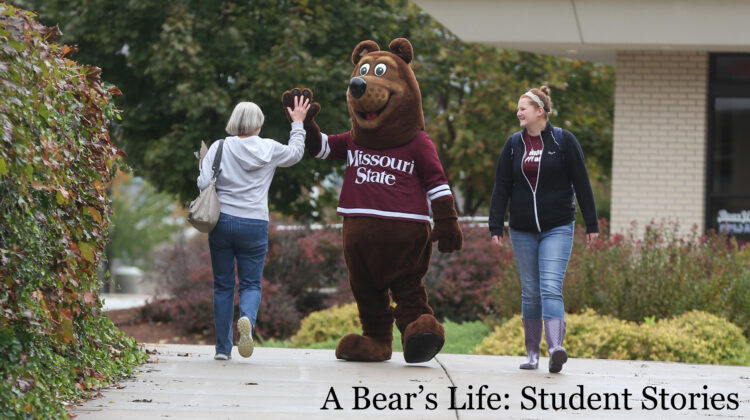
Boomer giving someone a high five; text on the photo says 'A Bear's Life: Student Stories"

Welcome back Bears! I hope everyone’s been enjoying the warmer weather and making the most of these final weeks of the semester. With the end of the year coming up fast, I’ve been thinking about how far we’ve all come. In early May, I’ll be walking the stage at commencement. As that day gets closer, I’ve been reflecting on my time here at MSU—why I chose Missouri State, and more importantly, why I decided to stay.

Why did I choose MSU: 

During my senior year of high school, I was hearing back from the colleges I’d applied to and facing a big decision. At the time, COVID was still a major factor, influencing the choices of students across the country. I remember seeing an email from Missouri State that read, “Apply today for free,” which caught my attention.

When it came down to making my decision, financial factors played a huge role. I took a leap of faith and applied to Missouri State, and was not only accepted but also offered financial aid. As a triplet, with both of my siblings also heading to college, making the most financially sound decision was crucial.

I was fortunate enough to make the drive to Springfield for a campus tour, which became a memorable day trip for my family and me. We explored MSU’s campus and the surrounding area, and we quickly fell in love with what both the university and Springfield had to offer. It became clear that Missouri State was the right choice for me.

Why do I choose to stay: 

When I first stepped onto campus, I’ll admit I was nervous—especially since I didn’t know anyone. Facing the fear of the unknown, I challenged myself to step out of my comfort zone and build new friendships. Thanks to my scholarship, I was able to get involved in various campus events, connecting with students from all kinds of backgrounds.

One of the things I cherish most about Missouri State is the sense of community. Joining different organizations has helped me find my home away from home. Even during moments when I felt isolated or anxious, I was able to lean on my friends and professors for support and guidance.

My biggest tip: Get involved in at least one organization! It’s a great way to build connections, find your community, and create lasting memories.

Another reason I chose to stay at MSU is the amazing staff across every department. As a Psychology major, I’ve had the opportunity to connect with professors and staff from various disciplines, learning new things outside of my field. Despite being part of a large university, MSU has a tight-knit feel—there’s always someone looking out for you.

I’m deeply grateful for the opportunities I’ve had here—whether it’s research projects, conferences, or the lifelong friendships I’ve made along the way.

No matter what you’re going through, remember that you’re never alone here. There are always people supporting you. Missouri State is a place where you can try new things and grow.

Takeaways 

College is an amazing time to step outside your comfort zone, try new things, and create lasting memories. One quote I live by is, “Growth doesn’t happen when you’re comfortable.” Challenge yourself every day to become the best version of yourself. Whether you’re graduating this semester or finishing your first year, take a moment to be proud of everything you’ve accomplished, and make sure to enjoy these final weeks.

The Center for Academic Success and Transition is a fantastic resource to support your success throughout your college journey. I highly encourage you to meet with a peer mentor or success coach—they can help connect you to valuable resources and provide guidance as you navigate your next steps.

~Melyssa  

(Bio: My name is Melyssa Hernandez, and I am a senior studying psychology. Fun fact: I am an out-of-state student from Chicago, Illinois)

Filed Under: Campus Life, Student Stories

Overcoming Imposter Syndrome (Spring 2025, Week 14)

April 14, 2025 by CAST

Boomer giving someone a high five; text on the photo says 'A Bear's Life: Student Stories"

When I was in middle school in Saudi Arabia, I decided to become a lawyer. By 12th grade, I planned to study law in the U.S., only to learn that it required a bachelor’s degree first. Since many pre-law students chose political science, I did the same—despite having no background in American politics.

In class, I felt out of place. My classmates confidently discussed political theories and global affairs, while I struggled to keep up. I often wondered, “Did I get here by luck?” or “What if they realize I don’t know as much as they do?” These thoughts held me back, making me hesitant to speak in discussions.
What I didn’t realize at the time was that I was experiencing imposter syndrome—the feeling that I wasn’t as capable as others believed, despite my achievements.

What Is Imposter Syndrome?

Imposter syndrome is that persistent voice in your head telling you that you’re a fraud, that your success is just luck, and that sooner or later, people will “find out” you’re not as smart or talented as they think. Studies show that nearly 70% of people experience it at some point, especially in competitive academic or professional environments.

How It Showed Up in My Life

As a political science student, my imposter syndrome often flared up in these ways:
  • Comparing myself to classmates who seemed to grasp concepts faster.
  • Downplaying my accomplishments—even when I got good grades, I told myself it was just because the professor was lenient.
  • Avoiding participation in class because I feared saying something “unintelligent.”
  • Over-preparing for presentations to the point of exhaustion, just to avoid being “exposed.”
I remember once staying up all night rewriting a paper because I was convinced my first draft wasn’t “good enough,” even though my professor had praised my previous work. That’s when I realized: I wasn’t struggling with my abilities—I was struggling with my mindset.

How I Started Overcoming It

  1. Recognizing the Pattern
    • I began journaling my thoughts and noticed a trend: every time I succeeded, I dismissed it. Seeing this in writing helped me challenge those thoughts.
  2. Talking About It
    • When I opened up to friends, I was shocked to learn that many of them felt the same way—even the ones I thought were “naturally brilliant.”
  3. Reframing My Thoughts
    • Instead of “I don’t belong here,” I shifted to “I earned my place, and I’m still learning.”
    • I started keeping a “win log” where I recorded small victories—like contributing in class or receiving positive feedback.
  4. Embracing Imperfection
    • I accepted that not knowing everything was normal. Political science is vast—no one has all the answers!
  5. Seeking Mentorship
    • Talking to professors and older students helped me see that even experts once felt unsure. Their advice? “Confidence isn’t about knowing everything—it’s about being willing to learn.”

Tips to Combat Imposter Syndrome

If you’ve ever felt like an imposter, here’s what helped me—and might help you too:

  • Normalize the feeling—most high achievers experience it at some point.
  • Focus on progress, not perfection—growth matters more than flawless performance.
  • Celebrate small wins—keep a journal of achievements to remind yourself of your capabilities.
  • Talk about it—you’ll realize you’re not alone.
  • Ask for feedback—sometimes, an outside perspective can silence your inner critic.

Final Thoughts

Imposter syndrome doesn’t disappear overnight, but it does get quieter. Now, when I feel that familiar doubt creeping in, I remind myself: I am here because I worked for it. My perspective matters. And I don’t have to be perfect to belong.
If you’re struggling with these feelings, know that you’re not alone—and you’re definitely not a fraud. You’ve earned your place. Keep going.

Need support?

Remember, MSU’s Counseling Center is a great resource—you get 8 free sessions every semester to talk through anything on your mind. You can also reach out to CAST for student academic assistance—sometimes, a little guidance goes a long way. Plus, your peer mentors and coaches have likely been where you are and can offer real, relatable advice.

~Yomna
(Bio: I’m Yomna Awad, a grad student in my final semester of Project Management (with a Conflict Resolution certificate!). Fun fact: My birthday is March 20th—which also happens to be the International Day of Happiness… so yes, I take the “treat yourself” mentality very seriously.)

References

Clance, P. R. (1985). The impostor phenomenon: Overcoming the fear that haunts your success. Peachtree Publishers.

Hibberd, J. (2019). The imposter cure: How to stop feeling like a fraud and escape the mind-trap of imposter syndrome. Vermilion.

Mann, S. (2019). Why do I feel like an imposter? How to understand and cope with imposter syndrome. Watkins Media.

Parkman, A. (2016). The impostor phenomenon in higher education: Incidence and impact. Journal of Higher Education Theory and Practice, 16(1), 51–60.

Vergauwe, J., Wille, B., Feys, M., De Fruyt, F., & Anseel, F. (2015). Fear of being exposed: The trait-relatedness of the impostor phenomenon and its relevance in the work context. Journal of Business and Psychology, 30(3), 565–581.

Young, V. (2011). The secret thoughts of successful women: Why capable people suffer from the impostor syndrome and how to thrive in spite of it. Crown Business.


← Back

Thank you for your response. ✨


Filed Under: Student Stories, Tips

Navigating the End of the Semester Stress (Spring 2025, Week 13)

April 8, 2025 by Melyssa Hernandez

Boomer giving someone a high five; text on the photo says 'A Bear's Life: Student Stories"

Can you believe the end of the year is just around the corner? It’s crazy how quickly time flies! As we approach the finish line, it’s normal to feel the pressure of juggling various responsibilities, whether it’s academics or your social life. Remember, it’s okay to feel stressed—just take a deep breath and tackle one day at a time. This blog is here to help ease your stress and offer practical tips for finishing the semester strong.

Personal Experience: 

With the end of the semester approaching, I am preparing myself for graduation! This semester feels bittersweet as I balance finishing my current academic work while also gearing up for the next chapter. I’m thrilled to share that I’ll be continuing my academic journey by pursuing a master’s degree in Clinical Mental Health Counseling. However, with all these changes on the horizon, my mind has been racing, and my planner is working overtime.

I’m someone who thrives on structure, so I make it a point to schedule time for everything—from workouts to homework. Having a clear plan for the week helps me stay organized and focused. I also make sure to prioritize my involvement in campus organizations, keeping track of their events in my calendar as well.

I tend to have a ‘what’s next?’ mentality, which can sometimes feel overwhelming. That’s why I also take time to appreciate the present moment and enjoy time with my friends. While staying on top of my studies is a priority, I make sure to cherish the relationships I’ve built along the way.

Resources: 

At Missouri State University, there are a variety of resources available to support your physical, emotional, and mental well-being. From Magers Health and Wellness Center to the Bear CLAW and Bear Pantry, there are many services designed to assist students in different aspects of life. These are just a few of the many resources available to help you thrive during your time here.

Your professors are another valuable resource. If you’re struggling with a course, don’t hesitate to reach out to them. You can schedule a meeting or attend their office hours for additional support. They are committed to helping you succeed academically and are here to guide you every step of the way.

Takeaways 

No matter what, be sure to reach out if you are struggling or feeling the stress of the end of the semester. The Center for Academic Success and Transition is a great place to help support students and their overall success. Please consider meeting with a success coach or peer mentor to help alleviate or lessen your stress. Although this can be a stressful time, it’s also an opportunity to create lasting memories. Let the end of the semester be a time to celebrate your accomplishments and appreciate the people around you. Remember, you’re one step closer to reaching your academic goals!

~Melyssa  

(Bio: My name is Melyssa Hernandez, and I am a senior studying psychology. Fun fact: I am an out-of-state student from Chicago, Illinois)


Filed Under: Campus Resources, Student Stories, Tips

Next Page »

A Bear’s Life

Our Peer Mentors share their stories, thoughts and experiences to help MSU’s students with navigating life and academics at MSU.

Categories

Archives

Meta

  • Log in
  • Entries feed
  • Comments feed
  • WordPress.org
  • Accessibility
  • Disclaimer
  • Disclosures
  • Equal Opportunity Employer and Institution
  • © 2026 Board of Governors, Missouri State University
  • Contact Information