

Last week, the FCTL caught up with Dr. Sarah Jean Baker, winner of the 2025 Teaching Excellence Award, to learn more about her teaching philosophy and the exemplary teaching methods she uses to make a difference in her classroom.
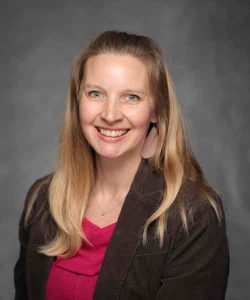
Dr. Sarah Jean Baker, Associate Professor in the School of Teaching, Learning, and Developmental Science and Coordinator for Early Childhood Education, has had experience teaching students of both early childhood and early adulthood age. Her approach to teaching either group isn’t as different as one might assume—in fact, Dr. Baker says her teaching philosophy is applicable to teaching students of any age.
“I always tell my students that being an early childhood educator means you can teach students at any level, because the methods and theories that we’re pulling from work with even adult learners. The things I do with my college students are similar to the things I did with my kindergarteners and first grade students, because they still transfer,” Dr. Baker explained. The key to these any-age instructional strategies? An intellectual, collaborative, and ever-improving approach to teaching that Dr. Baker champions in her classrooms.
Teaching: Both Relational and Intellectual
It’s an understatement to say that there are a broad spectrum of views on and approaches to teaching in higher education today. Every instructor has their own set of beliefs and practices unique to their content, however broad or specific they may be. These beliefs and practices, like every other aspect of education, have evolved as new information and research has arisen to show the changing needs and demands of students. But, in a vastly changing world of technology and information overload that demands an even more critical review of teaching practices, questions are being asked. Which aspects of the teaching process matter most in creating a lasting impact? What should instructors prioritize in their teaching processes? How do educators create effective and meaningful teaching experiences in today’s academic world?
As an educator of future teachers, these questions are always at the center of Dr. Sarah Jean Baker’s approach to instruction. Dr. Baker was named the winner of the 2025 Teaching Excellence Award in February of this year, and her teaching philosophy provides a solid blueprint for her answers to these dilemmas. “I think it comes down to two things,” Dr. Baker answered when asked about the core of her teaching ideology. “It’s building relationships with students, and [seeing] teaching as intellectual work.” Teaching, she says, is more than just the transfer of knowledge. It’s an inherently intellectual act, calling on educators to constantly strategize for and analyze the effectiveness of their instruction.
“Teachers [have to] think about how to make content relevant for students, how to make content meaningful for the students that are in [their] classrooms. I think that is work that takes a lot of thinking, and can be challenging.” Too often, this attitude can tend to get lost in the clamor over other intellectual pursuits. “We don’t often think of teaching as intellectual work, especially at an institution that has faculty teaching and researching. We can prioritize research as the intellectual work faculty are doing, but I would argue that it’s both,” Dr. Baker explained. Prioritizing teaching as an intellectual pursuit places it in a similar vein as research; a continuous, focused effort to investigate different methods and their effects. This manifests in Dr. Baker’s classes through the intellectually-based methods she uses to create educational experiences, such as real-world application, hands-on experiences, culturally responsive practice, and inquiry-based methods.
Meanwhile, the relational aspect of teaching — which Dr. Baker says is rooted in getting to know students as individuals — enables the creation of a supportive environment that fosters students’ growth as learners. Getting to know students as individuals isn’t as simple as it sounds at first, though; understanding the individual people that make up a body of students means taking the time to understand the many aspirations, experiences, and challenges that influence how students respond to instruction. “It’s about seeing people, caring for people, and supporting them in that learning journey that they’re on,” Dr. Baker said. This responsibility goes deeper than the surface level model of teaching that only emphasizes the content given to students, asking educators instead to take a more active and involved role in creating impact through education joined with personal connection. Dr. Baker’s quest to build these connections has allowed her to bridge the gap between theory and practice, creating experiences that resonate with students both professionally and personally.
Building Community in the Classroom
The definition of teaching as both relational and intellectual has led Dr. Baker to prioritize certain aspects of the classroom environment to facilitate both of those factors. For example, another priority for her is the mission to create a lively, interactive community in her classrooms, allowing the relational side of teaching to flourish among her students. One strategy that Dr. Baker employs to do that revolves around a tool not usually thought of in connection to teaching: food.
“One of the things that I started in the last couple years is bringing in snacks for students to enjoy, and finding ways to do that cheaply.” She said. “There’s something about what food does when we’re in spaces with people […] that helps in the creation of the community.” Encouraging students to build relationships and connections in the classroom increases their investment in the course and creates an environment that students can feel safe to speak up, make mistakes, and grow in. Part of the creation of this community comes from the professor overseeing the class, as well – Dr. Baker points to vulnerability as a key consideration in this regard.
“Bell hooks writes a lot about being vulnerable in our teaching as professors, and that’s something I try to lean into,” Dr. Baker said, referencing American author, theorist, educator, and social critic Gloria Jean Watkins (pen name bell hooks). “I would encourage faculty to be more vulnerable with their students, because that’s what it is to be human. That’s what people are looking for, they want to learn and be guided and mentored by people that are willing to admit that [they] don’t have all the answers, but are willing to find them together with students.” Professors who remove themselves as active participants in the learning process can unintentionally create an environment where students feel less able to ask questions or make mistakes. Placing oneself in a similar position to students in the quest for knowledge, on the other hand, encourages a growth mindset that enables students to feel comfortable taking risks. “I want them to know that I’m going to manage and take care of things if I need to step into that authority position, but most of the time I want us to be doing things together, because that’s where the learning is going to be the most impactful and meaningful for them,” Dr. Baker explained.
The Growing Importance of Community
While building community may always have been somewhere on the list of goals for educators, Dr. Baker explained that it needs to be prioritized now more than ever. With students increasingly turning to technology instead of people in their educative endeavors, the importance of a community in the classroom has never been greater. “In a time of artificial intelligence, students can get a lot of content or knowledge from language models. So, I see the classroom becoming even more important because the human connection can’t be replicated by those models,” Dr. Baker explained. Asking questions together, finding answers collaboratively, connecting on a level that technology can’t recreate—these are the things Dr. Baker says can’t fall by the wayside in the new age of education. “My challenge to faculty would be that. What are the things you could do in class that create that community that students can’t get anywhere else?”
“In a time of artificial intelligence, students can get a lot of content or knowledge from language models. So, I see the classroom becoming even more important because the human connection can’t be replicated by those models.” – Dr. Sarah Jean Baker
Collaborative Teaching
As the classroom community is established, students grow more comfortable and interactive. This then fosters collaboration between the instructor and their students that is invaluable to creating an effective learning experience. According to Dr. Baker, one of the most important aspects of that collaboration is collecting – and listening to – student feedback.
“To me, teaching is about the student experience,” she explained. When ascertaining what that experience is, student feedback plays an invaluable role. “I am continually reminded that I’m getting farther and farther from the age of undergraduate students, so I rely on my students to give me feedback about what feels good in class. What do they want more of, what do they want less of, what do they need?” Dr. Baker uses this feedback to create a continuous process of improvement, a cycle built in partnership with her students and the needs they share with her. This establishes a loop that continually serves both sides of her teaching philosophy; the relational aspect encourages students to share their thoughts, needs, and challenges, and the intellectual aspect then guides her in her implementation of teaching strategies to respond to that feedback.
The process of obtaining feedback can look different depending on the day. “Sometimes that’s an anonymous exit ticket, sometimes it’s an anonymous survey I give them, but sometimes it’s just asking them in class: how is this feeling? How is this fitting for you? Where are the trouble areas you’re experiencing, how can I make adjustments?” Just as important as getting the feedback though, Dr. Baker said, is implementing it. “It can be really disheartening if you give feedback and then no one actually uses [it]. I want to model that [for my students] too, that they can ask even their kindergarteners or first grade students for feedback, but then using that feedback is important. Otherwise, even little kids will figure out that no one is really listening to [them].” Continually seeking this feedback lets Dr. Baker evaluate her teaching materials and methods in real time, which she can then use to alter her practices. This feedback and alteration process allows Dr. Baker and her students to collaboratively create the learning experience that is most effective for that specific group.
Shaping Meaning Together
Student feedback isn’t the only aspect of collaboration that Dr. Baker identifies in her classes, and the collaboration doesn’t only change how the instruction is delivered. It often changes the meaning of the content itself, and sometimes, it changes how Dr. Baker herself thinks about that content.
“I’m learning from my students, too,” Dr. Baker explained. “I know that I have things they will learn and things I will teach them, but I also want to learn from them. That’s why my teaching semester to semester will never look the same.” The community of learners, as she calls it, shapes the meanings identified during learning just as much as her content does. “Even if a topic or reading may be the same, the community of learners is what makes that reading and that experience come more alive. The meaning that we get from that is going to be different each semester.”
This process of learning from students as they learn from her once again places students in a collaborative, open space that encourages them to grow their confidence as active participants in the learning process. Learning, Dr. Baker says, is a reciprocal and continuous process, unending and shaped by those around us, and she wants to make sure her students understand this. “I was always waiting to grow up, and then you just kind of realize that that never really happens—I’m always growing and learning. I think making that more clear to students, too, that the learning process is truly an ongoing process, helps even more to create the culture and community in my classroom. We’re all learners in here. I’m a learner in here too, just like you.”
“Even if a topic or reading may be the same, the community of learners is what makes that reading and that experience come more alive. The meaning that we get from that is going to be different each semester.” – Dr. Sarah Jean Baker
Continuously Improving
Of course, the effort to create successful teaching experiences doesn’t end with implementing just a few strategies, no matter how effective they may be. Perhaps the most important thing an educator can strive for is continuous improvement – a fact Dr. Baker knows well. Reflective practices play a major role in her teaching year to year, allowing her to continually assess and revise her instructional materials. Seeking out other sources of educational knowledge and research is another vital piece of that process.
“For me, it’s reading,” Dr. Baker answered when asked what faculty members can do to evaluate and update their courses. “There’s a ton of literature out there. Two years ago, I [went and] read about mental health for young people, because I was seeing that. When I see student needs, not only in the feedback they’re giving me but also in the classroom, I try to find other scholars that I could be reading to help me understand those needs.”
Community can be a help in finding areas to improve, too. “The FCTL does and is continuing to do a great job providing opportunities for faculty to engage with other faculty around pedagogy,” Dr. Baker mentioned. “Another way I learned is going into other classrooms and asking if I could come in and sit. That way, you get to see a teacher at work and all the pieces [that go into] that.” Observing peers provides unique insight that educators don’t always get when they are the ones doing the teaching. “I still love doing that, because I think when you’re in that observational space, you can see more how teacher and students are interacting together. You can see student engagement better, so you’re able to get a different perspective and notice things that you could do, and then think about how you could do that with the specific content area that you’re teaching.”
These resources, and many more, are fantastic ways for educators to search for, identify, and elevate areas of their teaching practices that may not be as effective as they could be. The thing to remember, Dr. Baker says, is to not let yourself get overwhelmed. “Picking one thing that you want to do. Maybe that looks like, I’m going to increase community in my classroom, and I’m going to do it by X and Y. You just focus on those things, because otherwise you can become overwhelmed with all the changes you want to make in the classroom—and when we’re overwhelmed is when we quit and don’t follow through on our goals.” Improvement is a never-ending journey that can feel daunting, but taking things one step at a time paves the way for bigger and more impactful changes down the road. Dr. Baker’s final advice to MSU faculty echoed that sentiment. “Starting small, what could be one or two things that you could try all semester with all your classes – or maybe even with one class? Then you go from there.”
“Starting small, what could be one or two things that you could try all semester with all your classes – or maybe even with one class? Then you go from there.” – Dr. Sarah Jean Baker
Get Started
If you found yourself inspired by Dr. Baker’s teaching philosophy or practices and are looking for a place to start improving or revising your teaching methods, the FCTL offers plenty of educational resources to MSU faculty that can help you begin. To schedule a consultation with an instructional designer, browse through our faculty library of educational literature, or learn more about getting connected with colleagues also experimenting with pedagogy, visit the FCTL website below.
Interested in applying for the Teaching Excellence Award yourself or nominating a peer for the award? The FCTL is accepting applications and nominations for the 2026 Teaching Excellence Award starting October 15. To learn more about how to apply or nominate a peer, follow the link below.
| Browse Through the FCTL Website Resources | Learn More about the Teaching Excellence Award |
Discover more from What's Happening at FCTL
Subscribe to get the latest posts sent to your email.