
Recently, all Missouri State University faculty were added into the FCTL Academic Community, a Brightspace Community course created by the FCTL that provides resources, scholarly opportunities, and assistance to MSU faculty members as they navigate the act of teaching and all that it entails. Read on to find out about some of the Academic Community’s features and discover the many ways it can help you in your professional and scholarly pursuits.
A New and Improved Community
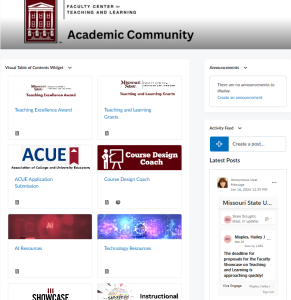
The FCTL Academic Community may be familiar to faculty members who have been around long enough to remember the days of Blackboard—a version of the Community was available to faculty members on that learning management system before the university switched over to Brightspace. The Community has undergone significant changes since the switch; in addition to the previous information, resources have been added to assist faculty with more current teaching and learning issues such as AI and online testing tools. One of the most prolific and involved of these resources that we encourage faculty to interact with is the AI assistant referred to as the Course Design Coach.
The Course Design Coach found in the Academic Community is a GPT-powered AI that has been trained on academic standards from predominant academic theory (such as Bloom’s Taxonomy, D. Fink’s Taxonomy of Significant Learning, and the Quality Matters (QM) 7th Edition Standards) and data from academically reliable sources. The resulting AI assistant is able to walk you through the course design process, utilizing evidence-based practices rooted in academic literature along the way. In order to use the Course Design Coach, all the user has to do is input some basic information about the course topic and structure through a conversation led by the Design Coach – answer a few questions about things like your course duration, modality, target learners, and goals, and the Course Design Coach will help you flesh out a well-designed course through the chats that follow.
Dr. Rice, one of the FCTL’s Instructional Designers and the architect of the Academic Community on Brightspace, compared the Course Design Coach to “working with an instructional designer without the designer.” The Coach does not, of course, replace that valuable interaction—in fact, if a faculty member would like to speak to an instructional designer at any point while interacting with the Design Coach, they only need to ask. The AI will provide the booking link to contact and set up a meeting to fill in any gaps in the course. The Course Design Coach’s reliance on established frameworks and its specific functioning parameters also makes it the perfect way for faculty who are hesitant to use AI to experiment with its benefits—so, if you’ve been looking for a safer way to explore your options and get familiar with interacting with AI, this is the perfect place to do so.
Information Abounds
AI assistance on course design if far from the only thing the Academic Community offers. The site is, first and foremost, an information repository designed to assist faculty members asynchronously with teaching inquiries and course design processes. To accomplish this, the Community is loaded with informational modules that offer external sources on topics ranging from AI use to learning technologies and instructional strategies. If you’re looking for reliable sources of information on a teaching question but don’t have the time to go searching yourself, take a look at the Community—chances are there’s information waiting for you.
The Academic Resource Hub, a new section of the Academic Community, is yet another avenue within the site to find more in-depth information on teaching and learning topics. The Resource Hub is made up of a variety of informational documents containing handout-style information on various teaching topics. After the FCTL underwent a website-revamp earlier this year, multiple informational pages were transformed into Academic Resource Hub documents to preserve valuable information while making space for new content and organization. These documents harbor information on a wide variety of topics, ranging from academic integrity to active learning strategies and AI policies. All Academic Resource Hub documents can be downloaded or simply viewed via the Community.
In addition to external resources and internal informational documents, the Academic Community serves as a repository for prior Showcase on Teaching and Learning sessions and all the valuable knowledge shared during them. If you missed this year’s Showcase and would like to listen to the keynote speaker session, the Academic Community is the place to look. The most recent Showcase isn’t the only one included on the site, though; if you were present at one of the previous Showcases and would like to hear the keynote speaker session again, you can find these dating back to 2017 within the Community’s Showcase module. If you’ve never had the opportunity to attend the Showcase before, we encourage you to take a look back through the years of academic scholarship and sharing—you may find inspiration that sparks new ideas for your classrooms in the future.
Discover Professional Opportunities and Get a Glimpse into the Student Perspective
While the Academic Community functions primarily to provide information and resources, it also serves the dual purpose of housing the submission portals for many of the FCTL’s academic programs. Faculty members can find information and application opportunities for professional opportunities such as the Teaching Excellence Award, Teaching and Learning Grants, and ACUE Cohort in the various submodules within the site, providing convenient paths to engagement and professional development.
While the Community provides information and opportunities directly to instructors and faculty at MSU, it also provides a more unexpected contextual benefit: giving faculty a look into what students see when they interact with courses. Faculty members are enrolled in the FCTL Academic Community in the “Learner” role, meaning they see the Community from the same role that students view faculty-managed courses from. If you’ve ever wondered how your materials or course organization look to students, or are curious how students navigate the innerworkings of the courses you create, this is your chance to check it out from their perspective—poking around in our community design may even give you some ideas for your own.
These features are far from the only ones you’ll find within the Academic Community, but they comprise some of the most notable ones as of now. The current version of the site is not where the growth will end, however; the Academic Community is a living site that will continue to be updated with content, modules, and resources to meet the needs of educators as they arise in the future. For now, the FCTL encourages faculty to explore the newly-improved site to find the information, resources, and opportunities that are most beneficial to them.
Questions?
If you have questions about the FCTL Academic Community, need assistance finding it in your Brightspace course, or would like more information about anything listed in the Community, feel free to contact the FCTL via email at fctl@missouristate.edu.
Discover more from What's Happening at FCTL
Subscribe to get the latest posts sent to your email.