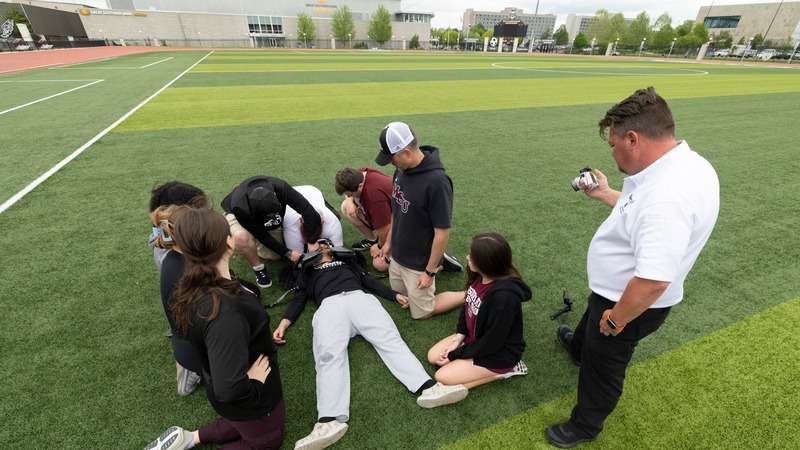
A single moment on the field or court can change everything. When an athlete goes down, time slows and someone must be ready, not just with skill, but with calmness, confidence and the instinct to act.
For Missouri State University graduate students Cooper Lewis and Malia Moore, that moment is not hypothetical — it is the reason they chose the athletic training path.
Both are in the Master of Athletic Training program at Missouri State and will graduate this spring. Through their time at the university, they have found their purpose by combining a love for sports with a drive to help others.
Finding the calling
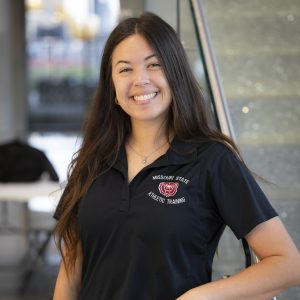
Moore grew up in Liberty, Missouri, just outside Kansas City. Her path to athletic training began through personal experience.
“I played soccer in high school and suffered from an injury,” she said. “I saw what athletic trainers did firsthand and knew this was something I wanted to do in future.”
While exploring programs across Missouri, Moore was drawn to Missouri State’s strong reputation and felt the Springfield location was the right fit. She began her bachelor’s degree in sports medicine in fall 2020 and, after graduating in May 2024, continued on to pursue her master’s.
As for Lewis who grew up in Laredo, Missouri, he came to the field through a different way. A lifelong sports enthusiast, he spent years searching for a career that included everything he cared about: athletics, health and helping people. Athletic training brought those pieces together.
“I loved sports my entire life and wanted a career that could combine my interests,” he said. “Once I discovered athletic training, the rest was history.”
Lewis chose Missouri State for its high-quality program and supportive learning environment. He also valued the opportunity to complete both his undergraduate degree in sports medicine and graduate degrees in one place, building his clinical foundation from the ground up.
Learning that extends beyond the classroom
The duo began their master’s program in summer 2024. They found a curriculum that places students in real clinical environments early and often. They got to work alongside athletes, preceptors and health care professionals in ways textbooks alone cannot replicate.
“I thought I wouldn’t like any setting other than high school. But I fell in love with the college environment, which I didn’t expect,” Moore said.
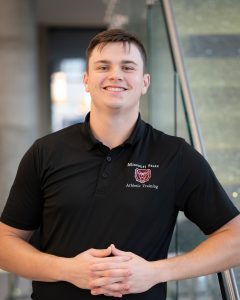
Lewis credits the program for turning him into a professional.
“The relationships made the biggest impact on my life,” he said. “I’ve enjoyed and developed friendships with classmates, professors, preceptors, athletes and patients.”
Both students also stepped into research and leadership. Lewis is completing a critically appraised topic research study on dry needling and its effects on chronic tendinopathy injuries. He also serves as president of the Athletic Training Student Association.
Moore worked on a research project that focused on the effectiveness of dry needling on hamstring strength, range of motion, pain and extensibility. She presented it at the recent McQueary College of Health and Human Services Student Research Symposium.
An experience that stands out for both of them was traveling with Missouri State Football to its first-ever bowl game, the Xbox Bowl in Frisco, Texas, last December. They enjoyed experiencing a major athletic event.
“It was such a fun experience and one of my favorite memories,” Moore said.
Lewis echoes that feeling and described it as an opportunity to build strong connections while working alongside fellow students and professionals.
What comes next
With graduation coming up, the students are already clear on their next steps and purpose.
Moore wants to work in college athletics, building the same kind of relationships with athletes she experienced with her own athletic trainers, including assistant professor Dr. McCall Christan.
“I hope to help athletes stay healthy, recover from injuries and perform at their best,” she said. “As a former injured athlete, I know the value of having someone steady in your corner.”
Lewis is interested in rehabilitation and clinical care, with long-term goals in health system leadership. In a profession often misunderstood or overlooked, that kind of advocacy matters and begins with practitioners who believe in the work.
“I want to continue to advocate for athletic trainers and increase public knowledge of what we do,” he said.
For Lewis and Moore, athletic training is more than a career path. It is about being present in critical moments, building trust with patients and using knowledge and compassion to help them return stronger.
Learn more about the athletic training program
Discover more from Health and Human Services News
Subscribe to get the latest posts sent to your email.