

Missouri State University conducted another successful archaeological field school May 20-June 14, 2024, at the historic Phenix Marble Company Town site in northwest Greene County, Missouri.
Once again, Dr. Elizabeth Sobel and Dr. Scott Worman of the Department of Sociology, Anthropology and Gerontology (SAG) directed the program. They also co-taught the field school at Phenix in 2019 and 2022.
Twenty Missouri State students, along with three teaching assistants, participated in this year’s field school.
This year the group investigated remnants of a company town where Phenix employees lived from the late 1800s to the 1930s.
Local focus gives professional training at reduced costs
Missouri State has been holding archaeological field schools nearly every summer since the mid-1970s, Sobel said.
“While there have been MSU field schools in places like New Mexico and Jamaica, the costs of travel, food and lodging made those inaccessible to many students,” she explained.
Instead, Sobel and Worman have opted for local field schools. These reduce costs while giving students the training they need to become professional archaeologists.
Sobel said she and Worman direct the field school every other year, alternating with staff from Missouri State’s Bernice S. Warren Center for Archaeological Research (CAR).
Phenix Site has many pluses
Sobel and Worman said they return to Phenix as a field school site for several reasons.
“The fieldwork at Phenix builds on our previous archaeological research, [which explored] daily life of Black families in nearby Ash Grove in the late nineteenth and early twentieth centuries,” Sobel explained. “Like the Phenix community, much of the Ash Grove community worked in the limestone industry.”
“In 2019, we chose to expand this research to include the site of the Phenix Marble Company, which hired and housed only Whites to quarry and process limestone,” Worman added. “Our study can more fully explore both race and class dynamics in this part of the Ozarks in the nineteenth and twentieth centuries.”

In addition, the Phenix Marble Company owns the site. The owners give the field school access to the property, maintain the landscape, share historical information about the site and even provide portable toilets, Sobel said.
These, along with the site’s proximity to campus, are additional benefits to returning to the Phenix site.
At the site, rain or shine
Students gain hands-on experience during the field school program by learning how to find, excavate and record archaeological sites, Worman said.
Zane Wigton, one of this year’s field school participants, welcomed that hands-on training.
“The field school was a great experience and allowed me to get to know people with similar interests,” Wigton said. “Being able to work hands-on has helped me to better understand the field and what I want to do going forward.”
Likewise, the program parallels real-world job responsibilities, such as committing to a full workweek.
Students met on campus every weekday morning at 8 a.m. to load equipment and ride to the site in university vans, returning to campus around 4 p.m., Sobel explained.
“They reached the site before 9 a.m. and typically spent the next seven hours outside, rain or shine,” she said.
Learning the trade
Over the four-week session, Sobel and Worman guided the students through the steps of a typical archaeological investigation.
They began by surveying a previously unexamined section of the company town.
“In practical terms, the survey involved systematically digging small pits known as ‘shovel test probes’ on a 20-meter grid across a large field, then screening the excavated sediment, collecting any artifacts, documenting each probe, and looking for patterns that might show where workers’ houses were located,” Worman explained.

Once the students identified a promising location, they dug 1×1 meter square unit “block excavations” at 10-centimeter levels, Worman explained. They then recorded all artifacts and other content with written descriptions, maps and photographs.
“While most of this work is done with hiking boots, trowels, shovels, pencils and paper, students also used high-tech GPS mapping equipment and helped with geophysical prospecting using ground penetrating radar,” he added.
Michael Beattie, another field school participant, appreciated the chance to practice using archaeological equipment.
“I got a feel for the different aspects that go into doing archaeology and really enjoyed learning how to use the auger and GPS, as well as learning how to identify the different kinds of artifacts that we found,” Beattie said.
Daily life on display

During the field school, students identified the remains of several houses where Phenix Marble Company employees and their families lived, Sobel said.
They focused most of their work on one household, however, she added. The students examined part of a house foundation, a stone walkway, a patio area and a pit filled with rubble and trash.
“Canning jars, condiment bottles, ceramic plates, tea cups, buttons, irons, marbles and doll fragments highlight the work and play of the women and children who lived in the company town,” Sobel said.
The site also contained remnants of metal files, work gloves and mechanical components. These probably reflect household economic activity, including work at the Phenix quarry and stone mill, Sobel said.
Job market shortage spells opportunities
Trained archaeologists are in high demand, according to Sobel and Worman. Missouri State’s field school program helps meet that demand by providing legally required training.

“There is currently a severe shortage of trained archaeologists,” Worman said. “Many people think archaeology is an arcane and strictly academic profession, but the reality is that tens of thousands of professional archaeologists work in the public sector.”
Worman cited the National Park Service as one example.
Private sector jobs, such as with environmental consulting firms, also provide career opportunities for archaeology students, Sobel said. Many of these jobs are connected to road and dam construction and energy infrastructure.
“There is a large job market for trained staff to work on archaeological projects in the U.S.,” Worman explained. “Virtually all these archaeological projects require permits, ultimately overseen by the Department of the Interior.”
He added that the Department of the Interior requires all persons working on these projects to complete an archaeological field school from an accredited institution.
Job offers, good wages, and dreams coming true
Field school participant Tracy Benjamin said the experience would help make a career dream come true.
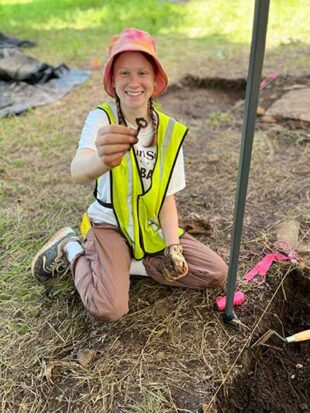
“Going into archaeology field school, I was nervous and did not have the slightest idea on what to do,” Benjamin said. “However, the four weeks I spent in Phenix has given me the skills and confidence I need to fulfill my dream as an archaeologist.”
Within a week after the 2024 session closed, three student participants had job offers to work as archaeological technicians for the remainder of the summer, according to Worman.
Each was offered wages over $20 an hour, he said.
“Students learn useful skills and have fun participating in an archaeological project. The class is an excellent value and the anthropology program’s field archaeology course opens the door to a wide range of professional opportunities,” Worman said.
Explore opportunities in anthropology and archaeology
Discover more from Reynolds College Blog
Subscribe to get the latest posts sent to your email.