Missouri State University

Skip to content Skip to navigation
a b c d e f g h i j k l m n o p q r s t u v w x y z

Reynolds College Blog

Environmental Communication class highlights university’s public affairs mission

May 18, 2026 by Lynn M. Lansdown

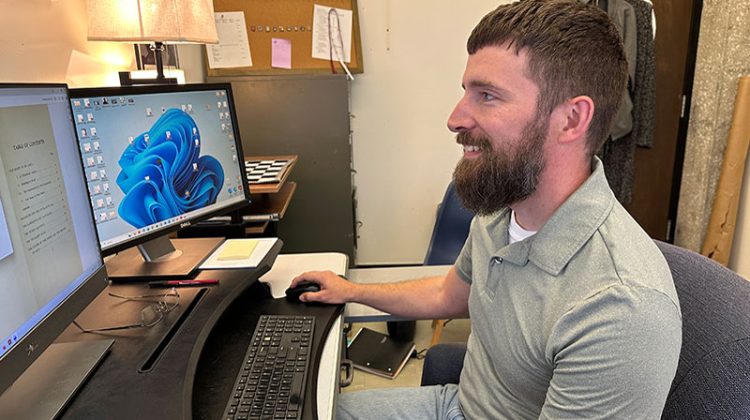
Man sitting at desk looking at computer

When communication majors began enrolling for Spring 2026 classes, they encountered a new offering: Environmental Communication. Structured as a second block online class, this was the first time Environmental Communication had been offered as part of the communication studies curricula.

The course is another choice within the fully online option of the communication studies program, according to Senior Instructor Jay Howard. Its purpose is to help students understand the role of communication in negotiating the relationship between people and the environment.

Howard, who teaches in the Department of Communication, Media, Journalism and Film, created the class as a special topics course. He was thrilled when 29 students enrolled, a number just a bit over the class limit.

Most of the students were upper level communications majors, Howard said. “But we did have people from other majors as well find their way into the class, which I was happy to see. And if I get to teach the class again, I’d love to continue to expand and have people enrolled from all across the university.”

Consumers of environmental messaging

Throughout the course, Howard stressed to students how all members of a society are “consumers” of environmental communication. While not everyone will become a public official or climate activist, he noted, people engage in and consume environmental communication daily.

“We need to be able to critically evaluate [this communication] and have some tools for knowing whether the messaging coming at us is accurate or not,” Howard said. “See what they’re trying to get us to do, and why, and whose agenda is being served.”

Because environmental issues tend to affect entire communities and societies, not just individuals, the topic itself can have a wide reach and impact.

“It’s big, it crosses boundaries, has all kinds of stakeholders that all have to cooperate,” Howard said. “There’s a collective action problem. And when you’re trying to coordinate action, you have to use communication.”

[Read more…] about Environmental Communication class highlights university’s public affairs mission

Filed Under: Community Engagement, Cultural Competence, Ethical Leadership, Feature, Public Affairs, RCASH Highlights Tagged With: communication studies, Department of Communication Media Journalism and Film, environmental communication, Jay Howard, School of Communication

Religion and Healing course emphasizes critical thinking

April 28, 2026 by Lynn M. Lansdown

Students and instructor sitting and talking in a classroom

Students who take Dr. Amy Artman’s Religion and Healing course (REL 378) can expect her to ask a lot of questions.

Artman even starts her course syllabus with questions.

“What does it mean to be healed? How do we cure?” she asks. “Can I be healed without being cured? Cured without being healed? What role does religion play in healing? Does religion have a place in healing?”

She concludes by stating, “These are only a very few of the many questions we will explore together this semester.”

Right away, students understand that Artman will journey with them as they explore the relationships between religion, health and healing. Specifically, students will look at the complex histories of biomedicine, faith and folk healing in twentieth century America up to the present.

Grant-funded course examines role of faith in medicine

Artman first taught REL 378 in 2020. Now a regular offering in the Department of Languages, Cultures and Religions (LCR) curriculum, the class was originally part of a suite of courses developed through a grant. That grant was funded by the Wabash Center for Teaching and Learning in Theology and Religion, Artman said.

Coordinated by Dr. Stephen Berkwitz, Dr. John Schmalzbauer and Dr. Philippa Koch, the grant supported research and course development for the Medical Humanities certificate. Berkwitz, Schmalzbauer and Koch all teach in LCR, and Berkwitz also serves as department head.

Today, introducing students to the debate about whether biomedicine should include a spiritual component remains an important learning objective in the course.

“In recent years, the idea that medical healing should include a spiritual component had basically won,” she noted. “But post-Covid, and as I teach the course in 2026, this discussion is now a live one again, I believe, if in a different way.”

Her goal is not to revive the debate but rather to give students a historical overview of the question and how it has been examined over time.

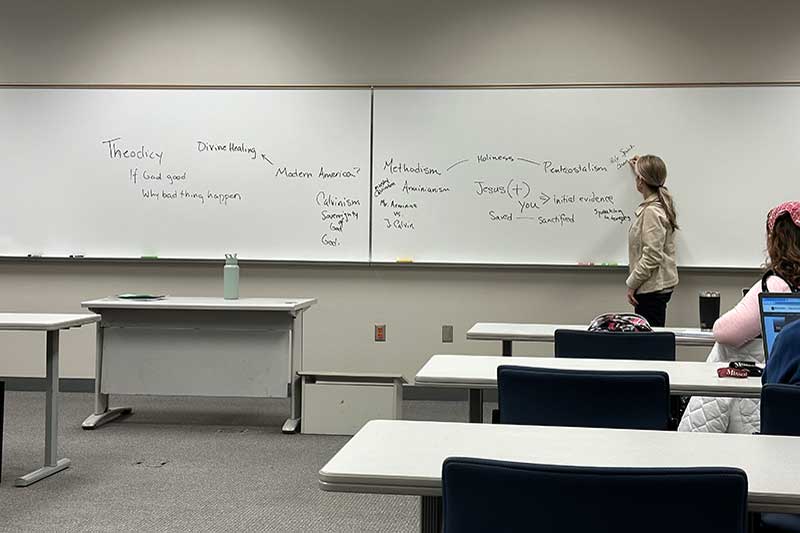
Woman standing in front of classroom writing on board
Dr. Amy Artman reviews historical concepts during her Religion and Healing course.

[Read more…] about Religion and Healing course emphasizes critical thinking

Filed Under: Community Engagement, Cultural Competence, Ethical Leadership, Feature, Public Affairs, RCASH Highlights Tagged With: Amy Artman, Department of Languages Cultures and Religions, John Schmalzbauer, medical humanities, Philippa Koch, religious studies, School of Humanities and Social Sciences, Stephen Berkwitz

Gerontology program readies students to work in the “longevity economy”

April 24, 2026 by Lynn M. Lansdown

Group of aged persons with their caregiver standing outside a building

The American population is getting older—quickly.

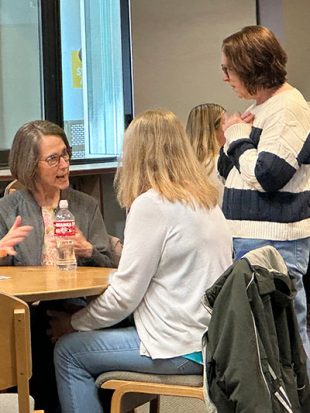
A woman stands at a table and listens to two other women as they speak.
Dr. Maureen Templeman (standing, right) listens to one of the MSU 62 participants in the Unlearning Ageism project.

According to the U.S. Census Bureau, older adults will outnumber children in the U.S. by 2034. The number of people in the U.S. age 65 and older is expected to grow to nearly 90 million by 2050.

As coordinator of Missouri State’s gerontology program, Dr. Maureen Templeman, assistant professor in the Department of Sociology, Anthropology and Gerontology, always has statistics on hand. She can quickly illustrate just how broadly a gerontology education can be applied to what economists call the “longevity economy.” The term refers to the goods, services and industries driven by older adults’ needs and spending habits, Templeman said.

A recent AARP statistic, for example, estimates that adults age 50+ contribute $8.3 trillion annually to the U.S. economy. According to Templeman, this trend contradicts the stereotype that older adults are dependent. Instead, they are consumers, workers, caregivers and community members.

And employers are looking for professionals who can address the needs of this growing population.

Workforce training for the “longevity economy”

Templeman wants students to know that gerontology is not a niche field of study. It is a vibrant and growing career option.

“It’s relevant to almost every career path you can imagine,” Templeman said. “We live and work in an aging society.”

In short, gerontology students graduate with skillsets that can be used in any career. These include, but are not limited to, healthcare, social work, law, finance, public policy, education, architecture, communications and technology.

“Really, any field where understanding the needs and experiences of older adults is an asset,” Templeman said.

[Read more…] about Gerontology program readies students to work in the “longevity economy”

Filed Under: Community Engagement, Cultural Competence, Ethical Leadership, Feature, Public Affairs, RCASH Highlights Tagged With: Department of Sociology Anthropology and Gerontology, Digital Humanities Lab, experiential learning, gerontology, Maureen Templeman, School of Humanities and Social Sciences, workforce training

Digital humanities strategies enhance interdisciplinary research

April 20, 2026 by Reynolds College

Close up of person using digital app on smart phone

The online encyclopedia Britannica defines the humanities as “those branches of knowledge that concern themselves with human beings and their culture.”

In the 21st century, digital technology now dominates all fields and professions, including the humanities. As a result, the field of digital humanities (DH) has emerged as an innovative approach to blending the two.

“There’s a lot of scholarship on what digital humanities is and isn’t,” said Assistant Professor Leah Washburn. “Ultimately, I think it is an area that acknowledges technology as an asset to fields that are often associated with older scholastic traditions.”

One of the most attractive features of DH is its ability to foster interdisciplinary research and teaching, according to Washburn.

“At its core, digital humanities celebrates an interdisciplinary turn in the humanities,” she said. “It invites exploration and inquiry across multiple platforms, fields and subjects in a way that highlights connections between knowledge bases.” [Read more…] about Digital humanities strategies enhance interdisciplinary research

Filed Under: Community Engagement, Cultural Competence, Faculty Research, Feature, Public Affairs, RCASH Highlights, Research, Student Research Tagged With: Department of English, Department of History, digital humanities, Digital Humanities Lab, interdisciplinary, School of Communication, School of Humanities and Social Sciences

Accounting, Biology, Math…and the Arts?

April 10, 2026 by Lynn M. Lansdown

Young man and young woman standing outside near arts park sign

The Judith Enyeart Reynolds College of Arts, Social Sciences and Humanities, or “RCASH,” offers students a variety of academic studies and professional opportunities. Art, theatre, dance, music, communication, history, sociology, languages, criminology and political science are just some of RCASH’s programs.

Opportunities are indeed abundant. Just ask Veronika Yerina, Rocky Lane and Caroline Wolfe.

Yerina, Lane and Wolfe are all pursuing non-RCASH degrees. Yerina, a junior, is pursuing a Bachelor of Science in biology. Lane will graduate this spring with a Bachelor of Science in accounting. Wolfe will graduate this spring with a Bachelor of Science in applied mathematics and will continue her studies through Missouri State’s accelerated master’s program.

Yet these students are also supplementing their degrees with arts-intensive programs and courses. For each of them, there are no contradictions. Studying the arts has improved their professional prospects. They also believe it has made them better humans.

[Read more…] about Accounting, Biology, Math…and the Arts?

Filed Under: Community Engagement, Cultural Competence, Ethical Leadership, Feature, Public Affairs, RCASH Highlights, Student Accomplishments Tagged With: Azaria Hogans, Cameron LaBarr, Carol Chapman, Chris Herr, dance, Department of Music, Department of Theatre and Dance, Jessica Madden, Micheal Foster, opera, School of the Arts

Next Page »

Submit your RCASH News

Send news of accomplishments and major events to RCASHNews@MissouriState.edu.

Categories

  • Alumni
  • Alumni Accomplishments
  • Announcements
  • Camps
  • Club
  • Colloquium
  • Commencement
  • Community Engagement
  • Competitions
  • Concerts
  • Conferences
  • Cultural Competence
  • Education Abroad
  • Emeritus
  • Employment
  • Ethical Leadership
  • Event News
  • Exhibitions
  • Faculty Accomplishments
  • Faculty Research
  • Feature
  • Festivals
  • Field Trips
  • Graduate Student
  • Internships
  • Lecture Series
  • Open House
  • Panels
  • Pre-college
  • Public Affairs
  • RCASH Highlights
  • Readings
  • Recital
  • Remembrance
  • Research
  • Scholarships
  • Shows
  • Student Accomplishments
  • Student Research
  • Tournaments

Archives

Meta

  • Log in
  • Entries feed
  • Comments feed
  • WordPress.org
  • Accessibility
  • Disclaimer
  • Disclosures
  • Equal Opportunity Employer and Institution
  • © 2026 Board of Governors, Missouri State University
  • Contact Information