
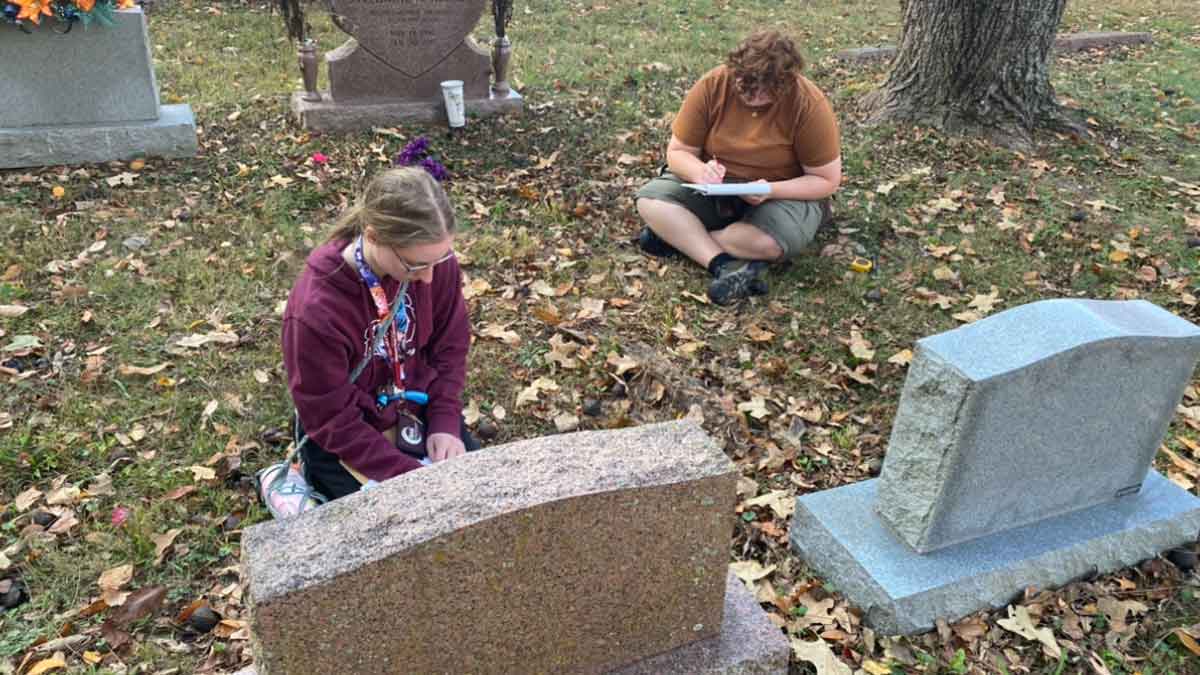
Members of Missouri State University’s Anthropology Club visited the historic Danforth Cemetery in Strafford, Missouri, during the Fall 2024 semester as part of a field trip learning experience.
Nine members, along with club officers Erin Ashford and Cora Darmody, accompanied Dr. Elizabeth Sobel and Dr. Scott Worman from the Department of Sociology, Anthropology and Gerontology on the trip.
Danforth Cemetery history
According to Sobel, the Danforth cemetery was established in the nineteenth century for the burial of White and Black pioneers. The oldest surviving grave markers date to 1860, but the cemetery may have been established before then.
“Black pioneers were enslaved, brought to southwest Missouri by force, rather than by choice,” Sobel said. “Like many other historic cemeteries, the Danforth Cemetery was historically racially segregated, with the south end serving as a burial ground for Black individuals.”
Sobel added that the cemetery remains active, used by descendants of both the White and Black founding families as well as other community members.
Historic ties to MSU
According to Sobel, one goal of the field trip was for students to understand the historical relationship between Danforth Cemetery and MSU.
The Black section of the Danforth Cemetery is but one example of the history of racial segregation in Missouri, she explained. It illustrates for students how their experience at MSU is connected to that history.
Danforth Cemetery is the resting place of Mary Jean Price Walls, the first Black person to apply to (then) Southwest Missouri State University.
Price Walls applied to MSU in 1950, prior to the 1954 Brown v. Board of Education ruling. She was denied admission to the university despite being an academically strong student, Sobel said.
In 2010, MSU granted Price Walls an honorary undergraduate degree in recognition of her significance as the university’s first Black applicant. MSU then named its Multicultural Resource Center after Price Walls in 2016. More recently, in August 2024 the Springfield-Greene County African American Heritage Trail placed a historical marker on the MSU campus to honor Price Walls.
Price Walls died in 2020.

Guided tour provides unique insights
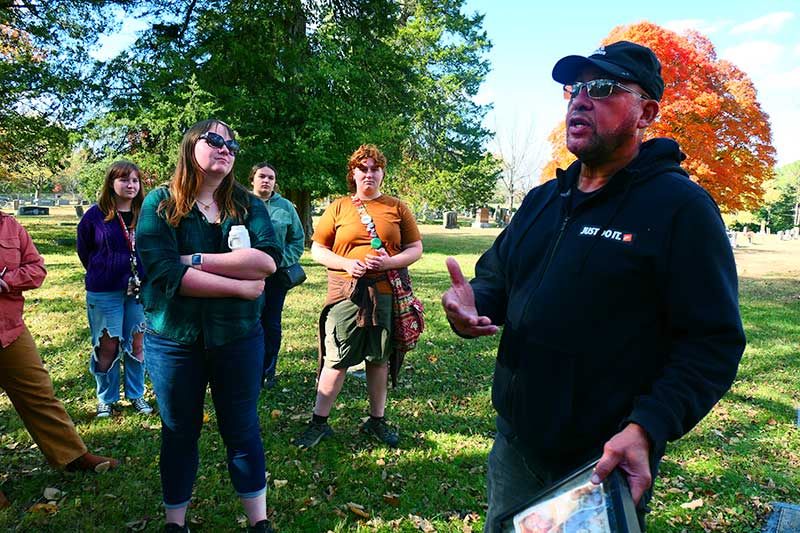
Amin Walls, caretaker of the Black part of the Danforth Cemetery, is the son of Price Walls. As part of the field trip experience, Walls gave the students a guided tour of the property.
The Price family has continued to use Danforth Cemetery up to the present day, Sobel said. Walls, a descendant and relative of many individuals buried there, provided unique insights about the cemetery’s history and cultural relevance. During the tour, he pointed out family members’ graves, many of them dating to the nineteenth century. He also discussed the area dedicated to the burial of enslaved persons.
It was important for the students to learn directly from Walls, Sobel said, as he could teach them about the site’s significance in local and regional Black cultural heritage.
“I was very intrigued by the history of this cemetery,” said Ashford, a junior history major. “From a historical perspective, this trip helps students gain an understanding of how our past has been impacted by things like racism and how it has impacted every area of life, including death.”
Opportunity to practice skillsets
After the tour, the students gathered for instructions from Sobel and Worman on how to document the gravestones. The group concentrated specifically on the historically Black section of the cemetery.
Ashford said the students split into pairs and used tape measures to note each gravestone’s dimensions. Additionally, they identified the type of stone used for each marker by comparing them to samples of common headstone materials.
The students also documented the text, images, form and condition of each marker, according to Sobel.
“We knew that the students would enjoy and remember the grave marker documentation — it was intellectual, tactile, and social, and took place outside on a beautiful fall day,” Sobel said. “We hoped that this brief but high-impact hands-on experience would motivate students to seek out additional anthropological field, lab and research opportunities.”
Site speaks to “real-world” importance
Darmody, a senior anthropology major, was on hand to assist the other students. She previously took Sobel’s historical archaeology course, which helps students develop skills to identify stone types and document grave markers. The course also requires that students complete a historic grave marker research project.
The historical archaeology course not only helped Darmody assist other students, it has also prepared her for an upcoming project on the Danforth Cemetery.
“This experience was the start for me in my individualized research project that I will be doing at the Danforth Cemetery,” Darmody said. She will work with Walls, Sobel and Worman to document the cemetery and submit materials for its inclusion in the Black Cemetery Network.
According to Sobel, the Black Cemetery Network is part of a national effort to identify, document and preserve Black American cemeteries.
“Black Americans and other marginalized groups were often pushed out of the communities where their ancestors are buried, thus many of their burial grounds are endangered,” Sobel explained.
Caring about and preserving the past
Sobel said she and Worman wanted this field trip to provide students with hands-on experience in documenting and understanding the significance of historic cemeteries like Danforth.
“We hoped that in light of the tour and talk by Amin Walls, the brief foray into grave marker documentation would help students understand the real world importance of such work to the descendants and the public,” Sobel said. “They can better understand the link between past and present by visiting and learning about sites such as the historically Black section of the Danforth Cemetery.”
The historical lesson did not go unnoticed by Darmody.
“The hard work and dedication that he [Walls] has put into keeping this cemetery running is amazing,” Darmody said. “He cares, and that is what makes it special.”
Explore degree options in anthropology
Photo credits: Elizabeth Sobel.
Discover more from Reynolds College Blog
Subscribe to get the latest posts sent to your email.