
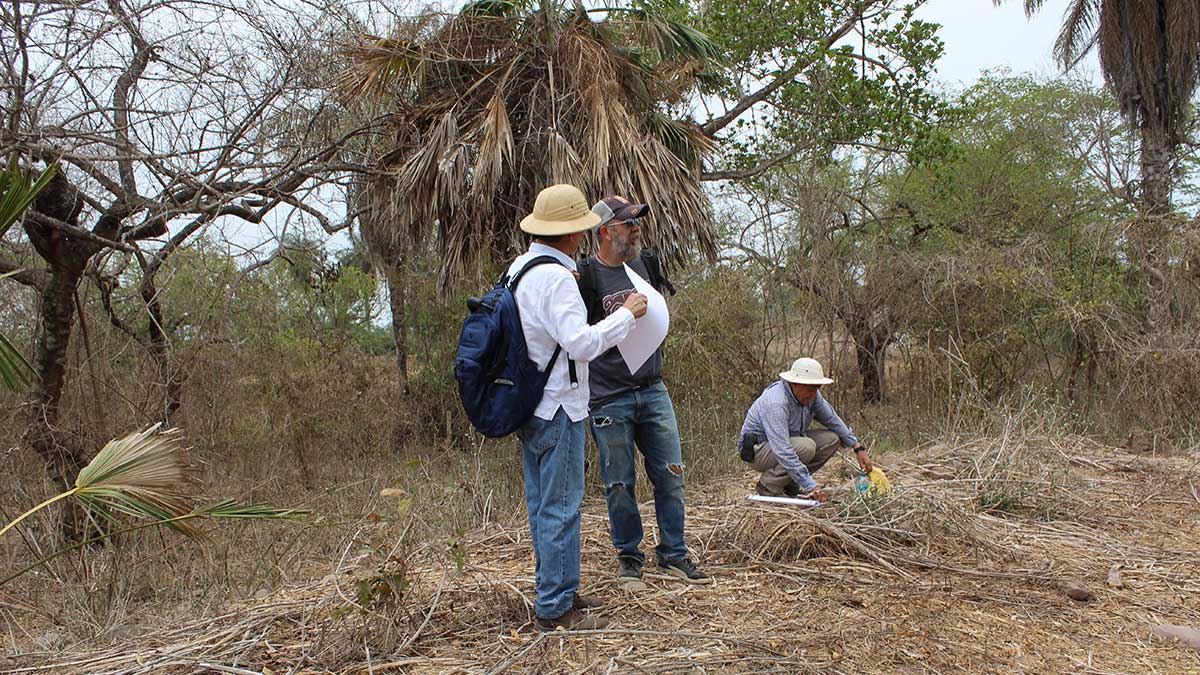
Missouri State University’s Dr. Daniel Pierce, research archaeologist in the Bernice S. Warren Center for Archaeological Research (CAR), recently completed a trip to western Mexico to investigate an ancient pottery find. During his visit, Pierce also viewed a potential research excavation site and gave a presentation on his research.
Funded by a Missouri State faculty research grant, the trip ran from May 28-June 4.
Ancient pottery holds clues to the past
Pierce traveled to Mexico to analyze a collection of Classic Period pottery (ca AD 700). This collection was found at a site in the western Mexico state of Nayarit.
For the analysis, Pierce used geochemical and neutron activation processes. The University of Missouri-Columbia’s Archaeometry Laboratory granted Pierce access to its nuclear reactor for the neutron activation testing. Neutron activation, which takes several weeks, causes each ceramic artifact to radioactively decay. “Through this radioactivity, we can determine the chemical composition — or elemental make-up — of the artifact,” Pierce explained.
This testing process reveals the artifacts’ composition, which should be the same as any artifact produced with the same material. Thus, because pottery is made of clay, its composition will resemble the soil where the clay was extracted. “This means that we can tell where the artifact was created,” Pierce said.
Pierce expects to have the test data in early September. He will analyze the data and draw a firm conclusion about the pottery at that time.
Connecting ancient societies?
The Nayarit pottery discovery presents some fascinating possibilities.
“The interesting thing about this pottery is that it appears to have come from the great city of Teotihuacan,” Pierce observed. Teotihuacan was the largest ancient city in Central America. It was located in central Mexico, hundreds of miles from Nayarit.

With his previous research, Pierce identified obsidian from the Teotihuacan region located at sites in western Mexico. Obsidian is a volcanic glass that was used to make blades and knives.
As of yet, however, no one has discovered any other ancient trade items — like pottery.
“If this pottery is in fact from Teotihuacan, this would be the first ever discovery of Teotihuacan pottery this far west,” Pierce said.
Insights into broad cultural shifts
According to Pierce, if pottery was traded in western Mexico, this would indicate that a connection existed between the two regions. Moreover, this connection would have occurred at a time when both regions experienced significant population, socioeconomic and cultural changes.
Pierce was excited to speculate on what the discovery might mean. “Perhaps this could be the first clues suggesting that as Teotihuacan was in decline and the city was de-populating, maybe some people made it all the way to the west coast of Mexico. They may have influenced the birth of the Aztatlán Tradition.”
Even if the pottery is not from Teotihuacan, Pierce noted, the find still illustrates that “a really interesting phenomenon” was taking place. In short, someone was reproducing Teotihuacan styles in western Mexico. According to Pierce, this suggests one of two possibilities: either a Teotihuacan artisan migrated from central to western Mexico, or someone in western Mexico was familiar enough with the styles to perfectly replicate them.
“Either way, it represents a cultural connection with the transfer of knowledge between two very distant regions and cultures,” Pierce said.
Potential excavation site at Las Animas
Also during his visit Pierce, with his colleague and friend, Mauricio Garduño Ambriz, evaluated the western Mexico site of Las Animas as a potential excavation project.
“Our intention would be to learn as much as possible about the site and how it related to the rest of the coastal plain of Nayarit during the Aztatlán Tradition,” Pierce said about their future goals.
Las Animas is about an hour by car from Tepic, Nayarit’s state capital. The site became a point of interest about ten years ago, Pierce noted, with the launch of a public works project. Ambriz, an archaeologist with the Instituto Nacional de Antropologia e Historia (INAH) was the first to document the site.
Unusual discovery
When Pierce and Ambriz explored the site, they paid special attention to its large mounds and altars.
“Often at sites such as these, the altars are oriented in such a way that the sun will rise directly over them during the solstice,” Pierce explained. “This was important, as this welcomed the return of the sun with the new year.”
The Las Animas site was different, though. “Here, the sun would rise over the altar at the equinox instead,” Pierce said. “This is not common. However, indigenous people in the region today – the Huichol and Cora people – also celebrate the equinox rather than the solstice.”
Pierce explained that this decision was based on regional rain patterns and agricultural needs. “Though the rains have yet to start on the coastal plain by the equinox, they have started in the highlands. This means that the floods start ahead of the rains. This would have been an incredibly important time, as it would signal the best time for crops.”
Las Animas might represent a thousand years of cultural and traditional continuity in the region, Pierce observed. “This would be an incredibly exciting discovery.”

Lecture series invites international dialogue
In addition to his research, Pierce delivered a lecture at the invitation of the INAH Museo Regional de Nayarit. The museum asked Pierce to discuss his research as part of its lecture series. His presentation, “Utilization and social use of obsidian in Nayarit during the Prehispanic period,” reviewed his research on obsidian artifacts.
“I felt especially honored to receive the invitation,” Pierce said. “It is rare for a foreigner to be invited to give a lecture at the State museum.”
Photo credits: Jasmine Pierce except where otherwise indicated.
Discover more from Reynolds College Blog
Subscribe to get the latest posts sent to your email.