

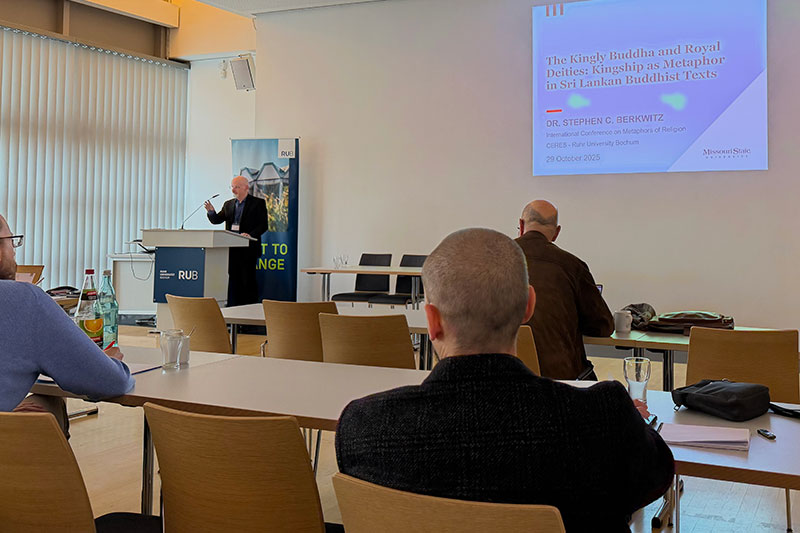
Missouri State University’s Dr. Stephen Berkwitz and Dr. Bryan Brinkman recently presented their research at the “Metaphors of Religion” conference at Ruhr University in Bochum, Germany.
Berkwitz is head of the Department of Languages, Cultures and Religions (LCR). Brinkman is an assistant professor in LCR.
The conference was held Oct. 27-29 at the Center for Religious Studies (CERES). Organizers describe it as an interdisciplinary event that “explores metaphors as fundamental elements of religious language, thought and practice across cultures and historical periods.”
Berkwitz and Brinkman attended the conference as part of a formal agreement between LCR and CERES. Created to foster collaborative relationships, the two groups signed a memorandum of understanding in 2019. Berkwitz helped write the memorandum in consultation with members of CERES.
In particular, LCR and CERES hope the agreement strengthens international collaboration. In turn, the agreement might increase research and course opportunities for graduate students and faculty members, Berkwitz said.
Berkwitz examines royal imagery in Buddhist texts
Berkwitz’s latest research explores the use of royal imagery to describe the Buddha. He presented “The Kingly Buddha and Royal Deities: Kingship as Metaphor in Sri Lankan Buddhist Texts” at the conference.
“[This] was a literary convention that was augmented by a rise in eulogistic praise texts in medieval Sri Lanka,” Berkwitz explained. “This historical development, in turn, was the result of increased political and cultural influences from the Indian mainland starting around the tenth century CE.”
Berkwitz read and analyzed Buddhist literature, especially the fourteenth century “Sinhala Bodhivamsaya,” to identify royal metaphor usage. He built his theoretical foundation on metaphors from the works of George Lakoff, Mark Johnson and Zoltan Kovecses.
“I concluded that the description of the ‘kingly Buddha’ is not in fact incongruous but served as an extension of the use of royal metaphors for deities as well,” Berkwitz said. “The descriptions of great beings in premodern Buddhist literature often resorted to using metaphors of kingship to make them easier to comprehend and venerate.”
Brinkman explains metaphors in Roman monuments
Brinkman presented, “The Egyptian Gods as Metaphor in Imperial Rome: Historical and Material Considerations.”
Not all historical evidence is in written form, as Brinkman illustrates in his research. Using Roman monuments as examples, he examined how the Romans linked messages of “imperial peace” to changing notions of Egyptian divinity.
Brinkman focused on two examples: the “Altar of Peace” and the “Temple of Peace.” Each structure represented physical and symbolic ties to Egyptian religious monuments. And, as “metaphorical visual language,” these monuments illustrated how Romans understood religious change.
The Ara Pacis, for example, was connected to one of the obelisks Augustus brought from Egypt as a war spoil, Brinkman explained. While also a monument to Roman imperialism, its underlying message to the Roman people was “peace through conquest” of Egypt.
“In both cases, these were overt symbols of Roman peace whose aim was to communicate ‘peace established’ or ‘peace restored’ through the actions of [their] respective rulers,” Brinkman explained.
Enjoying international scholarship
Both Berkwitz and Brinkman appreciated the opportunity to learn from a wide body of international scholarship.
The conference serves as a “great example” of the global intellectual connections Missouri State’s scholars continue to create, Brinkman said. “I hope for continued collaboration of this sort in the future.”
Photos provided by Stephen Berkwitz and Bryan Brinkman.
Discover more from Reynolds College Blog
Subscribe to get the latest posts sent to your email.