
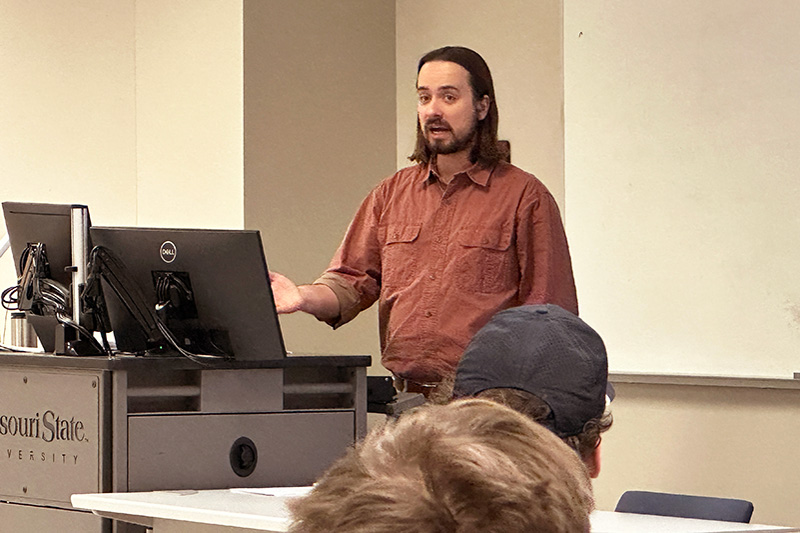
Missouri State University’s Dr. Steve McKnight, assistant professor in the Department of Political Science and Philosophy, has been named a Founders Fellow of the American Society for Public Administration (ASPA).
The Founders Fellows program provides a support network for early-career public administrators and public administration scholars, McKnight said.
McKnight is a member of the 2026 Founders Fellows cohort. He will present his research at ASPA’s annual meeting March 20-24, 2026, in Hollywood, California.
“At the conference, fellows present their research, attend professional development workshops, and get paired with an experienced member of ASPA that connects with the fellow’s career interests,” he said.
As part of the fellowship, ASPA provides financial and logistical assistance to attend the conference.
Opportunity to engage with public administration professionals
ASPA’s emphasis on connecting public administration academics and practitioners immediately impressed McKnight.
“As a professor, it is fairly easy for me to access literature and theory on the topics of learning, local government and resilience,” McKnight noted. “However, I don’t always have the opportunity to speak with the very people who I am hoping to help.”
That’s where attending the ASPA conference becomes especially useful.
“[It] gives me a chance to hear from professional government employees and learn about the challenges they face and the solutions they hope to implement,” McKnight said.
Making research useful and relevant
McKnight hopes his research can eliminate some of the guesswork out of public administration and make their jobs “a little bit easier.”
“I like to make my research as useful as possible for public servants who are dealing with real-world problems,” McKnight said.
“Governing is not easy work,” he continued. “Public administrators are often expected to accomplish very much with very little resources.”
Career inspired by father’s example
An important factor leading to McKnight’s interest in public administration stems from his childhood. He grew up watching his father navigate between different levels of government as a conservation biologist for the U.S. Fish and Wildlife Service.
“[My dad’s] work was really inspiring to me as a child,” he said. “Once I realized that biology and ecology weren’t my strong suits, it was pretty clear that studying government and political science was a natural extension of my curiosity.”
Particularly noteworthy, McKnight recalled, was observing how his father helped communities determine how to use BP restitution funds around the Gulf Coast after the Deepwater Horizon spill in 2010. Not only did his father’s experience inspire McKnight to write a high school senior thesis, it steered his professional future.
Fellowship will enhance classroom experience for students
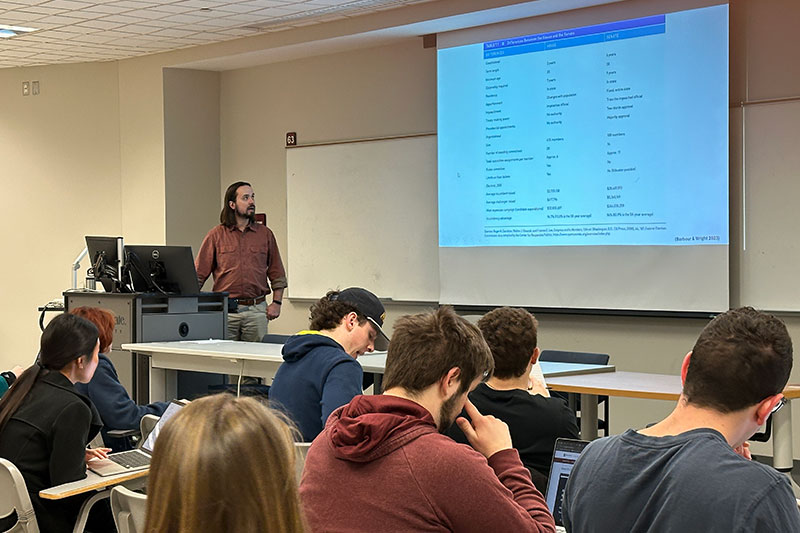
While the fellowship expands his professional network and supports his research, it also enhances McKnight’s teaching. The ASPA Fellow allows him to hear the perspectives of public administration professionals outside of academia.
“Hopefully, I can share their insights with our [Master’s in Public Administration] students and prepare them for the future,” he said.
McKnight brings strong academic credentials and real-world experience to the classroom. He earned his bachelor’s and master’s degrees in political science and public administration at Texas A&M University. After working in the public sector, McKnight earned his doctorate in public administration and public policy from Auburn University. His academic areas of interest include emergency management, community planning and environmental justice.
Currently, McKnight teaches Policy Analysis (PLS 673), the seminar in Public Administration (PLS 771) and courses in American Citizenship & Democracy (PLS 101). He will add emergency management classes to his schedule in the near future.
Teaching to make a difference
Because he specializes in emergency management, McKnight can use disaster response examples in all his classes. He even incorporates these examples in his PLS 101 course to illustrate dual federalism and cooperative federalism.
Students respond to these examples, McKnight believes, because they want to know that what they study will make a difference in their lives.
“Considering how often we interact with public administrators and public goods in our day-to-day lives, I feel that it is important for students to understand how their governments work at all levels: federal, state, and local,” he said. “If I can help students understand how to participate in civic life in a way that gives them more agency, then I will consider my teaching a success.”
About ASPA
ASPA is the leading professional membership association for public service, according to the organization’s website. Its members represent all areas of public administration. These include civil servants, city managers, elected officials, appointed officials, researchers, scholars, thought leaders and nonprofit managers. Currently, ASPA boasts more than 50 local chapters and 30 subject matter sections.
Study public administration at MO State
Photo credits: Lynn Lansdown
Discover more from Reynolds College Blog
Subscribe to get the latest posts sent to your email.