
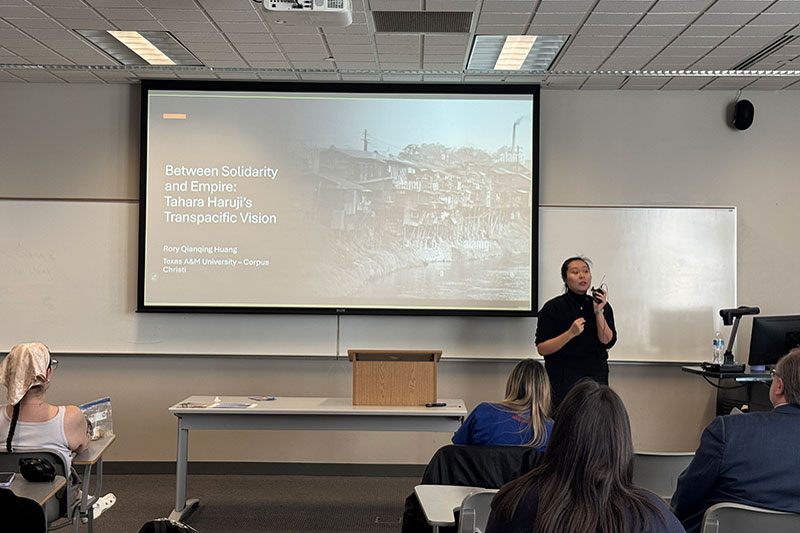
Missouri State University’s Department of History recently welcomed Dr. Rory Huang as a guest lecturer Feb. 23, 2026.
Huang is an assistant professor of history at Texas A&M University-Corpus Christi. She received her Ph.D. from the University of California-Los Angeles in 2023.
In her lecture, “Between Solidarity and Empire: Tahara Haruji’s Transpacific Vision,” Huang discussed the transpacific influences informing Tahara Haruji’s political vision. Haruji was a Buraku activist associated with the Suiheisha movement, Japan’s first nationwide human rights movement.
Huang spoke to students in Dr. Linshan Jiang’s Modern East Asia (HST 381) course. Several faculty, staff and students from other classes also attended the lecture.
Jiang, an assistant professor specializing in East Asian history and culture, coordinated the event. She estimated 40-45 people attended.
Social movements, diaspora and Buraku activism

Huang’s work focuses on Buraku minority rights, social movements and diaspora in the Japanese Empire.
According to her, the Burakumin were a historically marginalized group in Japan. Their social exclusion persisted even after legal discrimination was abolished.
Huang’s research highlights the Burakumin experience by examining Haruji’s time in the United States during the 1920s. While in the U.S., Haruji witnessed African American freedom movements and racial exclusion. These encounters influenced Buraku critiques of inequality and Japan’s own imperial contradictions.
Research a labor of love
Initially, Huang became interested in the Buraku as a research project while still an undergraduate student.
“During my stay in Nagasaki as an exchange student, a close friend revealed to me his Buraku identity and spoke extensively about his family stories,” she said. “Over the past decade, I went back to Japan frequently to learn more about those communities and their activism.”
The project continues to be a labor of love for Huang. She has worked on the topic since 2015. It was also the focus of her doctoral dissertation research.
Vibrant discussion
Jiang was pleased with the event’s turnout and audience response. “We had a really vibrant discussion for the last 30 minutes of the event,” she said.
In particular, students asked about the links between Haruji and black activists like Marcus Garvey. They also expressed interest in Haruji’s time as a student within the University of Missouri system in the 1920s.
“The students asked questions about Burakumin’s histories, their comparative status as other colonial subjects of the Japanese empire, and questions about caste in general,” Huang said. “You [could] see they really tried to understand this by contextualizing.”
“I loved the students and their engaging comments and questions!” Huang added. “It was a real honor to be there.”
Seeing and hearing how scholars work
For Jiang, the lecture gave her students multiple examples that deepened their understanding of the connections between empire, race and social movements in modern Japan and East Asia.
“By examining Buraku activism, migration and imperial expansion through a transpacific lens, [Huang’s research] complements course units on Japan’s modernization, colonialism and social movements in the early twentieth century,” she explained.
Huang’s discussion also presented students with an opportunity to see cutting-edge historical research firsthand, Jiang said. “The lecture fosters intellectual exchange beyond the classroom by creating opportunities for students to engage directly with a scholar whose research bridges East Asian history, diaspora studies and global racial politics.”
By telling stories about trans-imperial and transnational crossings of people and ideas, Huang hopes students can see and understand broader global historical connections.
“Students will come to see that these histories are not isolated narratives about individuals or separate nations,” she noted. “Rather, they are deeply intertwined, revealing how movements, ideas and struggles were connected across borders throughout history.”
Discover more from Reynolds College Blog
Subscribe to get the latest posts sent to your email.