
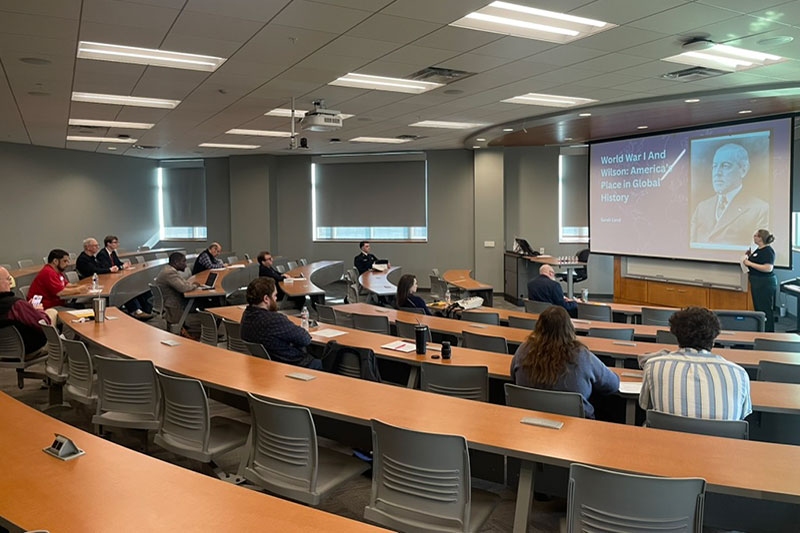
Elayna Eastin and Sarah Land, two MA students from Missouri State University’s Department of History, recently presented their research at the regional Phi Alpha Theta (PAT) conference.
The conference was held March 14 at Arkansas State University in Jonesboro, Arkansas. Phi Alpha Theta is the national History Honor Society.
This year’s conference theme was “250 Years of US and the World.”
Papers highlight American role in world affairs
Eastin and Land selected topics that highlight America’s role in world affairs, especially in the late 19th and early 20th centuries. For both students, this was their first time to present at a professional history conference.
“As the faculty advisor for PAT, I was so proud of both students for the excellent presentations they delivered,” said Assistant Professor Chelsea Davis.
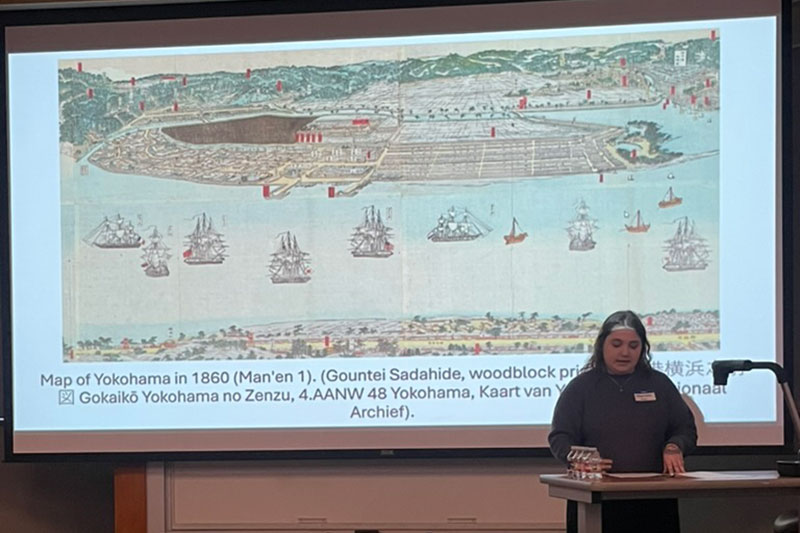
Eastin discussed her research on 19th-century Yokohama, Japan. In “Harbor Of Change: The Social And Cultural Whirlwind of 19th-Century Yokohama,” she shows how after 1859 the port city became an international trade center by developing a robust tourism industry.
Now in her first year of graduate studies at Missouri State, Eastin also works as an archivist at the State Historical Society of Missouri. Long term, she is also considering furthering her education at the doctorate level.
Meanwhile, Land presented a historiographical paper, “World War I and Wilson: America’s Place in Global History.” Her paper explored how scholarship on America’s influence during the post-World War I era has changed over the past 30 years.
Land, who will graduate this spring, hopes to one day pursue a doctorate in history.
Academic and financial support essential to success

According to Davis, Eastin and Land received support through the Student Achievement funding program offered by Missouri State’s Reynolds College of Arts, Social Sciences and Humanities (RCASH). The funds helped defray conference fees and travel costs.
Eastin and Land appreciate the support they have received from the history department and RCASH.
This “allowed us to focus on the conference itself without worrying about paying for it or not having the money to attend,” Eastin noted.
“Everyone in the department has been helpful in encouraging an environment of academic excellence and the growth of my historical reasoning skills,” Land said.
Both students also praised Davis for her guidance. Davis worked hard to provide feedback and meet with them to practice their presentations, they noted. She even helped them navigate the logistics of attending the conference.
Students employ traditional research methods, shun AI
Eastin said her research methodology involved finding comprehensive source material to highlight the themes and arguments she began to identify.
“Most of these sources came from both libraries and online databases, but also as recommendations from professors who encouraged me to look into other areas, such as the tourist industry and souvenir photography,” she explained.
For Eastin, AI methods are not an option. The technology inhibits her full understanding of her topic, she said.
“I do not use AI at all within my research or writing,” she said. “As a history student, my critical thinking skills and ability to interact with historical processes, documents and theories rely on direct interactions with the source material. I have to deeply understand the material, its nuances and complexities, and the contradictions in order to make sound, well-rounded arguments that acknowledge all of these issues.”
Using AI, Eastin said, would prevent her from identifying those details.
“If I had used AI, I would not have been able to as successfully present my research or answer questions about it,” she said. “I wouldn’t have understood it as deeply as I needed to.”
“History, at least to me, is much more than its summaries or synopses of events,” Eastin continued. “It is understanding and applying the past in new ways that allows us to see a different view of the world.”
History “a human endeavor”
Because Land’s paper involved historiographical research and synthesis, she found nearly all of her sources through Missouri State’s Duane G. Meyer Library.
Like Eastin, Land avoids using AI for any of her history writing.
“AI is tricky to incorporate when the goal is original historical research,” she said. “AI obfuscates the original human source in attempts to present simplified information. History is an inherently human endeavor, and humanity is a prerequisite for good historical research.”
Conference experience increases academic and professional prospects
Eastin gained experience in receiving and applying constructive criticism by interacting with other history professionals. “This conference greatly enhanced my academic goals,” she noted. “I got the opportunity to engage actively with other history professionals who asked great questions and forced me to consider my project within a new light.”
For Land, one highlight of the conference was presenting with other history students.
“We had a wonderful Q&A after the presentations,” she recalled, adding that the audience asked engaged and insightful questions.
Land was delighted when her panel’s chairperson said she had made historiography fun.
“I would like to engrave that on my tombstone now!” she said.
Photo credits: Chelsea Davis.
Reynolds College blog posts are human researched, written and reviewed unless otherwise indicated.
Discover more from Reynolds College Blog
Subscribe to get the latest posts sent to your email.