

Missouri State University faculty members Dr. Linshan Jiang and Stacy Johnson got an idea during a Writing Circle event sponsored by the Faculty Center for Teaching and Learning (FCTL).
Johnson was intrigued when Jiang mentioned she would be hosting an event featuring activist Shiori Itō. Jiang is an assistant professor in the Department of History. Johnson is a licensed clinical assistant professor in the Social Work program.
“We began discussing how meaningful the experience could be for social work students,” Johnson said. “From there, we collaboratively developed an outline designed to create a deeper and more meaningful learning experience for students.”
The result? The social work and history programs collaborated to bring Itō to Missouri State’s Springfield campus for a two-day speaking event April 20-21, 2026.
Itō is a Japanese journalist and filmmaker whose work focuses on gender equality and human rights issues. She published her memoir “Black Box” upon which the documentary is based, in 2017. Time magazine named her one of its “100 Most Influential People” in 2020.

Students take lead in coordinating event

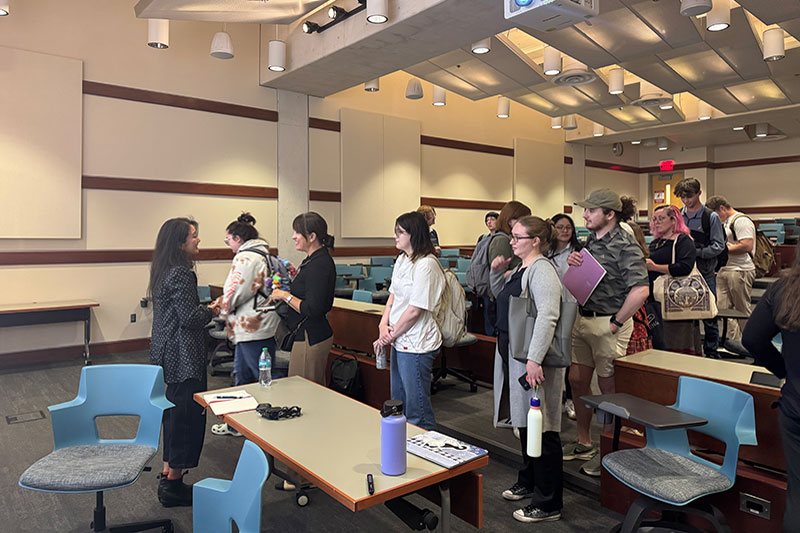
First, Itō spoke to Jiang’s Modern East Asia students April 20. Over 60 people attended that event. During that session, Itō defined the Me Too movement and explored its history and repercussions in Japan and China. She also took questions from Jiang and the audience.
The next day, April 21, Itō met informally with Johnson’s social work students, fielding questions and listening to their observations. Seniors Hannah Byers and Breauna Cater co-facilitated the discussion. Both are majoring in social work, and Byers is president of the Social Work Club.
“Our facilitators, Hannah and Breauna, did an amazing job,” Johnson said. “We intentionally wanted the experience to be student-led in order to promote engagement, reflection and active participation.”
“It was a great honor meeting Shiori Itō,” Byers said. “Listening to her story of resilience and courage inspired me to be a better advocate and future social worker. I look forward to sharing her powerful story with others.”
Dual purposes, same goal
Jiang organized the event to reinforce topics in her Modern East Asia course. She wanted her students to see how East Asian history connects to ongoing social and cultural phenomena in Japan.
“The event also offered a comparative perspective on the histories of feminist movements in both Japan and the United States,” she added.
Meanwhile, Johnson hoped the event would encourage her students “to engage with the experience on a deeper level than simply viewing a documentary.”
“I wanted them to critically reflect on how witnessing stories like these can promote advocacy, deepen empathy, and influence the work we do as social workers,” she explained. “More broadly, I hoped students would recognize the importance of listening to lived experiences and consider how social workers can help foster intentional change at both individual and systemic levels.”
The results were overwhelmingly positive, Johnson noted. “One of the most meaningful aspects for me was the discussion that followed the event,” she said. “I largely took on the role of observer. I was encouraged by how engaged and attentive our students were throughout the workshop.”
“What impressed me most was how meaningful the event was for students,” Jiang said. “Many told me they felt less alone and more willing to speak about their own experiences with gender-based violence after reading Shiori’s memoir or watching her film. Some even shared her story with family members.”
“Hearing students describe the experience as ‘monumental’ and share that it was one of the most impactful learning experiences they have had will stay with me for a long time,” Johnson added.
For Jiang, this was the most powerful aspect of Itō’s visit. “It created a space for exposure, reflection and openness.”
“All history is contemporary history”
Jiang quoted the Italian philosopher Benedetto Croce to illustrate how Itō’s speaking event reflects the overall goals of the history program.
“All history is contemporary history,” she said. “In this sense, past events and current developments are mutually intelligible. By learning about historical contexts alongside contemporary issues, students gain a deeper and more meaningful understanding of both.”
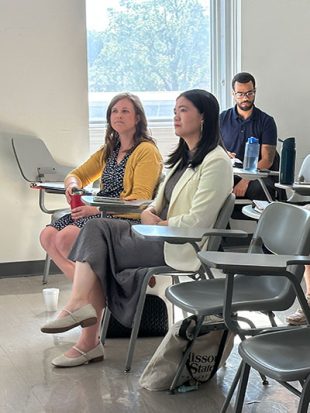
Johnson, too, made clear connections between Itō’s history and the social work profession. “Experiences like this allow students to connect complex human experiences directly to social work practice,” she said.
“Collaboration is everything”
Both Jiang and Johnson enthusiastically encourage more interdisciplinary collaboration between different schools at Missouri State.
“In today’s world, interdisciplinary knowledge is essential,” Jiang said. “Faculty and students can learn a great deal by engaging with different perspectives. For example, I have studied trauma primarily from historical and cultural perspectives, but I have had limited opportunities to engage with its connections to mental health and social work. Collaborating with Stacy has been especially rewarding in this regard.”
“I often say, ‘collaboration is everything,’” Johnson said. “Opportunities to engage with varying perspectives allow all of us to grow collectively and deepen our understanding of others’ lived experiences. These collaborations help foster empathy, connection and a greater sense of safety and awareness across disciplines and backgrounds.”
Photo credits: Lynn Lansdown except where otherwise indicated.
Reynolds College blog posts are human researched, written and reviewed unless otherwise indicated.
Discover more from Reynolds College Blog
Subscribe to get the latest posts sent to your email.