
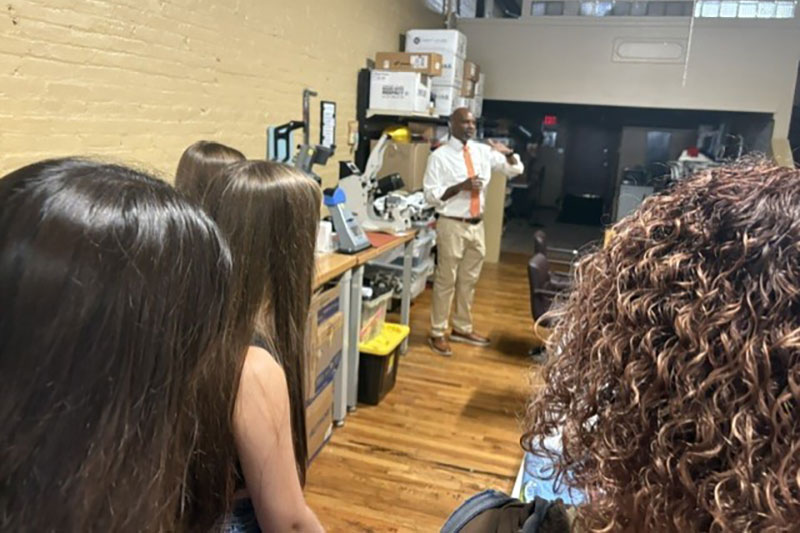
When Associate Professor Dr. Lyle Q. Foster learned about the Engaged Civic Learning and Economic Mobility Project, he immediately saw an opportunity to apply its concepts in the classroom.
Specifically, Foster had his eye on revisiting Public Sociology and Community Studies (SOC 398), a course offered through the Department of Sociology, Anthropology and Gerontology.
“I felt it was time for a revamp of the course, and some of the [project] criteria really interested me,” Foster said. “Community sociology is such a passion for me. The opportunity to blend it with entrepreneurship—a personal passion—seemed ideal.”
The project is a faculty and staff cohort initiative run by the American Association of State Colleges and Universities (AASCU) American Democracy Project.
Foster applied to the project, was accepted and began training in March. The training, which ended in June, included a one-week conference and several virtual sessions with cohort members.
From there, Foster was eager to implement its objectives into his community-facing classes “as soon as possible.”
Community-engaged learning focuses on economic mobility
Previous public sociology courses have always used community partnerships, Foster said. Key to the revised course, however, is the concept of economic mobility.
The goal of economic mobility is already built into the role of the community partners, Foster said. The revised course, however, allows students to also learn about its importance. For them to achieve this, Foster specifically sought businesses “where the students could potentially see themselves as customers.”
Foster also wanted students to work with businesses that are entrepreneurial in nature but have only a few employees. Doing so, he explained, allows the students to directly engage and work with the store owner/entrepreneur.
Moreover, he sought businesses willing to work with university students and listen to their ideas. The results, he noted, are community partners invested in the planning and evaluation of the course.
“Community-engaged learning encourages a still more active role for the community…in the curriculum design and the student engagement experience, which is quite exciting,” Foster said. “There is a different level of curiosity and engagement with this approach.”
Working with local business to understand community
For the Fall 2026 session, students will identify the essential elements of a community, what functions a community provides and why community is important, Foster said. To do this, they will work with two Springfield businesses: Ozarks Life and Serendipity.
Ozarks Life is a local T-shirt and clothing store located on Springfield’s historic Commercial Street. Serendipity, a local gift shop, is also located on Commercial Street.
Throughout the semester, students will engage frequently with the two stores. Initially, they will review the Springfield Community Focus Report, using it as well as other data to learn as much as they can about challenges and opportunities in the market or trade area for the assigned business.
From there, they will apply skills learned in class, such as public sociology theory and community research skills, to identify strategies that will assist the entrepreneurs in understanding their local communities.
“We will consider the impact of housing, poverty, unsheltered, food deserts and other social issues on the community and businesses,” Foster said.
For their assignments, students will complete reflection activities, present an extensive community report to the entrepreneurs and complete an exam.
“Students will discover what it might be like to utilize the learning and takeaways from the course for their own career perspectives,” Foster said.
Public Affairs mission
The revised public sociology course models Missouri State’s public affairs mission very effectively, Foster said.
“I think the values of the university are all over this,” he noted. “Students get out of the classroom. [They] encounter social and economic challenges that communities face that they have had very little experience with. They learn about Springfield in a way that they have not known before.”
Foster looks forward to seeing how the course’s new approach works out.
“The student experience was fairly predictable in the past, as they were often with similar agencies,” Foster recalled. “This fall I have no idea what the finished product will look like, and I love it.”
Reynolds College blog posts are human researched, written and reviewed unless otherwise indicated.
Discover more from Reynolds College Blog
Subscribe to get the latest posts sent to your email.