
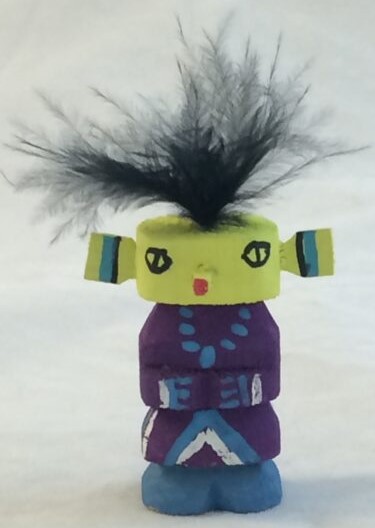
Kachina figures are made by many different Native cultures of the American Southwest region, but they are believed to have originated with the Hopi culture. The more geometric, compact, and simplified Kachina figures, or Tihu figures (plural Tithu), are traditional sculptures that depict Hopi spirits and serve as educational, religious objects; these figures are carved by the men of the community, and they are given to girls during the Kachina season to help them learn about the many different Kachina spirits.
The more active, naturalistic, carved wooden figures, sometimes called Kachina dancer figures, are depictions of Hopi men who wear the regalia of certain Kachina spirits while they engage in ceremonial dances to honor the spirits during the Kachina season. The tall, willowy figures that are made of many different media, sometimes called Kachina spirit figures, are creative depictions of Kachina spirits. Both of these latter two types of Kachina figures are made by both male and female artists, for commercial purposes. While they are genuine works of art by Native artists, these types of figures do not have a religious function, and the buying and selling of these figures is therefore not controversial.
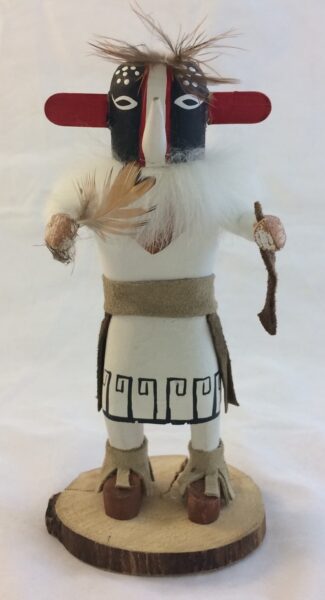
Navajo/Diné culture
Late 20th-early 21st century
Wood, pigment, felt, fur, and feathers, L. 6.5 cm x W. 7 cm x H. 16 cm
BFPC collection #2012.44
With its helmet mask and phallic, corn husk nose, this dancer figure depicts a man wearing the regalia of Kokopelli, a Kachina spirit of fertility and story-telling as well as a prankster. While Kokopelli is known most widely from his depiction in pictographs and petroglyphs as a charming, hump-backed flute player, this image is a later permutation of depictions of this spirit, as the flute in the depictions was originally a phallic symbol.
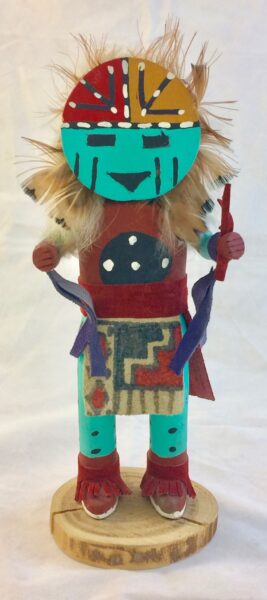
by E. A. L.
Navajo/Diné culture
Late 20th-early 21st century
Wood, pigment, leather, and feathers, L. 7 cm x W. 7 cm x H. 20 cm
BFPC collection #2012.43
The Sun Kachina, or Tawa, is among the most easily identifiable Kachina dancer figures, with his round, brightly colored face. Tawa was the first Kachina, and he created the four successive worlds with the help of Spider Woman and several other spirits. Strangely, while Tawa is a popular Kachina figure, he is only rarely impersonated by a dancer.
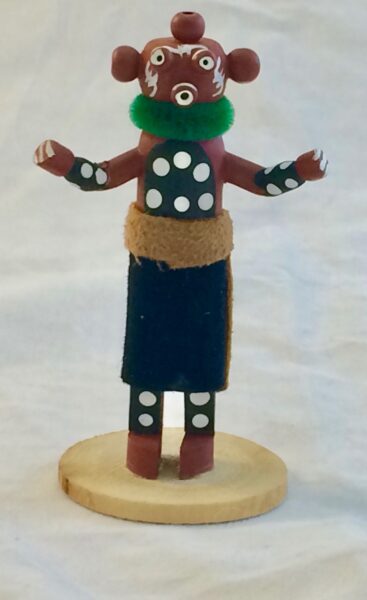
Navajo/Diné culture
Late 20th-early 21st century
Wood, pigment, felt, and pipe cleaner, L. 4 cm x W. 4 cm x H. 9 cm
BFPC collection #2003.19
The Mudhead is not actually a Kachina spirit, but a character who appears in most of the ceremonial dances, playing the role of a clown or a jokester. While the Mudheads are in charge of playing games and handing out awards and prizes to the winners of the games, they also interact with the spectators and often exhibit inappropriate behavior, which is intended to serve as a bad example that people should not follow. Like the Kokopelli Kachina Dancer and the Sun Kachina Dancer figures, this Mudhead figure wears felt or leather clothing and armbands rather than clothing that is carved into the wood; such features serve to identify these figures as being made by Navajo/Diné artisans.
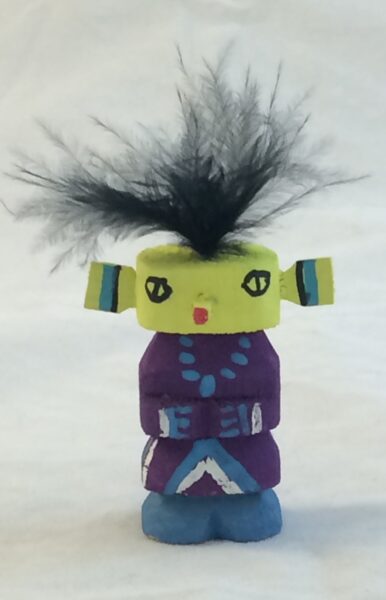
Navajo/Diné culture
Late 20th-early 21st century
Wood, pigment, and feathers,
L. 4 cm x W. 4 cm x H. 7 cm
BFPC collection #2012.16
This tiny Kachina figure appears to be modeled after the more Traditional Hopi Tihu figure, with simplified, geometric form, its arms held close to the body at the waist, and its legs held tightly together as a solid mass. The Yei Kachina, however, is a Navajo/Diné character, and this figure is tiny; therefore, this is most likely a Navajo-made figure that was carved in a simplified style. Such miniature figures, made in a variety of colors, are commonly found in the trade markets along Historic Route 66, which runs by the Navajo/Diné and Hopi Nations.
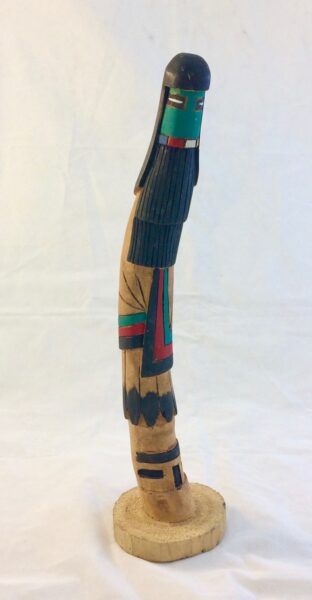
by JJ
Hopi culture
Late 20th-early 21st century
Wood and pigment, L. 7 cm x W. 7.5 cm x H. 29 cm
BFPC collection #2003.18
The Long Hair Kachina is a beloved and popular spirit among the Hopi, as this Kachina spirit sings beautiful songs and brings much-needed rain for the spring crops. Carved in one piece from a twisted branch, this spirit figure of the Long Hair Kachina also illustrates the typical Hopi techniques of carving the clothing and features directly into the wooden piece and embellishing the figure with painted details. All together, this is a classic example of a tall, willowy Hopi Kachina spirit figure.
For more information, you may contact the researcher(s) noted in the title of this exhibit entry, or Dr. Billie Follensbee, the professor of the course, at BillieFollensbee@MissouriState.edu