

As the homeland of the Fon culture, the Dahomey kingdom was located in the southern part of what is today the country of Benin. The Dahomey kingdom is well-known historically for the Agojie, the elite female “amazon” military unit that guarded the king, as well as for the participation of the Fon in the African slave trade. The Dahomey kingdom came to an end after they were … [Read more...] about The Dahomey Kings Quilt: Researched by Mckenna O’Connor
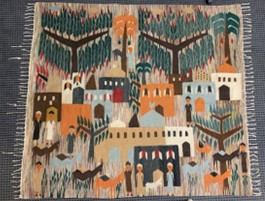
This tapestry textile was woven by one of the students of the Wissa Wassef school of Cairo and Harrania, Egypt. This school of handmade textiles was founded in the 1940s and 1950s by the architect Ramses Wissa Wassef, whose aim was to revive and revitalize traditional Egyptian crafts and handiwork by providing local, poor children with training in spinning sheep’s wool and … [Read more...] about Wissa Wassef School Textile with an Islamic Egyptian Village Scene: Researched and Conserved by Hanna Henroid
Contemporary Peruvian textile artists are predominantly of mixed Andean and Spanish ancestry, and they illustrate a mastery of their craft that draws strongly upon this Andean-Mestizo heritage. Fine textiles served as symbols of wealth and socioeconomic status among Pre-Columbian Andean cultures because of the fine fabrics, their elaborate weaving techniques, and their … [Read more...] about 20th-century Andean-Mestizo Textile with Chimú or Moche Motifs: Researched and Conserved by Alyssa Cartier
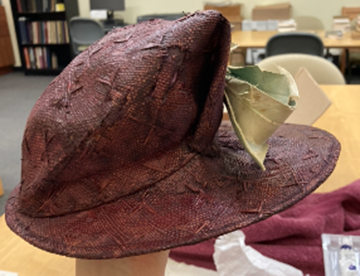
This basketry hat was made by Ina Caraway, a milliner who operated in Springfield, Missouri from 1939 through 1941. Caraway wove this hat from straw, dyed or painted the material purple, and then folded, sewed, and molded it into a bonnet-style hat; she then lined the hat with synthetic cloth and grosgrain ribbon. The finishing touches were a green paper bow covered with … [Read more...] about Women’s Basketry Hat: Researched and Conserved by Emily Hughes
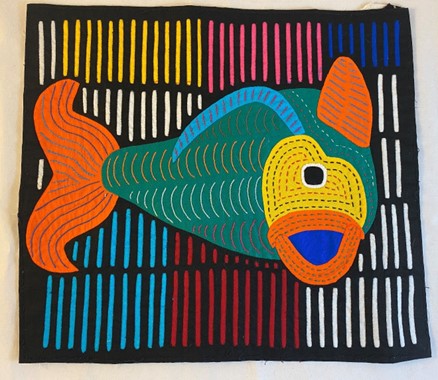
The colorful textiles featured in this exhibit are known as molas, which are artworks designed and produced by female artists of the Guna culture (also known as the Cuna or Kuna culture) of Panama. A mola is a rectangular panel of cloth that is decorated using a reverse appliqué technique: Two to six layers of different-colored fabric are stacked one on top of the … [Read more...] about 20th-century Guna Culture Molas from Panama by: Kylei Giles, Brianna Shatto, and Melissa Payte