
American culture
Late 19th to Mid-20th century
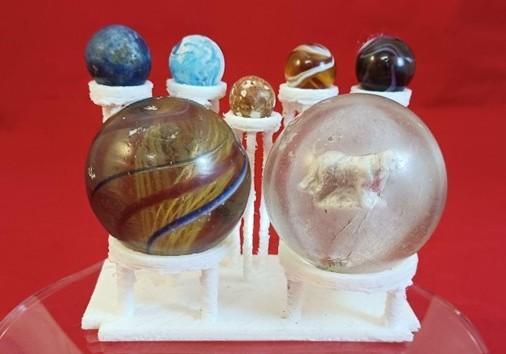
Clay and pigment marbles:
Blue Marble: Diameter 1.94 cm
Orange Marble: Diameter 1.4 cm
Glass and pigment marbles:
Marble with Dog Figure Inside: Diameter 5.1 cm
Marble with Swirl Design: Diameter 4.6 cm
Red Marble: Diameter 1.9 cm
Light Blue Marble: Diameter 1.75 cm
Amber Marble: Diameter 1.68 cm
Christian County Museum collection #NN8
Marbles are among the world’s oldest toys, with the earliest-known examples made of highly polished stone appearing in Mohenjo-Daro, Pakistan by 2,500 BCE. Marbles of fired and unfired clay also appear in ancient times, and throughout history, clay has been the most common material used to make marbles – earning clay marbles the enduring nickname of “commies.” The two clay marbles in this collection date to the early 20th century and may have been produced in America or in Germany’s highly productive clay marble factories.
While glass marbles also appear early, the mass manufacture of glass marbles was made possible by German glassmakers who developed specialized tools for their production in the 1840s. At that time, glass marbles were made to imitate the more-coveted marbles of polished, multicolored agate stone. The glass marbles in this collection illustrate a variety of decorative designs. The largest, known as a sulfide marble, has the tiny white figure of a dog encased in the center, while the ribbon swirl marble has an intricate design that involved the heating and twisting of multiple colored glass rods.
Today, marbles are predominantly collector’s items rather than toys. Marbles are still played by enthusiasts, however, with national-level games and a World Marbles Championship game that is held regularly. Researched and conserved by Zane Wigton
American culture
20th century
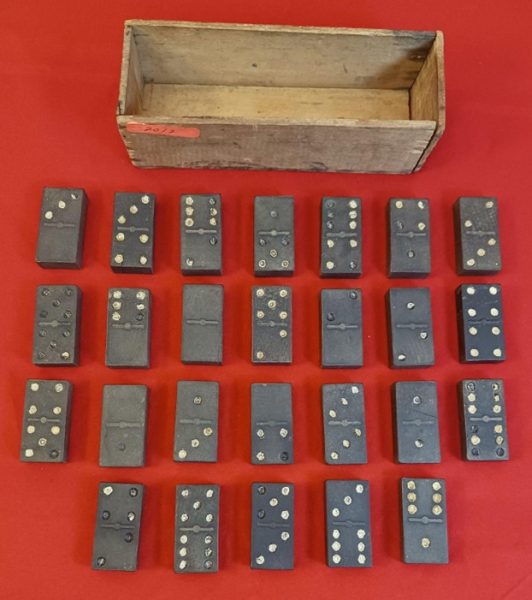
Wood and pigment, L. 5.8 cm x W. 17 cm x H. 5.2 cm
Christian County Museum collection #2012
While the use of dominoes can be traced back to 12th-century China, dominoes did not reach Europe and the Americas until the 18th century. Rather than serving as a game by themselves, dominoes instead most commonly serve as gaming pieces in a variety of games that use counting or the matching of pieces. Wooden dominoes started to be mass-produced in the 19th century, when they were carved from wood or they were formed by mixing wood dust with glues, which was then pressed into molds. These dominoes are each made of carved wood that has also been impressed with a lion motif on one side. Researched and conserved by Zane Wigton

American culture
Early 20th century
Pewter
9a Cup 1: L. 2.7 cm x W. 3.6 cm x H. 2.2 cm
9b Cup 2: L. 2.7 cm x W. 3.6 cm x H. 2.2 cm
9c Saucer: L. 5 cm x W. 5 cm x H.0.2 cm
9d Teapot: L. 5.8 cm x W. 9 cm x H. 6.2 cm
9e Lid: L. 2.4 cm x W. 2.4 cm x H. 3 cm
Christian County Museum collection #NN9a, 9b, 9c, 9d, and 9e
This miniature tea set is made of pewter, an alloy of tin, antimony, and bismuth, and it was likely cast in iron molds, which would have provided the fine details that are evident on these tiny objects. Pewter is a very soft metal that is easy to cast and that was inexpensive to produce in the early 20th century; however, it was also easy to dent, bend, and crack, which is why these pieces have sustained a great deal of damage while they were being used.
Miniature tea sets were popular toys for young girls up until the middle of the 20th century, and they reflect how tea parties had been important historically in Western culture as a way for women to socialize and to share knowledge without men being present. As with other toys, the tea sets served as educational, developmental tools, as they helped to instill current values and to enable girls to learn social skills and acceptable social roles within their communities. Researched and conserved by Zane Wigton
American culture
Early to Mid-20th century
Cardboard, wood, catalin plastic, glass, and felt
L. 12.5 cm x W. 16 cm x H. 4.1 cm
Christian County Museum collection
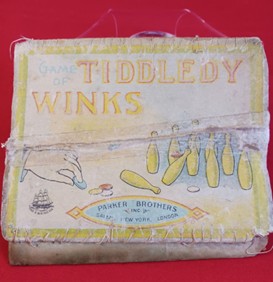
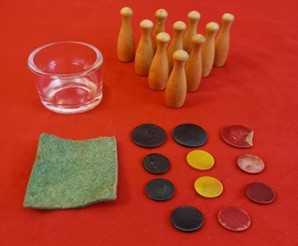
The game of Tiddledy Winks was first patented in 1888 as an adult parlor game, but the simplicity of the game made it popular with children by the early 20th century. The game consists of small disks (the tiddledy winks) that are placed upon the small square of felt (called the carpet), which are then pressed upon with a large disk (the squidger) to make the tiddledy winks fly into the small glass cup. Many different versions of the game later developed, including this set, which provides a set of bowling pins to knock down with the flying tiddledy winks. Researched and conserved by Zane Wigton
For more information, you may contact the researcher(s) noted in the title of this exhibit entry, or Dr. Billie Follensbee, the professor of the course, at BillieFollensbee@MissouriState.edu