
The stone artifacts in this exhibit date from the Paleo-American period (12,000 BCE or earlier–8000 BCE) to the Woodland period (1000 BCE-1000 CE), and they represent the development of these peoples from hunters, fishers, and gatherers into civilizations that were experimenting with agriculture, but who continued to fish and hunt in the lush valleys and forests of the Eastern Woodlands and border areas of the Ozarks.
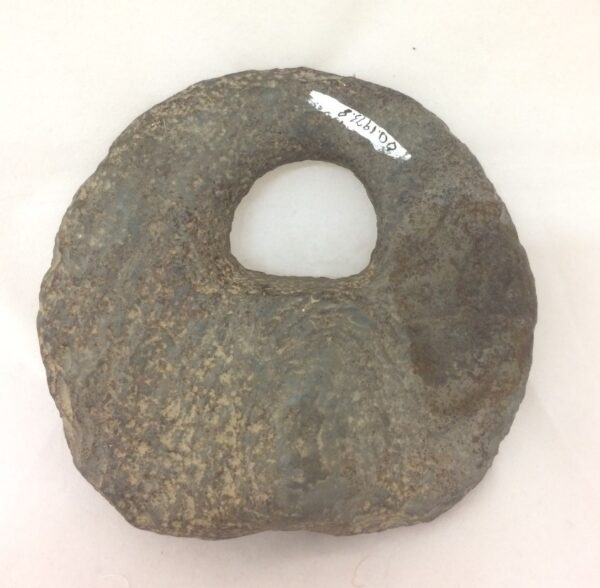
Paleo-American Ozarks cultures
12000-8000 BCE
Black stone, L. 13 cm x W. 3.5 cm x H. 10.5 cm
Ralph Foster Museum collection #00.1973.8
This stone anchor was painstakingly pecked and ground out of heavy stone to create a weight that would be secured to one end of a rope, while the other end would be tied to a wooden dugout canoe. While it is somewhat lopsided and not aesthetically sophisticated, it was nonetheless carefully planned and executed as a practical object, with a large hole and handle, flattened sides, a bulbous “belly,” and a flat bottom, which all together created an effective and relatively easy-to-use weight to keep the boat in place. Researched by Hannah Harmon
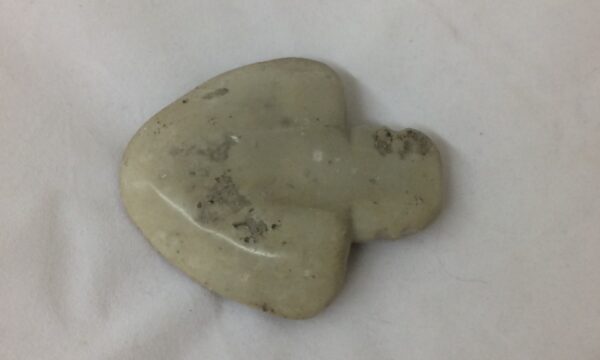
Eastern Woodlands cultures
1000 BCE-1000 CE
Chert, L. 6.75 cm x W. 1.75 cm x H. 7.5 cm
Ralph Foster Museum collection #00.1977.63
Spuds are the heads of ancient digging tools, and they generally have elongated handles and flat, smooth sides. This spud is unusual with its concave sides and the pronounced grooves on its short handle. It is possible that the longer handle on this spud had broken off, and that the spud was reworked with these features to facilitate the attachment of a wooden handle; a split wooden handle would have fit into the hollows on each side, and the leather or cord lashings to secure the handle would have fit into the grooves. Researched by Hannah Harmon
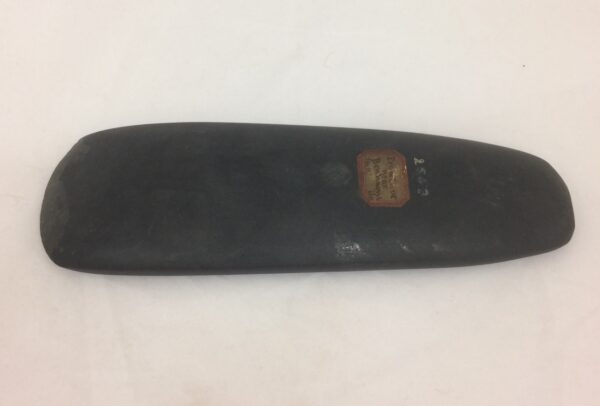
Paleo-American Ozarks cultures
12000-8000 BCE
Black stone, L. 22 cm x W. 2 cm x H. 6.5 cm
Ralph Foster Museum collection #00.1977.116
With its high polish and symmetrical shape, this stone celt is an example of fine workmanship that raises a simple stone tool from a utilitarian object to a beautiful artifact, or even to a work of art. Like an axe, celts were used to cut and shape wood, but unlike an axe, a celt has no groove; if it was used, the celt would have been secured onto the handle with extra cordage lashings. Many celts, however, were not utilitarian in nature, but used for ceremonial purposes—which would also explain the fine workmanship and the good condition of this ancient artifact. Researched by Hannah Harmon
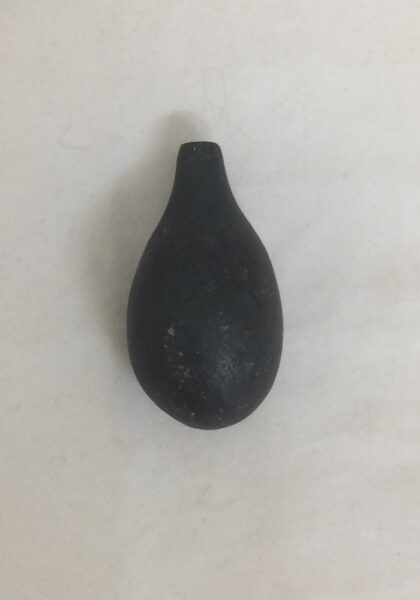
Eastern Woodlands cultures
1000 BCE-1000 CE
Iron ore, L. 2.5 cm x W. 3 cm x H. 5 cm
Ralph Foster Museum collection #00.1973.13
Ancient Native American “plummets” were named because of their similarity to an architect’s plummet, but they more likely functioned as weights for fishing nets. The top–apparently broken off–would originally have had a groove or a small hole where it was attached to the net. Like the Smooth Black Celt, this plummet was ground and polished into a beautiful, symmetrical shape that highlights its sparkling iron ore material, suggesting that this served as a luxury version of a utilitarian object. Researched by Hannah Harmon
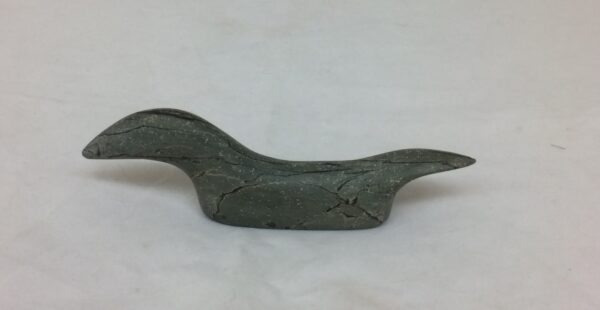
Eastern Woodlands cultures
1000 BCE-1000 CE
Slate, L. 12.5 cm x W. 1.5 cm x H. 4 cm
Ralph Foster Museum collection #00.1977.16
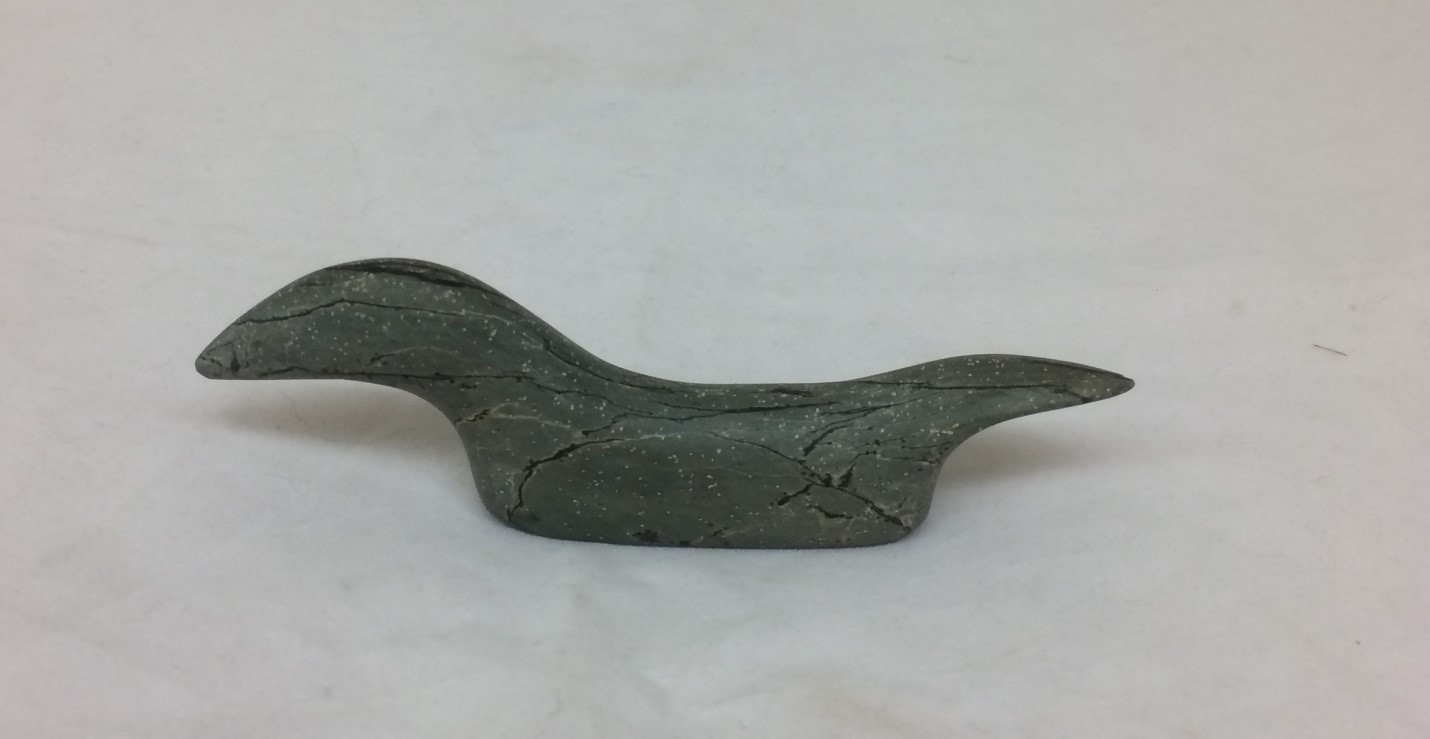
The ancient North American artifacts known as birdstones take a wide variety of different forms. This birdstone, made of polished green stone, takes a more common, sleek and simplified form, with a smoothly projecting head and tail. Scholars have proposed a number of different functions and meanings for birdstones, such as serving as a weight for an atlatl (a spear-throwing device), as a grip for an atlatl, as an ornamental attachment on a staff, or even as an ornament worn on one’s head. The consistent configuration of the holes that pierce through the bottom, front, and back of birdstones, however, does not support these hypotheses, and the actual purpose of these artistic forms remains unknown. Researched by Hannah Harmon
For more information, you may contact the researcher(s) noted in the title of this exhibit entry, or Dr. Billie Follensbee, the professor of the course, at BillieFollensbee@MissouriState.edu