

Haudenosaunee culture
Early 20th century
Velvet, silk, glass beads, glass buttons, and cardboard
L. 13.5 cm x W. 28 cm x H. 0.5 cm
Mincey collection #2023.1
“Whimsies” are small beaded items that were created by Native American artisans to sell to tourists. At the turn of the 20th century, the Niagara Falls region experienced a great boom in tourism, and visitors proved eager to buy handmade goods as souvenirs. Native cultures of this region were well-known for making skilled floral beadwork that appealed greatly to the aesthetics of the Victorian era; they quickly developed small beaded objects, such as picture frames and other household items, to sell to the Niagara Falls tourists.
This beaded black velvet wall pocket would have been a luxury version of the common wall pouch used to hold matches or to display items such as postcards. The looped beadwork, the intricate cupped and trefoil flowers, and the herringbone-design stems identify this piece as the skilled beadwork of a Haudenosaunee (also known as Iroquois) artisan. Researched and conserved by Cassidy Hale.
Lakota culture
Early 21st century
Leather, glass beads, and cotton thread
L. 7 cm x W. 16 cm x H. 0.5 cm
Grant Hodge collection #2018.1
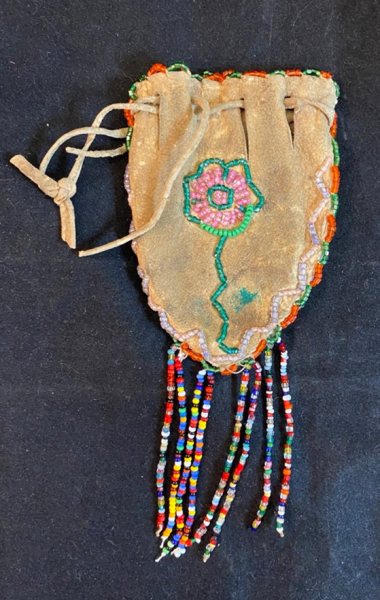
This small beaded leather bag is a contemporary example of a personal object that has been made for centuries by Native American cultures of the Great Plains. Traditionally called medicine bags, medicine pouches, or medicine bundles, the term “medicine” is used here to refer not to medicinal substances, but to objects that are powerful and personally significant to the owner and that have special properties such as strength, which are believed to transfer to the wearer of the bag. This medicine bag contains a small dreamcatcher and a projectile point.
Earlier medicine bags were typically made with animal organs such as buffalo bladders, but in recent times they are more commonly made with leather. Embellishments are often added to the exterior of the bags, including beaded motifs, beaded edging patterns, and tassels. The main motif on this bag was originally a pink flower, divided into four quadrants, with a green border and stem. Likewise, Great Plains beadwork is well-known for showcasing floral motifs, often for the purpose of preserving knowledge of medicinal plants. In addition, four-part motifs carry special significance, representing important elements in nature such as the four cardinal directions. Researched and conserved by Cassidy Hale.
For more information, you may contact the researcher(s) noted in the title of this exhibit entry, or Dr. Billie Follensbee, the professor of the course, at BillieFollensbee@MissouriState.edu