

The molo mask is a sacred performance mask made by the Bobo culture of Burkina Faso and Mali, in western Africa. With its long, rectangular face, helmet-shaped and crested top, tall horns, and chevron scarification patterns, this mask symbolizes but does not directly represent Dwo, the main son of Wuro, the creator god of the Bobo. The mask is also supplied with a rectangular knob at the base, which may be tied with raffia to form a sort of beard and serves as a handle to enable the dancer to execute the more acrobatic feats of his performance. Unusual features of this mask are the hornbill beak below the nose and the use of blue pigment, along with the more traditional black, red, and white pigments; these are likely the result of Bobo experimentation with symbolic elements and with new pigments as they have become available on the world market.
The molo mask is one of many masks that the Bobo use to help bring into equilibrium the opposing forces of the world, which the Bobo believe are only precariously balanced and can easily be thrown off. The molo mask is used primarily in educational masquerades during male initiation ceremonies, but it is also used in masquerades for annual harvest-time rites, for the funeral ceremonies of priests of Dwo, and for the funeral ceremonies of people whose deaths are attributed to Dwo.
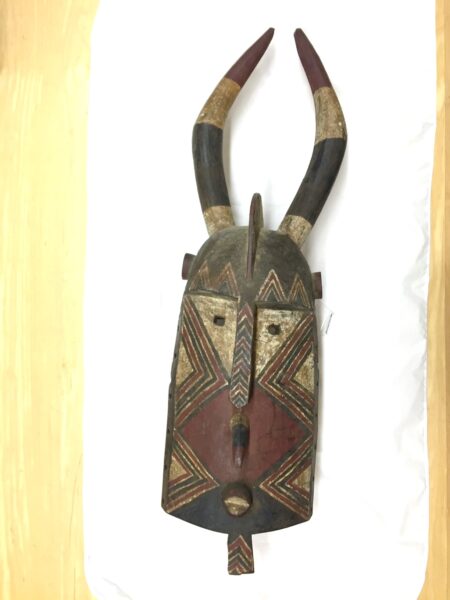
Molo Mask with Beak and Red, Blue, Black, and White Pigments
Bobo culture
20th century
Wood and pigment, L. 30 cm x W. 23 cm x H. 102 cm
Mace collection TA #036

Molo Mask with Beak and Red, Blue, Black, and White Pigments
Bobo culture
20th century
Wood and pigment, L. 30 cm x W. 23 cm x H. 102 cm
Mace collection TA #036
For more information, you may contact the researcher(s) noted in the title of this exhibit entry, or Dr. Billie Follensbee, the professor of the course, at BillieFollensbee@MissouriState.edu