
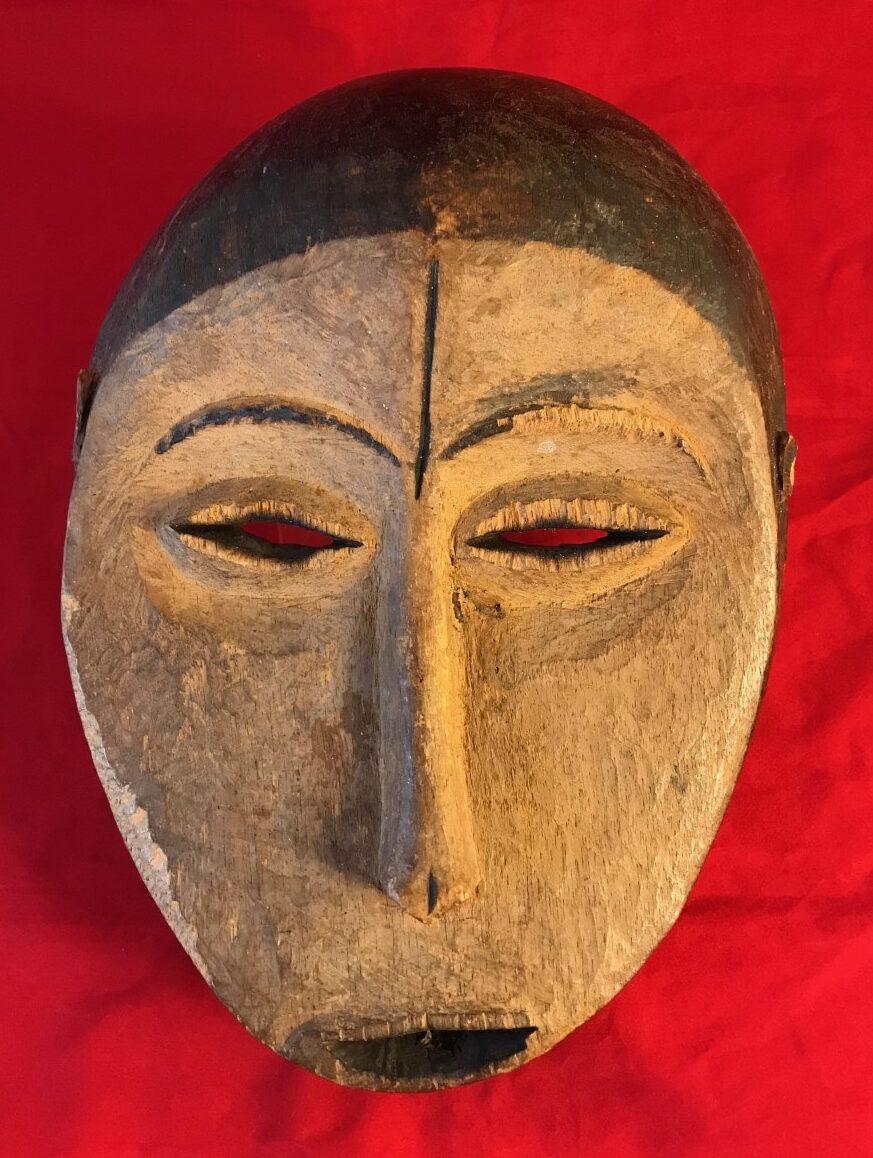
The three masks in this exhibit have the identifying features of both the lukwakongo masks and the idimu masks of the Lega culture Bwami society. The long, slender noses and the scarification are typical, as are the small mouths with protruding lips, which represent a dissatisfied teacher’s pursed lips. The incised vertical scarification lines in the lips are also typical, and said to signify the fleeting nature of youth. The holes along the sides and bottom of the face function as a means to attach beards made with bundles of long or short plant fibers. These holes also allow masqueraders to utilize the mask in a variety of ways, including wearing them over the face, attaching them to different parts of the body, dragging them on the ground, displaying them on fences, or displaying stacked in piles of masks.
The primary difference between these two masks is the ownership of the mask, as the idimu mask is owned collectively by the kindi, the highest ranking elders of the Bwami society, while the lukwakongo is owned by individual members of the society. Researched by Whitney Mosley.

Lega culture
20th century
Wood, L. 7.8 cm x W. 1.8 cm x H. 13.5 cm
MSU collection #2012.1.28
The Small Lukwakongo Mask is a smaller, simplified version of a full-size Lega lukwakongo mask. Carved from wood, this mask is a stylized portrayal of the ideal Lega man. Lukwkongo masks are passed down in lineages, and they are owned and used by initiates into the lower levels of the Bwami Society. These masks serve as one of the most important insignias of the Bwami, signifying their rank as Bwami members. The lukwakongo masks represent individual members of the society who are taught the higher levels of Bwami by the nenekisi, “master of the land,” represented by the idimu mask. When these members ascend the ranks of the society, they are given the lukungu mask, which is carved from ivory and used by initiated elders of kindi, the highest rank within the Bwami—and they pass on the lukwakongo mask to younger members of their lineage.
Small masks like this are not worn on the face, but may be attached to the temple, held in the hand, or placed in a display of masks. In a pala fence display, Bwami members display their individual lukwakongo masks alongside an idimu mask, which is a similar but large mask that is owned collectively by the kindi. Researched by Whitney Mosley

Lega culture
20th century
Wood and pigment, L. 20.5 cm x W. 7 cm x H. 28 cm
MSU collection #2012.1.21
The main features of the Lukwakongo/Idimu Mask with Scarification Line —the almond shape of the eyes, the curved slope of the nose, the crescent shape of the mouth, and the round, wide face—are relatively curvilinear in style, which illustrates how Lega artists have considerable latitude for creativity and variation within their culture’s art style. Researched by Whitney Mosley

Lega culture
20th century
Wood, clay and pigment, L. 21 cm x W. 8 cm x H. 38.1 cm
MSU collection #2012.1.1
Idimu masks are sometimes made of ivory, but often made of wood. Wooden masks are typically covered in white pigment, as is this mask, which was embellished with light-colored clay that has now mostly worn away. This mask features the traditional oblong face, but a less-typical rectangular mouth and eyes, as well as decorative details that show the artistic license exercised by the artist, including incised linear scarification marks around the face and down the nose, as well as protruding wooden bristles around the face and eyes. Researched by Whitney Mosley
For more information, you may contact the researcher(s) noted in the title of this exhibit entry, or Dr. Billie Follensbee, the professor of the course, at BillieFollensbee@MissouriState.edu