
Dolls in many different sizes and made of many different materials have been popular toys since ancient times, and they provide both entertainment and education for children to learn child care through play. “China dolls” are made of porcelain, a type of ceramic composed of fine clay along with ground quartz and feldspar. This formula was developed in China in 7th century, but it was long kept as a closely guarded secret. Knowledge of how to make porcelain eventually spread to Japan, and the formula became known to the rest of the world by the 19th century.
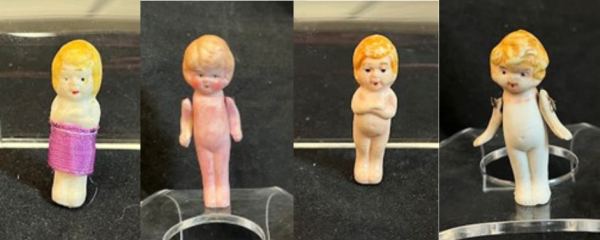
Japanese
Early 20th century
Bisque porcelain and pigment
L. 1.5-3.8 cm x W. 1.3-2.2 cm x H. 4.4-8.9 cm
Foster collection #2024.1a-h
These tiny dolls are made of bisque, which is unglazed porcelain. The dolls were mass-produced in Japan using molds, and their features were painted on with watercolor pigments, which made them inexpensive despite being made of fine materials. Although these dolls are fragile and their paint eventually wears off with use, such bisque porcelain dolls were popular with girls through the early 20th century because their faces and hands resemble real skin and hair better than wood, cloth, or shiny glazed ceramic. Researched and conserved by McKenna O’Connor

German
Late 19th- Early 20th century
Glazed porcelain, cotton, brass, and pigment
L. 25.4 cm x W. 7.5 cm x H. 47.3 cm
Christian County Museum collection #2122
When knowledge of how to make porcelain came to Europe in the 19th century, craftspersons in Germany and France designed glazed porcelain heads, forearms, and lower legs that could be attached to a stuffed cloth body. This process created a doll that had a beautiful ceramic head, hands, and feet like dolls that had been imported from China, but that also had a soft, cuddly body and was much less fragile.
This China doll is made of glazed white porcelain with hand-painted hair and facial features, and the style strongly suggests that this was made by Hertwig & Co., a German company that was one of the earliest manufacturers in Europe to mass-produce porcelain dolls. While at first these dolls were expensive and were purchased primarily by the wealthy, mass production eventually brought prices down so that people of more modest means could purchase these dolls for their children. Researched and conserved by McKenna O’Connor
For more information, you may contact the researcher(s) noted in the title of this exhibit entry, or Dr. Billie Follensbee, the professor of the course, at BillieFollensbee@MissouriState.edu