
The Union Campground Cemetery was established in 1840, and the graves in this integrated cemetery include people from all levels of wealth and status. Slaves and the poor marked their family graves here with rough fieldstones and sometimes with molded concrete grave markers, while people of more wealth erected monuments of local limestone and sandstone that were carved in creative shapes and incised with long epitaphs. Later freedmen of means and other wealthy individuals marked the graves of their loved ones with expensive, imported marble and granite markers; these were incised with extensive epitaphs and carved with ornate imagery.
As was the typical practice in the 19th century, children’s graves were unmarked or were marked simply, with footstones or other small monuments inscribed only with the child’s initials. Other children’s graves in the Union Campground Cemetery, however, illustrate both the financial means of their families and likely the profound grief of dealing with the death of a child, as a number of these graves are marked by large and elaborately shaped headstones with substantial epitaphs and carved imagery, as well as with inscribed footstones.
Ozark culture, American Midwest
19th century
Marble, L. 13.5 cm x W. 5 cm x H. 20.5 cm
Union Campground Cemetery #49

Ozark culture, American Midwest
19th century
Marble, L. 13.5 cm x W. 5 cm x H. 20.5 cm
Union Campground Cemetery #49

Ozark culture, American Midwest
19th century
Marble, L. 13.5 cm x W. 5 cm x H. 20.5 cm
Union Campground Cemetery #49
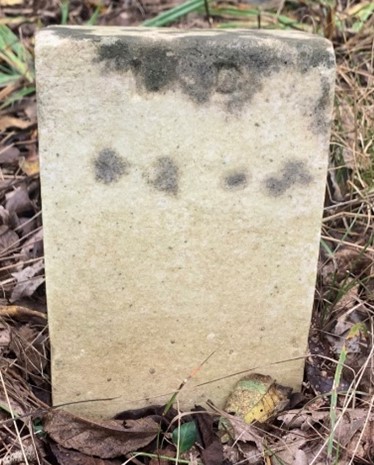
Conservation needed: This small gravestone of the Infant Doolen was leaning badly and needed to be cleaned, straightened, and supported with a natural rock so it will not fall over.
This small gravestone serves as the headstone of the Infant Doolen, the child of Eliza J. Doolen and J. W. Doolen, who died in 1882. The records of the burial state that the child was an infant, and the gravestone is marked with the letters “I. D.,” which together indicate that the baby had not yet been named when it died. Gravestones of this size and shape were originally made to serve as footstones, but in the 19th century footstones and other small gravestones were often used as the headstones for small children. Researched and conserved by Jordan Davis.

Ozarks culture, American Midwest
19th century
Limestone, L. 21.5 cm x W. 7.5 cm x H. 33.5cm
Union Campground Cemetery #18

Ozarks culture, American Midwest
19th century
Limestone, L. 21.5 cm x W. 7.5 cm x H. 33.5cm
Union Campground Cemetery #18

Ozarks culture, American Midwest
19th century
Limestone, L. 21.5 cm x W. 7.5 cm x H. 33.5cm
Union Campground Cemetery #18
Conservation needed: Josephine Deed’s footstone was broken and needed to be cleaned, reset in the ground, and supported with a natural rock so it will not fall over.
This headstone and footstone mark the grave of Josephine G. J. Deeds, the daughter of Margie Deeds, who died in 1844 before reaching her second birthday. These full-size gravestones were relatively large for a child’s grave, and they were hand-carved with a full epitaph and initials, indicating that Josephine’s family wanted their young child’s life to be remembered.
These two gravestones were found buried under multiple layers of dirt in the Union Campground Cemetery, and while her original gravesite could not be determined from historical records, her grave is early in the history of the cemetery (which was established in 1840) and was therefore likely in the oldest section of the cemetery. The headstone was reset in this area, but unfortunately it was set in front of a large tree, so her footstone could not be set behind her gravestone as is customary. Instead, the footstone was reset next to her gravestone. Researched and conserved by Jordan Davis.

Ozarks culture, American Midwest
19th century
Marble, L. 13.5 cm x W. 5 cm x H. 14 cm
Union Campground Cemetery #45

Ozarks culture, American Midwest
19th century
Marble, L. 13.5 cm x W. 5 cm x H. 14 cm
Union Campground Cemetery #45
Conservation needed: This small gravestone of the Hattie J. Doolen is too fragmentary to be reset into the ground; instead, a concrete base was made for it, and it was reset into the base with a soft mortar.
This small gravestone serves as the headstone of Hattie J. Doolen, the daughter of Eliza J. Doolen and J. W. Doolen. Hattie was born August 27, 1885 and died at less than two years old on June 12, 1887. This gravestone is marked simply with the letters “H. J. D.,” and it was a gravestone originally made to serve as a footstone; however, footstones and other small gravestones often were repurposed to serve as the headstones for small children in the 19th century. Researched and conserved by Jordan Davis.

Ozarks culture, American Midwest
19th century
Marble, L. 15.5 cm x W. 5 cm x H. 38.5 cm
Union Campground Cemetery #23

Ozarks culture, American Midwest
19th century
Marble, L. 15.5 cm x W. 5 cm x H. 38.5 cm
Union Campground Cemetery #23

Ozarks culture, American Midwest
19th century
Marble, L. 15.5 cm x W. 5 cm x H. 38.5 cm
Union Campground Cemetery #23
Conservation needed: This footstone needed to be cleaned and then reset into the ground, in alignment with the headstone of Robert L. Piper.
Robert L. Piper was a child of Elizabeth Ellison and Theophilus Piper, pioneer families who settled in Greene County, MO. His headstone illustrates a lamb, which represents Jesus Christ and was a motif often used on the gravestones of children. Robert was not yet six years old when he died in 1863, and the full-size marble gravestone and footstone placed on his grave suggest that the family was relatively wealthy, religious, and wanted their young child’s life to be remembered. Researched and conserved by Jordan Davis.

Ozarks culture, American Midwest
19th century
Marble, L. 24.5 cm x W. 5 cm x H. 58 cm
Union Campground Cemetery #30

Ozarks culture, American Midwest
19th century
Marble, L. 24.5 cm x W. 5 cm x H. 58 cm
Union Campground Cemetery #30

Ozarks culture, American Midwest
19th century
Marble, L. 24.5 cm x W. 5 cm x H. 58 cm
Union Campground Cemetery #30
Conservation needed: This footstone needed to be cleaned and then reset into the ground, in alignment with the headstone of Mary E. Sage.
The headstone and footstone of Mary E. Sage mark the grave of a three-year old child who died from typhoid, a highly infectious and deadly disease, in 1884. The bottom of the headstone epitaph reads, “Suffer Little Children Come Unto Me.” This relatively large, marble gravestone and the marble footstone suggest that this family had financial means and that they were grieving and desired reassurance that this treasured child would be remembered. Researched and conserved by Jordan Davis.

Ozarks culture, American Midwest
19th century
Marble, Exposed portion: L. 15.5cm x W. 4.5 cm x H. 6.5 cm
Union Campground Cemetery #42

Ozarks culture, American Midwest
19th century
Marble, Exposed portion: L. 15.5cm x W. 4.5 cm x H. 6.5 cm
Union Campground Cemetery #42

Ozarks culture, American Midwest
19th century
Marble, Exposed portion: L. 15.5cm x W. 4.5 cm x H. 6.5 cm
Union Campground Cemetery #42

Ozarks culture, American Midwest
19th century
Marble, Exposed portion: L. 15.5cm x W. 4.5 cm x H. 6.5 cm
Union Campground Cemetery #42
Conservation needed: Because this gravestone could not be removed from the tree that grew around it, the stone was partially excavated and cleaned so that the letters “J. W.” (on the other side) are visible. Natural rocks were then piled around the tree to mark this as a gravesite.
This small gravestone is likely the headstone of Jim Wresche, the child of W. G. Wresche and Minnie Painter, who died in 1915 at less than four months of age. This gravestone is marked simply with the letters “J. W.,” and it was a gravestone originally made to serve as a footstone; however, in the 19th century footstones and other small gravestones often were repurposed to serve as the headstones for small children. Over time this gravestone was partially enveloped by a tree that grew in front of it. Researched and conserved by Jordan Davis.

Ozarks culture, American Midwest
19th century
Marble, L. 32.5 cm x W. 5 cm x H. 60 cm
Union Campground Cemetery #39

Ozarks culture, American Midwest
19th century
Marble, L. 32.5 cm x W. 5 cm x H. 60 cm
Union Campground Cemetery #39
Conservation needed: This headstone needed to be excavated, cleaned, reconstructed, and reset into the ground.
This fragmentary headstone is the gravestone of Eliza Thomas, the wife of Woodson A. Thomas, who died at the age of 29 in 1849. The top of the gravestone is missing, but an indented area suggests that a relief sculpture adorned the top. The gravestone is made of imported marble, and the bottom of the gravestone includes an elaborate inscription in italic writing that is difficult to read, but appears to be a religious passage. Researched, conserved, and reconstructed by Sharlee Gunther.

Ozarks culture, American Midwest
19th century
Marble, L. 33 cm x W. 4.5 cm x H. 52 cm
Union Campground Cemetery #21

Ozarks culture, American Midwest
19th century
Marble, L. 33 cm x W. 4.5 cm x H. 52 cm
Union Campground Cemetery #21
Conservation needed: This headstone needed to be excavated and cleaned. Because it was broken off near the epitaph on the bottom, it could not be reset into the ground; instead, a concrete base was made for it, and it was reset into the base with a soft mortar.
This is the grave of Thomas Ellison, who is listed in the epitaph as having died in 1858 at the age of 63 years. According to the 1850 census, Thomas was married to Nancy Ellison, and they had seven children. Researched and conserved by Sharlee Gunther.

Ozarks culture, American Midwest
19th century
Limestone L. 22 cm x W. 5.5 cm x H. 28 cm
Union Campground Cemetery #47

Ozarks culture, American Midwest
19th century
Limestone L. 22 cm x W. 5.5 cm x H. 28 cm
Union Campground Cemetery #47
Conservation needed: This footstone needed to be cleaned and then reset into the ground.
This is the footstone for the grave of William B. Freeman, who died at the age of 37 in 1862. William was married to Eliza E. Snow, and they had a daughter, Ona A. Freeman, who died soon after she turned one year old. William’s burial at the Union Campground cemetery was recorded, and his footstone is identifiable because of the initials “W. B. F.” inscribed near the top; William’s headstone, however, has not been found. The footstone was reset in the cemetery next to the other Freeman family burials. Researched and conserved by Sharlee Gunther.
For more information, you may contact the researcher(s) noted in the title of this exhibit entry, or Dr. Billie Follensbee, the professor of the course, at BillieFollensbee@MissouriState.edu