
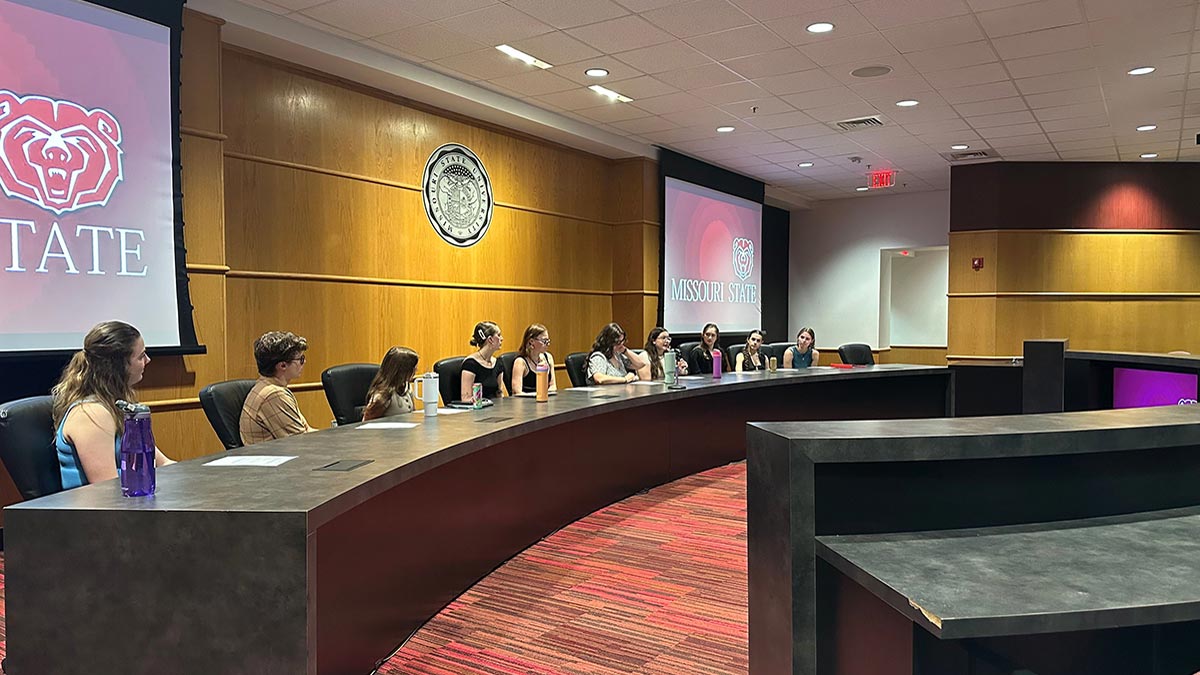
Missouri State University’s dance program, part of the Department of Theatre and Dance, held its first ever research symposium on the Springfield campus April 27-May 1.
Conceptualized and spearheaded by dance instructor Brittney Banaei, the event was developed to immerse dance students into a scholarly environment that reflects the professional dance world.
“Although dance is most often associated with performance, and our students are certainly excellent performers, there are a multitude of ways to engage with dance which are applicable in the ‘real world,’” Banaei explained.
For the symposium, Banaei said its organizers included “creative research, performance as research, embodied knowledge and inter/cross disciplinary research” in addition to traditional scholarly applications.
“Having the space to present cutting edge, research-integrated work is crucial for a dance program to stay responsive, relevant and connected to a rapidly evolving professional field,” Banaei said.
Several dance faculty and students participated in the event, which included presentations, roundtable discussions, creative and scholarly research projects and performances incorporating what students had learned. Several graduating BFA and BS in dance majors were featured as keynote speakers.
Approximately 30 students participated in the symposium, according to Banaei. Participation for the first symposium was limited to students enrolled in Dance Research Methods, Dance Composition II, Dance Fundamentals and West African Dance. In the future, however, Banaei hopes the conference can implement an open submission/application process.

Immersive scholarly experience
According to Banaei, the symposium gives Missouri State’s dance students hands-on experience in scholarly research by immersing them in a conference-like setting. This is essential to give students an advantage as they begin their careers, she noted.
The symposium mirrored several aspects of a typical scholarly conference. Students in the Dance Research Methods course submitted their final papers for review and acceptance to the conference. This process mimicked those of any conference or journal. These same students were also asked to create poster presentations of their work as well as a research statement, which they used to introduce themselves during the roundtable discussion.
“The entire process had the pedagogical goal of taking students through the lifecycle of a research project and developing the skills to submit to and present at conferences,” Banaei said.
Similarly, Dance Composition II students needed to think about their work as research, she added. They approached their choreography and performances by exploring a number of different methodologies.
“Research-integrated approaches to creative work are now standard and expected in a typical dance MFA program and a large portion of the dance performance landscape,” Banaei said. Learning this approach is essential to dance students who plan to pursue a graduate degree or a performance career outside of commercial dance, she explained.
Career prospects enhanced by dance studies
Jaden Brown, a senior BFA dance major, grew up dancing and taught at dance studios throughout high school and college. After graduation, she will start working for “Vitality in Motion,” an organization that brings dance to elderly care facilities.
“I’m very fortunate that my work throughout college and within college set me up for such a successful career path,” she said.
Ryan Sohrab, a junior musical theatre major, also sees his dance studies as essential to his career prospects.
“We’re in a generation of performance work that rides hand in hand with spectacle, especially performer spectacle,” he explained. “Having heightened dance capabilities will no doubt allow me to propel my career towards heights I doubt would be in reach if I had treated it as secondary to acting and singing.”
Freshman Abbey Racer, a BFA dance major, plans to be a professional choreographer. She also said her studies are vital to meeting that goal.
“Learning as much as possible in as many styles as possible is super important,” she said. “It will help me be the best and most informed choreographer I can be.”
“My experience in the MSU dance program has been one I wouldn’t trade for the world,” Brown added. “I have been given so many tools and guidance that have allowed me to feel comfortable going into the working field.”
Symposium helps dancers feel seen and heard
Several students involved in the symposium said they appreciated how the conference presented opportunities to share and discuss their work with others.
“We have been showing work with each other in our class all semester, but the symposium gave us a chance to share that work with the world,” Racer noted. “Dance research is just as important as any other research happening on the campus, so it’s important that [it] gets showcased.”
“Having a dance research symposium is so important because it offers a way for artists to share their research and creativity that they have been working on for a long time,” said Hannah Christian, a freshman marketing and dance double major. “Dancers have great ideas and goals that need to be shared.”
Brown enjoyed seeing people outside the dance department express interest in their work. “It made me feel really proud of the department I was in and it [made] a lot of us feel seen.”

Dance research encourages all research
Sophomore Jacob Nalley, a dance and theatre double major, described research efforts as often overlooked or devalued, especially in dance. The research symposium, he believes, helps to correct that attitude.
“Having the space and time to highlight and celebrate the many types and topics of research done by our students is integral to ensuring the livelihood of research everywhere,” he said.
Brown held a similar perspective.
“Dance is a dying language, and so many people don’t even know the importance of it,” she said. “A lot of people don’t necessarily understand what all it takes to get a dance degree. They honestly just think we dance around all day and that’s it.”
That’s why, for Brown, the symposium was so meaningful. “It shows that while we do dance, we also do a lot of research into how dance is possible and why it is important.”
The symposium represents “a significant aspect of the art,” added Sohrab. “[It] fulfills a very important duty within our department we don’t really see elsewhere.” In his view, the symposium highlights student talent and “keeps the passion for dance fiery.”
Research profiles: Dance Composition II
For their Spring 2025 Dance Composition II final, students needed to incorporate what they had learned into their performances. Racer, Christian, Nalley and Sohrab found research was critical to meet these instructions successfully.
Jacob Nalley: “Little Release”
Nalley’s final for Dance Composition II was an improvisational duet titled “Little Release.” He performed the piece with junior BFA Dance major Noah Johnson.
“The piece explored themes of connection through various ways and how energy and dynamics can change through movement between two people,” he said.
For his research, Nalley used a practice-as-research (PAR) method. He created and choreographed different pieces throughout the semester, then performed them for others to analyze and record audience responses. He found the feedback invaluable, as it helped him determine which elements of the performance were effective.
Abbey Racer: “Pedastal”
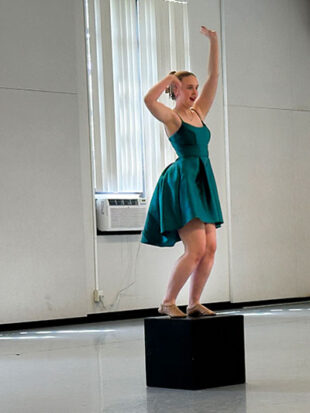
Racer performed a piece titled “Pedestal.”
“My piece is about how often times women will work hard and build something for themselves just to be torn down by critics around them,” she explained. “Sometimes it doesn’t matter how good you get, someone will have their own derogatory opinion of you or your work. That can really get to a person, and sometimes that critic can even be yourself.”
A large part of her research for the piece was to reflect on herself.
“I am still finding my style and how I fit into the dance space, she explained. “This was an exploration of things I hadn’t tried before.”
Racer said it was a “fulfilling process” to identify her body’s limits and connect that with the creative side of her brain.
Hannah Christian: “Here We Go Again”
Christian performed a piece titled “Here We Go Again.”
“This piece spoke to how I was feeling throughout my first year of college,” she explained. “I felt thrilled, excited, sad, distressed, confused, reckless and more.”
Her performance reflected the “rollercoaster of emotions and feelings” a person can feel in a given moment, she said. “I took what I was experiencing as a freshman in college and ran with it.”
Christian’s research method involved asking fellow freshmen about their first year of college. “I asked them to tell me what their freshman year has been like and how they have felt throughout this year,” she said.
The responses, which reflected a “wide range of emotions,” did not surprise her, she noted. They also convinced her that her performance was authentic.
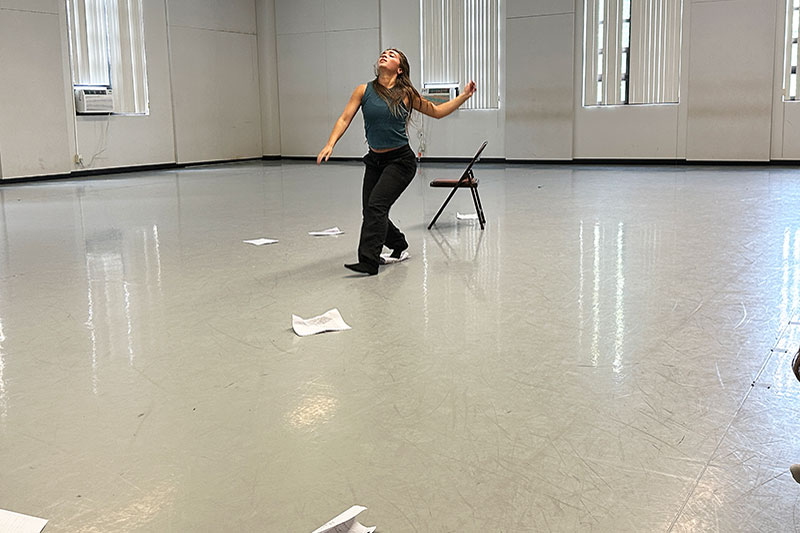
Ryan Sohrab: “Scratching Frequently”
Sohrab’s piece explored themes of entrapment and “the process of going against routine.” His performance used movement motifs to play on heightened gravity and individual encroachment, set to an “eerie” background of mixed music.
“I focused my research on conditions such as Stockholm syndrome and OCD, specifically, the effect they have on mental stability and what these individuals feel like on a usual basis,” he said. “I then tried to apply the normal psychological state they were in as a consistent choreographic principle.”

Students have high praise for instructors
Racer credited Banaei with expanding her understanding of dance while creating a safe space in which to experiment. “She has pushed me to create and try things I never would have,” Racer said.
Christian also credited Banaei with helping her to “think creatively and step outside of my box. I thank her so much for that.”
Meanwhile, Nalley described Banaei as patient, supportive and a valuable source of information. “Under her tutelage, I was able to start to grasp what dance ‘is’ and can be,” he said. Sohrab agreed, saying that Banaei had “transformed” his entire approach to dance.
Banaei was not the only professor Nalley studied with this semester. As a member of Associate Professor Azaria Hogans‘ West African Dance course, he had high praise for her as well.
“Azaria has been instrumental in my journey of understanding dance as an art form, understanding what dance is and where dance has been, as well as helping me to better understand the rich roots of dance,” Nalley said.
Throughout her time at Missouri State, Brown also worked with both Banaei and Hogans. She said both instructors pushed her to be “the best version” of herself. “I would not be the person I am today if it weren’t for those two.”
A “full-circle” moment
For Banaei, the most rewarding aspect of the symposium was to watch students present their research with confidence and poise.
“The dance program prides itself on a culture which emphasizes not just excellence in performance,” she said. The program places an “equal emphasis on personal agency, critical thinking, pedagogy, dance making and scholarship.”
Banaei said it was an “indescribable feeling” to watch students “use their own voices to articulate fully-formed ideas.”
“It was truly a full-circle moment which we are very proud of.”
Explore degree options in dance
Additional photo credits: Lynn Lansdown.
Discover more from Reynolds College Blog
Subscribe to get the latest posts sent to your email.