

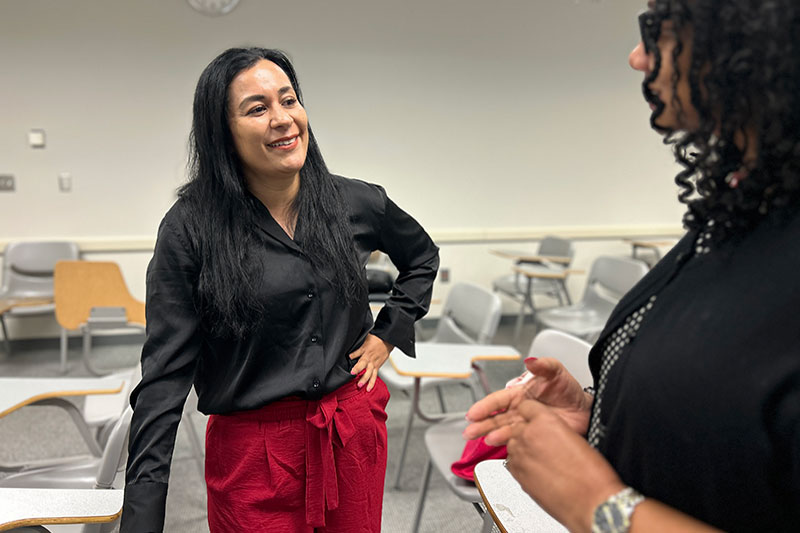
Four Missouri State University faculty members presented a research panel on Route 66 and its history April 22, 2026, in Strong Hall on the Springfield campus.
The panel event coincided with the roadway’s 100th anniversary.
“African American Lived Experiences: Unheard Stories of Route 66,” was a collaborative effort by the panelists to highlight how African American travelers experienced the famed scenic route.
Associate Professor Lyle Q. Foster of the Department of Sociology, Anthropology and Gerontology organized the event. Joining him were Assistant Professor Leonard Horton III of the Department of Communication, Media, Journalism and Film; Associate Professor Judith Martinez of the Department of Languages, Cultures and Religions; and Associate Professor Ximena Uribe-Zarain of the School of Special Education, Leadership and Professional Studies.
The researchers have been working on the project since September 2025.
Interdisciplinary approach highlights multiple views
As an interdisciplinary group, the panelists found that their varied academic backgrounds blended nicely, Foster noted. “Since the team brings together perspectives from sociology, communication, languages and cultures, and education, that mix of viewpoints really shaped how we interpreted what we found,” he said.
Each panelist drew heavily from oral history interviews conducted in 2014 and 2015 as part of the Greater Springfield Route 66 Oral History Project at Missouri State.
“These interviews are publicly available through the Missouri State University Libraries YouTube channel,” Foster said. “Anyone can go listen to them.”
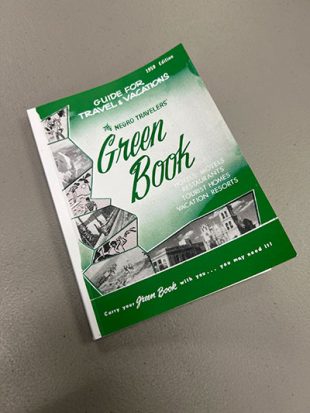
Other resource material included the Negro Motorist Green Book, historical records and existing scholarship on race and mobility in America. During the session, the panelists also premiered a mini documentary, “Reflections on the Route.”
“The film highlights the stories of local Springfieldians who traveled Route 66 during the Jim Crow era and used the Green Book directory as a guide to find safe places to eat and spend the night,” Foster explained.
“Sundown towns” part of Route 66 history
The Green Book was an important resource for Black travelers, Foster noted. They used it to identify hotels, restaurants and gas stations in communities along Route 66 known as “sundown towns.” Not only did the book identify safe places, it also gave practical advice or warnings about these sundown towns, he said.
Foster explained that from the 1890s up to 1968, sundown towns kept non-whites from living in them and were thus “all-white” on purpose. Typically, sundown towns passed laws barring African Americans after dark or prohibiting them from owning or renting property.
“Some sundown towns also kept out Jews, Chinese, Mexicans, Native Americans or other groups,” Foster added. “Part of the irony is in most cases you could work or shop in these downs by day. But you must be done by evening.”
Research reveals “wonderful” surprises
Route 66’s history and image presented the researchers with several questions, according to Foster.
“Route 66 is turning 100 years old, and the centennial celebrations are in full swing,” he said. “But when you look at how the highway gets celebrated—the museums, the tourism campaigns, the heritage events—the story being told is almost entirely about white, middle-class Americans hitting the open road. We wanted to ask: what did Route 66 mean for Black communities? Specifically, what did it mean for Black residents of Springfield, Missouri, the city where Route 66 was officially born in 1926?”
What they found was a history of strategy and aspiration. For Black Americans, Foster said, Route 66 was not a road of leisure and freedom. Still, their ability to travel its scenic vistas amazed the panelists.
“People worked along it, navigated its racial landscape with extraordinary skill and discipline,” Foster said. “[They] built a remarkable parallel infrastructure of safety and community. Places like Alberta’s Hotel, Graham’s Tourist Court and the North Side as a collectively known geography of relative safety made life not just survivable but rich and meaningful.”
Springfield hospitality hosts musical giants
Even more “wonderful” surprises lay in store for the researchers,” Foster recalled.
“The one that stopped us in our tracks was the music connection,” he continued. “We knew Alberta’s Hotel was significant. What we did not fully appreciate until we dug in was the degree to which Springfield’s Black hospitality network was serving national performers.”
Among those musical giants stopping at Alberta’s were Ella Fitzgerald, Nat King Cole, Mahalia Jackson and Little Richard.
“These artists were performing at the Shrine Mosque on Route 66, which was once the largest auditorium west of the Mississippi,” Foster noted. “Then [they were] going to Alberta’s Hotel and Graham’s Tourist Court because downtown hotels would not accept them. The same artists who were filling that stage for thousands of people could not get a room in the hotels their white counterparts used.”
The contrast is notable, Foster added. “It tells you everything about how Route 66’s promise of freedom operated in practice.”
Springfield an important place of safety
The researchers encountered another surprise about Springfield’s historical significance. As they dug deeper, they discovered that Springfield appeared across multiple Black travel guides, not just the Green Book.
These other publications included the Hackley and Harrison guide and Grayson’s. In all, twelve Springfield businesses appeared in these publications from the 1930s to the 1960s.
“That sustained presence across three decades tells you that Black Springfield had built a hospitality infrastructure that the broader Black travel community knew about and trusted,” Foster said.
Resilience a key part of history
From archives to oral histories to extant buildings, Foster said another great surprise was just how much of this history remains.
“One cabin from Graham’s Tourist Court still exists,” Foster said. “The Shrine Mosque is still on Route 66. The history did not disappear. It was just waiting for people in Springfield to talk about it more widely. We are trying to spread the word.”
The resilience of Black Americans represents another key part of that story. Despite the challenges, they discovered a new type of freedom, Foster said. They could explore the open road, visit relatives and see new places.
“That is why we are doing this work and why the centennial feels like exactly the right moment to bring it forward,” Foster said.
Photo credits: Leonard Horton III.
Reynolds College blog posts are human researched, written and reviewed unless otherwise indicated.
Discover more from Reynolds College Blog
Subscribe to get the latest posts sent to your email.